

284
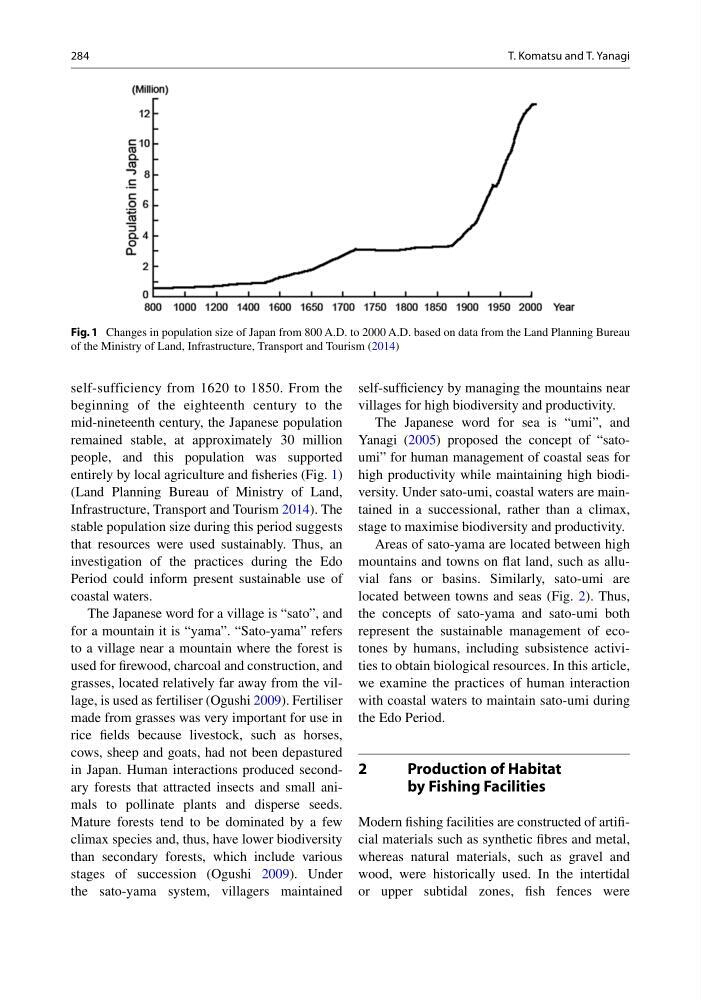
self- sufficiency from 1620 to 1850. From the
beginning of the eighteenth century to the
mid-nineteenth century, the Japanese population
remained stable, at approximately 30 million
people, and this population was supported
entirely by local agriculture and fi sheries (Fig. 1 )
(Land Planning Bureau of Ministry of Land,
Infrastructure, Transport and Tourism 2014 ). The
stable population size during this period suggests
that resources were used sustainably. Thus, an
investigation of the practices during the Edo
Period could inform present sustainable use of
coastal waters.
The Japanese word for a village is “sato”, and
for a mountain it is “yama”. “Sato-yama” refers
to a village near a mountain where the forest is
used for fi rewood, charcoal and construction, and
grasses, located relatively far away from the village, is used as fertiliser (Ogushi 2009 ). Fertiliser
made from grasses was very important for use in
rice fi elds because livestock, such as horses,
cows, sheep and goats, had not been depastured
in Japan. Human interactions produced secondary forests that attracted insects and small animals to pollinate plants and disperse seeds.
Mature forests tend to be dominated by a few
climax species and, thus, have lower biodiversity
than secondary forests, which include various
stages of succession (Ogushi 2009 ). Under
the sato-yama system, villagers maintained
self- suffi ciency by managing the mountains near
villages for high biodiversity and productivity.
The Japanese word for sea is “umi”, and
Yanagi ( 2005 ) proposed the concept of “satoumi” for human management of coastal seas for
high productivity while maintaining high biodiversity. Under sato-umi, coastal waters are maintained in a successional, rather than a climax,
stage to maximise biodiversity and productivity.
Areas of sato-yama are located between high
mountains and towns on fl at land, such as alluvial fans or basins. Similarly, sato-umi are
located between towns and seas (Fig. 2 ). Thus,
the concepts of sato-yama and sato-umi both
represent the sustainable management of ecotones by humans, including subsistence activities to obtain biological resources. In this article,
we examine the practices of human interaction
with coastal waters to maintain sato-umi during
the Edo Period.
2
Production of Habitat
by Fishing Facilities
Modern fi shing facilities are constructed of artifi -
cial materials such as synthetic fi bres and metal,
whereas natural materials, such as gravel and
wood, were historically used. In the intertidal
or upper subtidal zones, fi sh fences were
Fig. 1 Changes in population size of Japan from 800 A.D. to 2000 A.D. based on data from the Land Planning Bureau
of the Ministry of Land, Infrastructure, Transport and Tourism ( 2014 )
T. Komatsu and T. Yanagi
self- sufficiency from 1620 to 1850. From the
beginning of the eighteenth century to the
mid-nineteenth century, the Japanese population
remained stable, at approximately 30 million
people, and this population was supported
entirely by local agriculture and fi sheries (Fig. 1 )
(Land Planning Bureau of Ministry of Land,
Infrastructure, Transport and Tourism 2014 ). The
stable population size during this period suggests
that resources were used sustainably. Thus, an
investigation of the practices during the Edo
Period could inform present sustainable use of
coastal waters.
The Japanese word for a village is “sato”, and
for a mountain it is “yama”. “Sato-yama” refers
to a village near a mountain where the forest is
used for fi rewood, charcoal and construction, and
grasses, located relatively far away from the village, is used as fertiliser (Ogushi 2009 ). Fertiliser
made from grasses was very important for use in
rice fi elds because livestock, such as horses,
cows, sheep and goats, had not been depastured
in Japan. Human interactions produced secondary forests that attracted insects and small animals to pollinate plants and disperse seeds.
Mature forests tend to be dominated by a few
climax species and, thus, have lower biodiversity
than secondary forests, which include various
stages of succession (Ogushi 2009 ). Under
the sato-yama system, villagers maintained
self- suffi ciency by managing the mountains near
villages for high biodiversity and productivity.
The Japanese word for sea is “umi”, and
Yanagi ( 2005 ) proposed the concept of “satoumi” for human management of coastal seas for
high productivity while maintaining high biodiversity. Under sato-umi, coastal waters are maintained in a successional, rather than a climax,
stage to maximise biodiversity and productivity.
Areas of sato-yama are located between high
mountains and towns on fl at land, such as alluvial fans or basins. Similarly, sato-umi are
located between towns and seas (Fig. 2 ). Thus,
the concepts of sato-yama and sato-umi both
represent the sustainable management of ecotones by humans, including subsistence activities to obtain biological resources. In this article,
we examine the practices of human interaction
with coastal waters to maintain sato-umi during
the Edo Period.
2
Production of Habitat
by Fishing Facilities
Modern fi shing facilities are constructed of artifi -
cial materials such as synthetic fi bres and metal,
whereas natural materials, such as gravel and
wood, were historically used. In the intertidal
or upper subtidal zones, fi sh fences were
Fig. 1 Changes in population size of Japan from 800 A.D. to 2000 A.D. based on data from the Land Planning Bureau
of the Ministry of Land, Infrastructure, Transport and Tourism ( 2014 )
T. Komatsu and T. Yanagi