

229
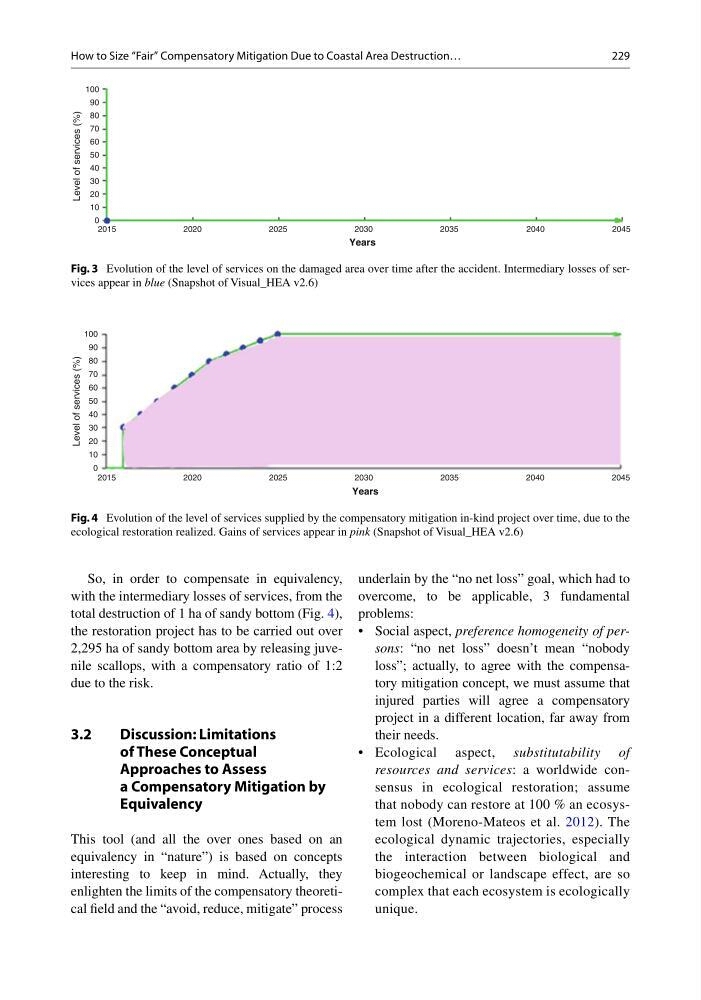
So, in order to compensate in equivalency,
with the intermediary losses of services, from the
total destruction of 1 ha of sandy bottom (Fig. 4 ),
the restoration project has to be carried out over
2,295 ha of sandy bottom area by releasing juvenile scallops, with a compensatory ratio of 1:2
due to the risk.
3.2
Discussion: Limitations
of These Conceptual
Approaches to Assess
a Compensatory Mitigation by
Equivalency
This tool (and all the over ones based on an
equivalency in “nature”) is based on concepts
interesting to keep in mind. Actually, they
enlighten the limits of the compensatory theoretical fi eld and the “avoid, reduce, mitigate” process
underlain by the “no net loss” goal, which had to
overcome, to be applicable, 3 fundamental
problems:
• Social aspect, preference homogeneity of persons : “no net loss” doesn’t mean “nobody
loss”; actually, to agree with the compensatory mitigation concept, we must assume that
injured parties will agree a compensatory
project in a different location, far away from
their needs.
• Ecological aspect, substitutability of
resources and services : a worldwide consensus in ecological restoration; assume
that nobody can restore at 100 % an ecosystem lost (Moreno- Mateos et al. 2012 ). The
ecological dynamic trajectories, especially
the interaction between biological and
biogeochemical or landscape effect, are so
complex that each ecosystem is ecologically
unique.
100
90
80
70
60
50
Level of services (%)
40
30
20
10
0
2015
2020
2025
2030
2035
2040
2045
Years
Fig. 3 Evolution of the level of services on the damaged area over time after the accident. Intermediary losses of services appear in blue (Snapshot of Visual_HEA v2.6)
100
90
80
70
60
50
40
30
20
10
0
2015
2020
2025
2030
2035
2040
2045
Years
Level of services (%)
Fig. 4 Evolution of the level of services supplied by the compensatory mitigation in-kind project over time, due to the
ecological restoration realized. Gains of services appear in pink (Snapshot of Visual_HEA v2.6)
How to Size “Fair” Compensatory Mitigation Due to Coastal Area Destruction…
So, in order to compensate in equivalency,
with the intermediary losses of services, from the
total destruction of 1 ha of sandy bottom (Fig. 4 ),
the restoration project has to be carried out over
2,295 ha of sandy bottom area by releasing juvenile scallops, with a compensatory ratio of 1:2
due to the risk.
3.2
Discussion: Limitations
of These Conceptual
Approaches to Assess
a Compensatory Mitigation by
Equivalency
This tool (and all the over ones based on an
equivalency in “nature”) is based on concepts
interesting to keep in mind. Actually, they
enlighten the limits of the compensatory theoretical fi eld and the “avoid, reduce, mitigate” process
underlain by the “no net loss” goal, which had to
overcome, to be applicable, 3 fundamental
problems:
• Social aspect, preference homogeneity of persons : “no net loss” doesn’t mean “nobody
loss”; actually, to agree with the compensatory mitigation concept, we must assume that
injured parties will agree a compensatory
project in a different location, far away from
their needs.
• Ecological aspect, substitutability of
resources and services : a worldwide consensus in ecological restoration; assume
that nobody can restore at 100 % an ecosystem lost (Moreno- Mateos et al. 2012 ). The
ecological dynamic trajectories, especially
the interaction between biological and
biogeochemical or landscape effect, are so
complex that each ecosystem is ecologically
unique.
100
90
80
70
60
50
Level of services (%)
40
30
20
10
0
2015
2020
2025
2030
2035
2040
2045
Years
Fig. 3 Evolution of the level of services on the damaged area over time after the accident. Intermediary losses of services appear in blue (Snapshot of Visual_HEA v2.6)
100
90
80
70
60
50
40
30
20
10
0
2015
2020
2025
2030
2035
2040
2045
Years
Level of services (%)
Fig. 4 Evolution of the level of services supplied by the compensatory mitigation in-kind project over time, due to the
ecological restoration realized. Gains of services appear in pink (Snapshot of Visual_HEA v2.6)
How to Size “Fair” Compensatory Mitigation Due to Coastal Area Destruction…