

228
this area exploited by fi shermen and managed for
a sustainable production.
According to Fifas ( 2004 ) the fi rst sexual
maturity for this population of scallops occurs
after 2 to –3 years, but we estimate that 100 % of
services could be produced after 10 years (total
life longevity). The project will, hypothetically,
need 10 years to produce the full services and offset the 100 % of losses occurred in the offshore
windmill project due to the foundation’s impact.
The compensation project is an in-kind (equivalency for habitat/species and ecosystemic area)
restoration project, located in the same ecological
area (sandy bottom habitat dominated by scallops). It is an overfi shed area, where the scallops
are disappeared or relict and the level of services
produced is 0 %.
The fi shermen are agreeing with the project
and the fi shery management proposed before the
restoration project begins. The aim is that the
compensatory sandy bottom area produces a
level of 100 % of services after 10 years. The restoration project is an enhancement, with juvenile
scallops released. The amount of juveniles and
the periodicity of release is based on experimental sea-enhancement project in the same area to
reach 0.67 scallops/m
2
, with the mortality rate
(predation, human pressure, disease, etc.). The
release of juveniles in an overfi shed area (0 % of
services produced) will restore 30 % of services
in the fi rst last year (regulating and supporting
services will be restored), and 10 % from the 2nd
until the 10th year, before reaching the full service rate for the cohort.
9
The compensatory ratio for this project is 1:2
because the restoration by enhancement (releasing juvenile scallops) is ecologically risky, with a
rate of success positive but strongly dependent of
complex social aspect (agreement of fi shery
management), with few failures in recent
experiences.
9 Cohort: in statistics and demography, a cohort is a group
of subjects who have shared a particular event together
during a particular time span.
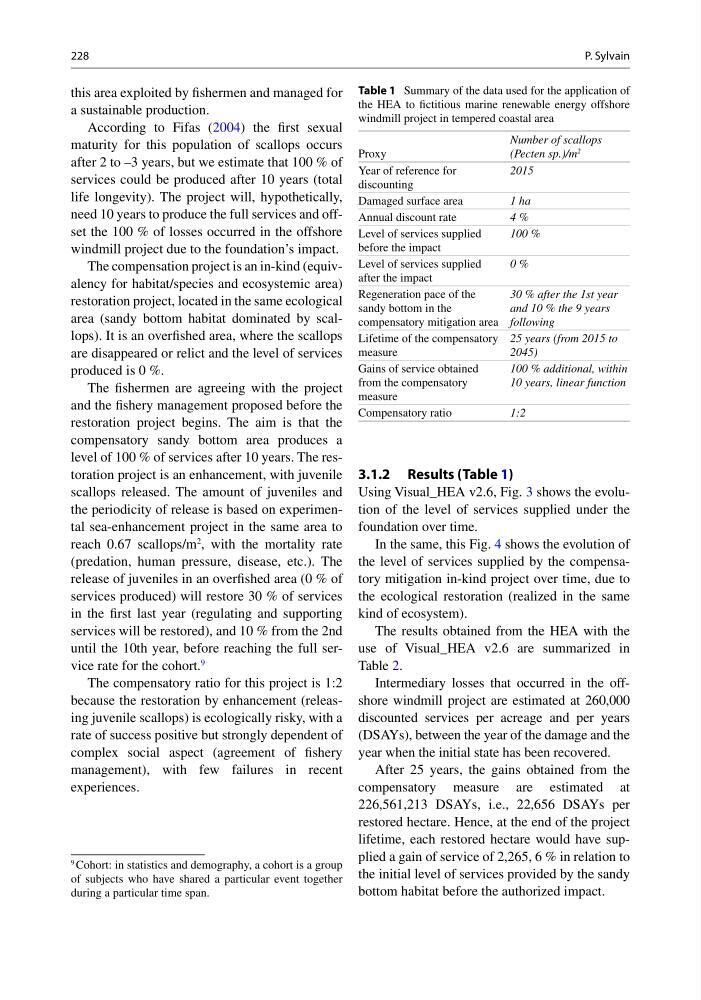
3.1.2 Results (Table 1 )
Using Visual_HEA v2.6, Fig. 3 shows the evolution of the level of services supplied under the
foundation over time.
In the same, this Fig. 4 shows the evolution of
the level of services supplied by the compensatory mitigation in-kind project over time, due to
the ecological restoration (realized in the same
kind of ecosystem).
The results obtained from the HEA with the
use of Visual_HEA v2.6 are summarized in
Table 2 .
Intermediary losses that occurred in the offshore windmill project are estimated at 260,000
discounted services per acreage and per years
(DSAYs), between the year of the damage and the
year when the initial state has been recovered.
After 25 years, the gains obtained from the
compensatory measure are estimated at
226,561,213 DSAYs, i.e., 22,656 DSAYs per
restored hectare. Hence, at the end of the project
lifetime, each restored hectare would have supplied a gain of service of 2,265, 6 % in relation to
the initial level of services provided by the sandy
bottom habitat before the authorized impact.
Table 1 Summary of the data used for the application of
the HEA to fi ctitious marine renewable energy offshore
windmill project in tempered coastal area
Proxy
Number of scallops
(Pecten sp.)/m
2
Year of reference for
discounting
2015
Damaged surface area
1 ha
Annual discount rate
4 %
Level of services supplied
before the impact
100 %
Level of services supplied
after the impact
0 %
Regeneration pace of the
sandy bottom in the
compensatory mitigation area
30 % after the 1st year
and 10 % the 9 years
following
Lifetime of the compensatory
measure
25 years (from 2015 to
2045)
Gains of service obtained
from the compensatory
measure
100 % additional, within
10 years, linear function
Compensatory ratio
1:2
P. Sylvain
this area exploited by fi shermen and managed for
a sustainable production.
According to Fifas ( 2004 ) the fi rst sexual
maturity for this population of scallops occurs
after 2 to –3 years, but we estimate that 100 % of
services could be produced after 10 years (total
life longevity). The project will, hypothetically,
need 10 years to produce the full services and offset the 100 % of losses occurred in the offshore
windmill project due to the foundation’s impact.
The compensation project is an in-kind (equivalency for habitat/species and ecosystemic area)
restoration project, located in the same ecological
area (sandy bottom habitat dominated by scallops). It is an overfi shed area, where the scallops
are disappeared or relict and the level of services
produced is 0 %.
The fi shermen are agreeing with the project
and the fi shery management proposed before the
restoration project begins. The aim is that the
compensatory sandy bottom area produces a
level of 100 % of services after 10 years. The restoration project is an enhancement, with juvenile
scallops released. The amount of juveniles and
the periodicity of release is based on experimental sea-enhancement project in the same area to
reach 0.67 scallops/m
2
, with the mortality rate
(predation, human pressure, disease, etc.). The
release of juveniles in an overfi shed area (0 % of
services produced) will restore 30 % of services
in the fi rst last year (regulating and supporting
services will be restored), and 10 % from the 2nd
until the 10th year, before reaching the full service rate for the cohort.
9
The compensatory ratio for this project is 1:2
because the restoration by enhancement (releasing juvenile scallops) is ecologically risky, with a
rate of success positive but strongly dependent of
complex social aspect (agreement of fi shery
management), with few failures in recent
experiences.
9 Cohort: in statistics and demography, a cohort is a group
of subjects who have shared a particular event together
during a particular time span.
3.1.2 Results (Table 1 )
Using Visual_HEA v2.6, Fig. 3 shows the evolution of the level of services supplied under the
foundation over time.
In the same, this Fig. 4 shows the evolution of
the level of services supplied by the compensatory mitigation in-kind project over time, due to
the ecological restoration (realized in the same
kind of ecosystem).
The results obtained from the HEA with the
use of Visual_HEA v2.6 are summarized in
Table 2 .
Intermediary losses that occurred in the offshore windmill project are estimated at 260,000
discounted services per acreage and per years
(DSAYs), between the year of the damage and the
year when the initial state has been recovered.
After 25 years, the gains obtained from the
compensatory measure are estimated at
226,561,213 DSAYs, i.e., 22,656 DSAYs per
restored hectare. Hence, at the end of the project
lifetime, each restored hectare would have supplied a gain of service of 2,265, 6 % in relation to
the initial level of services provided by the sandy
bottom habitat before the authorized impact.
Table 1 Summary of the data used for the application of
the HEA to fi ctitious marine renewable energy offshore
windmill project in tempered coastal area
Proxy
Number of scallops
(Pecten sp.)/m
2
Year of reference for
discounting
2015
Damaged surface area
1 ha
Annual discount rate
4 %
Level of services supplied
before the impact
100 %
Level of services supplied
after the impact
0 %
Regeneration pace of the
sandy bottom in the
compensatory mitigation area
30 % after the 1st year
and 10 % the 9 years
following
Lifetime of the compensatory
measure
25 years (from 2015 to
2045)
Gains of service obtained
from the compensatory
measure
100 % additional, within
10 years, linear function
Compensatory ratio
1:2
P. Sylvain