

212
The results demonstrate that light at a wavelength of 405 nm provides suitable excitation to
obtain species-distinct bio-fl uorescence images.
4.3
Field Test Using
a UV-LED Light
A UV-LED light system has been developed for
in situ recording of bio-fl uorescence in deep-sea
hydrothermal fi elds. The wavelength of the LED
emission is 385 nm with half-width of 10 nm, the
illumination power is about 15 W, the spread
angle is about 30°, and the video camera aboard
the ROV ‘Hyper Dolphin’ (JAMSTEC Web page
2013 ) was used for recording. Deep-sea observations were obtained in Iheya North fi eld, Okinawa
Trough, at a depth of 990 m. The difference in
colour by species is less clear than in the aquarium due to light attenuation by seawater between
targets and video camera. However, it is still possible to differentiate the fl uorescence colours of
hydrothermal vent galatheid crabs, hydrothermal
vent
shrimps
and
deep-sea
mussels
( Bathymodiolus platifrons ) as in the right panel
of Fig. 8 .
5
Conclusions
and Perspectives
The proposed mining of hydrothermal deposits
necessitates environmental impact assessment of
deep-sea ecosystems, and there is an urgent need
for technological development to assist such
detailed investigation. Current methods of monitoring hydrothermal ecosystems are operationally intensive. We therefore suggest a new
monitoring method using the bio-fl uorescent
characteristics of deep-sea macrobenthos.
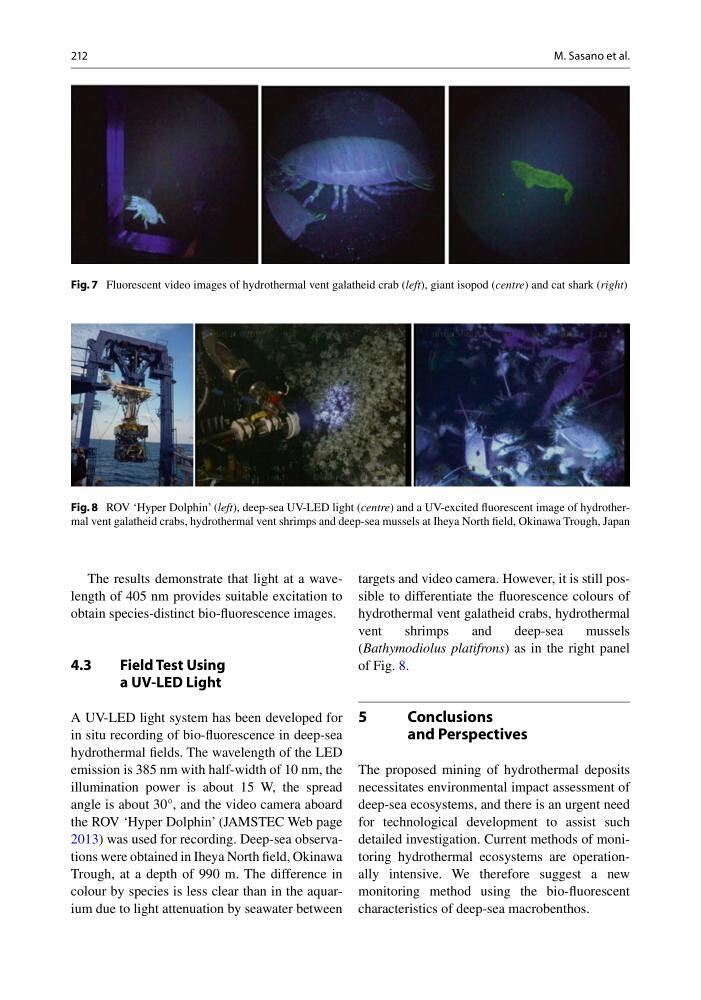
Fig. 8 ROV ‘Hyper Dolphin’ ( left ), deep-sea UV-LED light ( centre ) and a UV-excited fl uorescent image of hydrothermal vent galatheid crabs, hydrothermal vent shrimps and deep-sea mussels at Iheya North fi eld, Okinawa Trough, Japan
Fig. 7 Fluorescent video images of hydrothermal vent galatheid crab ( left ), giant isopod ( centre ) and cat shark ( right )
M. Sasano et al.
The results demonstrate that light at a wavelength of 405 nm provides suitable excitation to
obtain species-distinct bio-fl uorescence images.
4.3
Field Test Using
a UV-LED Light
A UV-LED light system has been developed for
in situ recording of bio-fl uorescence in deep-sea
hydrothermal fi elds. The wavelength of the LED
emission is 385 nm with half-width of 10 nm, the
illumination power is about 15 W, the spread
angle is about 30°, and the video camera aboard
the ROV ‘Hyper Dolphin’ (JAMSTEC Web page
2013 ) was used for recording. Deep-sea observations were obtained in Iheya North fi eld, Okinawa
Trough, at a depth of 990 m. The difference in
colour by species is less clear than in the aquarium due to light attenuation by seawater between
targets and video camera. However, it is still possible to differentiate the fl uorescence colours of
hydrothermal vent galatheid crabs, hydrothermal
vent
shrimps
and
deep-sea
mussels
( Bathymodiolus platifrons ) as in the right panel
of Fig. 8 .
5
Conclusions
and Perspectives
The proposed mining of hydrothermal deposits
necessitates environmental impact assessment of
deep-sea ecosystems, and there is an urgent need
for technological development to assist such
detailed investigation. Current methods of monitoring hydrothermal ecosystems are operationally intensive. We therefore suggest a new
monitoring method using the bio-fl uorescent
characteristics of deep-sea macrobenthos.
Fig. 8 ROV ‘Hyper Dolphin’ ( left ), deep-sea UV-LED light ( centre ) and a UV-excited fl uorescent image of hydrothermal vent galatheid crabs, hydrothermal vent shrimps and deep-sea mussels at Iheya North fi eld, Okinawa Trough, Japan
Fig. 7 Fluorescent video images of hydrothermal vent galatheid crab ( left ), giant isopod ( centre ) and cat shark ( right )
M. Sasano et al.