

145
about 0.003 mg/L as Cl and 0.009 mg/L as Cl
equivalent in the NaCl solution and fi ltered seawater, respectively.
4
Discussion
Comparison of the DPD and iodometric titration (Figs. 4 and 5 ) results indicates the existence of an unknown material that causes the
background signal to be larger with the DPD
method than with the iodometric titration
method in spring and summer. On the basis of
our experience, we hypothesized that the
unknown material responsible for the chlorine
residue blank was a by- product of phytoplankton photosynthesis. We believe that the positive
correlation between the concentrations of phytoplankton and chlorine residue estimated with
the DPD method (Fig. 7 , right) supports our
hypothesis. There is also a possibility that some
abiotic mechanism is responsible for the blank;
for example, strong solar radiation may produce oxidants in the atmosphere or in the sea
(Plane et al. 1997 ). At fi rst, we assumed that
H 2 O 2 was the naturally produced unknown
material that was interacting with the DPD
reagents because H 2 O 2 has been reported to be
one of the substances that interfere with the
measurement of chlorine residue by the DPD
method (Japanese Standards Association 2013 ).
According to the literature, H 2 O 2 is produced
in phytoplankton cells (Palenic et al. 1987 ; Twiner
and Trick 2000 ). But to produce a red color in the
DPD assay equivalent to a chlorine residue concentration of ++ (0.02 mg/L as Cl equivalent),
11 mg/L (0.3 mmol/L) of H 2 O 2 was required
(Fig. 8 ), which is about 1,500 times the reported
concentration in the Sargasso Sea [at most
0.0002 mmol/L; Miller and Kester ( 1994 )].
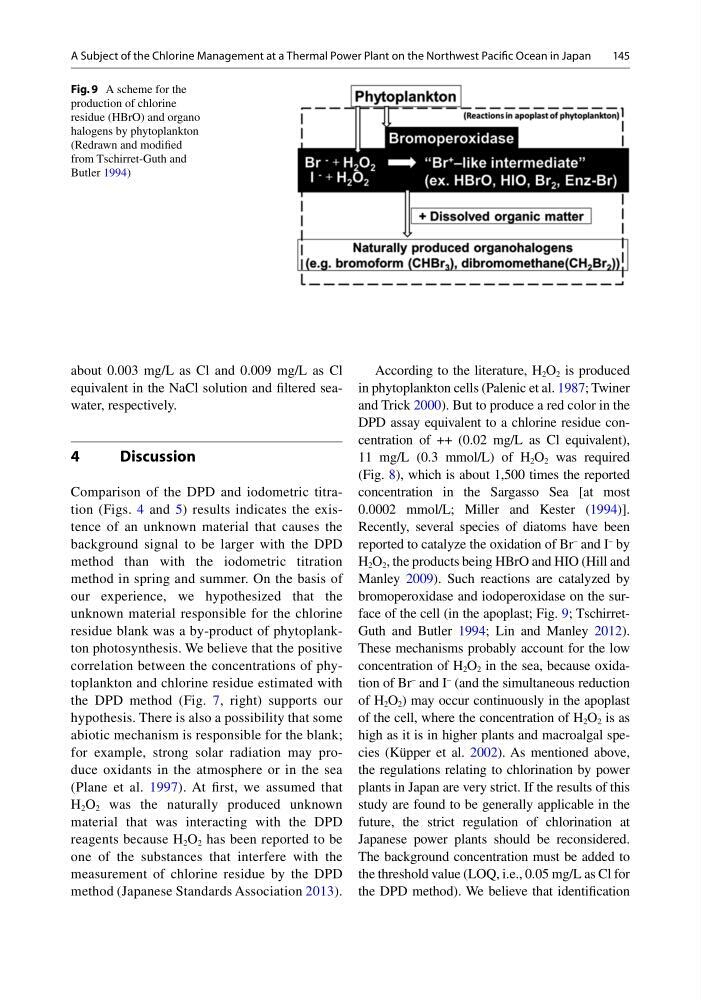
Recently, several species of diatoms have been
reported to catalyze the oxidation of Br
– and I
– by
H 2 O 2 , the products being HBrO and HIO (Hill and
Manley 2009 ). Such reactions are catalyzed by
bromoperoxidase and iodoperoxidase on the surface of the cell (in the apoplast; Fig. 9 ; TschirretGuth and Butler 1994 ; Lin and Manley 2012 ).
These mechanisms probably account for the low
concentration of H 2 O 2 in the sea, because oxidation of Br
– and I
– (and the simultaneous reduction
of H 2 O 2 ) may occur continuously in the apoplast
of the cell, where the concentration of H 2 O 2 is as
high as it is in higher plants and macroalgal species (Küpper et al. 2002 ). As mentioned above,
the regulations relating to chlorination by power
plants in Japan are very strict. If the results of this
study are found to be generally applicable in the
future, the strict regulation of chlorination at
Japanese power plants should be reconsidered.
The background concentration must be added to
the threshold value (LOQ, i.e., 0.05 mg/L as Cl for
the DPD method). We believe that identifi cation
Fig. 9 A scheme for the
production of chlorine
residue (HBrO) and organo
halogens by phytoplankton
(Redrawn and modifi ed
from Tschirret-Guth and
Butler 1994 )
A Subject of the Chlorine Management at a Thermal Power Plant on the Northwest Pacifi c Ocean in Japan
about 0.003 mg/L as Cl and 0.009 mg/L as Cl
equivalent in the NaCl solution and fi ltered seawater, respectively.
4
Discussion
Comparison of the DPD and iodometric titration (Figs. 4 and 5 ) results indicates the existence of an unknown material that causes the
background signal to be larger with the DPD
method than with the iodometric titration
method in spring and summer. On the basis of
our experience, we hypothesized that the
unknown material responsible for the chlorine
residue blank was a by- product of phytoplankton photosynthesis. We believe that the positive
correlation between the concentrations of phytoplankton and chlorine residue estimated with
the DPD method (Fig. 7 , right) supports our
hypothesis. There is also a possibility that some
abiotic mechanism is responsible for the blank;
for example, strong solar radiation may produce oxidants in the atmosphere or in the sea
(Plane et al. 1997 ). At fi rst, we assumed that
H 2 O 2 was the naturally produced unknown
material that was interacting with the DPD
reagents because H 2 O 2 has been reported to be
one of the substances that interfere with the
measurement of chlorine residue by the DPD
method (Japanese Standards Association 2013 ).
According to the literature, H 2 O 2 is produced
in phytoplankton cells (Palenic et al. 1987 ; Twiner
and Trick 2000 ). But to produce a red color in the
DPD assay equivalent to a chlorine residue concentration of ++ (0.02 mg/L as Cl equivalent),
11 mg/L (0.3 mmol/L) of H 2 O 2 was required
(Fig. 8 ), which is about 1,500 times the reported
concentration in the Sargasso Sea [at most
0.0002 mmol/L; Miller and Kester ( 1994 )].
Recently, several species of diatoms have been
reported to catalyze the oxidation of Br
– and I
– by
H 2 O 2 , the products being HBrO and HIO (Hill and
Manley 2009 ). Such reactions are catalyzed by
bromoperoxidase and iodoperoxidase on the surface of the cell (in the apoplast; Fig. 9 ; TschirretGuth and Butler 1994 ; Lin and Manley 2012 ).
These mechanisms probably account for the low
concentration of H 2 O 2 in the sea, because oxidation of Br
– and I
– (and the simultaneous reduction
of H 2 O 2 ) may occur continuously in the apoplast
of the cell, where the concentration of H 2 O 2 is as
high as it is in higher plants and macroalgal species (Küpper et al. 2002 ). As mentioned above,
the regulations relating to chlorination by power
plants in Japan are very strict. If the results of this
study are found to be generally applicable in the
future, the strict regulation of chlorination at
Japanese power plants should be reconsidered.
The background concentration must be added to
the threshold value (LOQ, i.e., 0.05 mg/L as Cl for
the DPD method). We believe that identifi cation
Fig. 9 A scheme for the
production of chlorine
residue (HBrO) and organo
halogens by phytoplankton
(Redrawn and modifi ed
from Tschirret-Guth and
Butler 1994 )
A Subject of the Chlorine Management at a Thermal Power Plant on the Northwest Pacifi c Ocean in Japan