

112
waters including embayments such as Tokyo Bay
(Ferrari and Orsi 1984 ; Anakubo and Murano
1991 ; Itoh et al. 2011 ), one of the most eutrophic
embayment in the world.
This bay is also known to be inhabited by
abundant moon-jelly Aurelia aurita , having
planktonic stages being voracious to smaller zooplanktons such as copepods (Omori et al. 1995 ).
It is intriguing that O. davisae remains so predominant in spite of the abundant existence of the
“copepod eater” A. aurita . In this context, we
may speculate that certain reasons should exist
for the coexistence of such abundant A. aurita
and O. davisae as its prey.
In the present paper, we will (a) show some
direct observations on the feeding behavior of
moon-jelly’s ephyra in laboratory conditions; (b)
discuss the special feature of the behavior of O.
davisae , able to escape easily from the ephyra ;
and (c) speculate the reason why O. davisae is
predominant in Tokyo Bay today.
2
Materials and Method
2.1
Ephyra as Predator
In order to perform direct observations of
predator- prey interactions between moon-jelly’s
ephyra and zooplankton, after the method previously established (Ishii et al. 2004 ), from mature
moon-jelly Aurelia aurita captured from the
innermost part of Tokyo Bay, planula larvae
were obtained fi rst, and then through the polyps,
after strobilation, the ephyra larvae were liberated (Fig. 2 ).
2.2
Zooplankton as Prey
As preys of the ephyra , zooplankton such as
Oithona davisae , Acartia omorii , cypris larvae of
barnacles, zoea larvae of decapods, and adults
of a small species of hydromedusae Rathkea
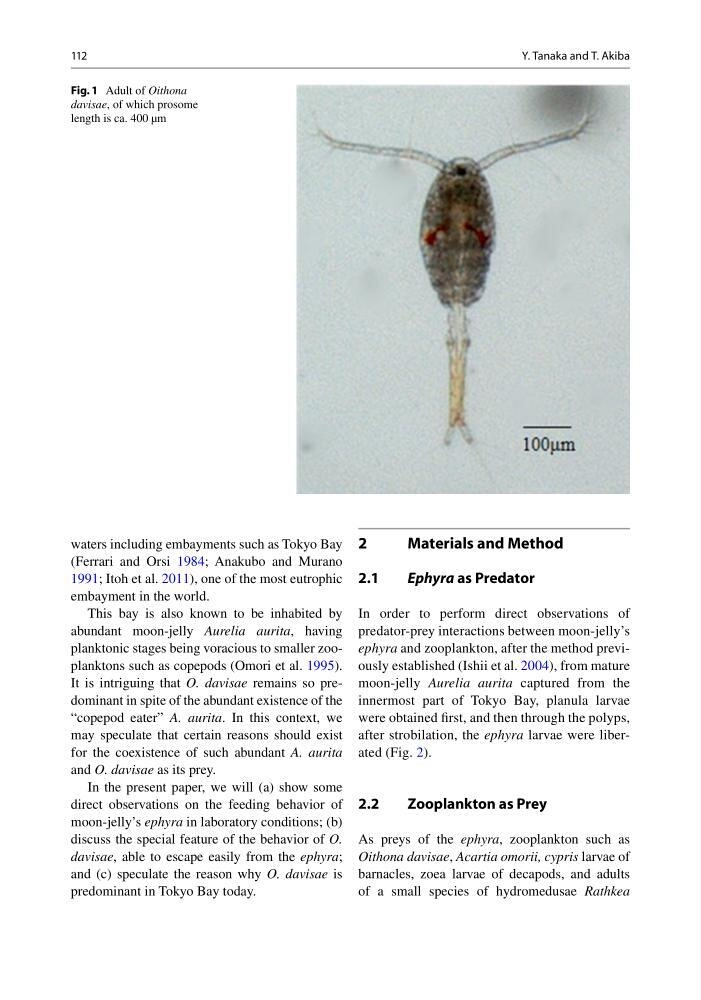
Fig. 1 Adult of Oithona
davisae , of which prosome
length is ca. 400 µm
Y. Tanaka and T. Akiba
waters including embayments such as Tokyo Bay
(Ferrari and Orsi 1984 ; Anakubo and Murano
1991 ; Itoh et al. 2011 ), one of the most eutrophic
embayment in the world.
This bay is also known to be inhabited by
abundant moon-jelly Aurelia aurita , having
planktonic stages being voracious to smaller zooplanktons such as copepods (Omori et al. 1995 ).
It is intriguing that O. davisae remains so predominant in spite of the abundant existence of the
“copepod eater” A. aurita . In this context, we
may speculate that certain reasons should exist
for the coexistence of such abundant A. aurita
and O. davisae as its prey.
In the present paper, we will (a) show some
direct observations on the feeding behavior of
moon-jelly’s ephyra in laboratory conditions; (b)
discuss the special feature of the behavior of O.
davisae , able to escape easily from the ephyra ;
and (c) speculate the reason why O. davisae is
predominant in Tokyo Bay today.
2
Materials and Method
2.1
Ephyra as Predator
In order to perform direct observations of
predator- prey interactions between moon-jelly’s
ephyra and zooplankton, after the method previously established (Ishii et al. 2004 ), from mature
moon-jelly Aurelia aurita captured from the
innermost part of Tokyo Bay, planula larvae
were obtained fi rst, and then through the polyps,
after strobilation, the ephyra larvae were liberated (Fig. 2 ).
2.2
Zooplankton as Prey
As preys of the ephyra , zooplankton such as
Oithona davisae , Acartia omorii , cypris larvae of
barnacles, zoea larvae of decapods, and adults
of a small species of hydromedusae Rathkea
Fig. 1 Adult of Oithona
davisae , of which prosome
length is ca. 400 µm
Y. Tanaka and T. Akiba