

87
2.2
The Fate of Antibiotic- Resistant
Fecal Bacteria: From the Source
of Contamination
to the Estuary
2.2.1 Occurrence of AntibioticResistant Escherichia
coli and Enterococcus
in the Seine Estuary
In parallel with the contamination by antibiotics,
a permanent high level of antibiotic-resistant
E. coli has been observed in the Seine estuary
(Laroche et al. 2009 ; Table 5 ). A high proportion
of these strains are multiresistant to antibiotics
(60.5–80 %), part of which (11.1 %) harboring an
integron
2 (Table 6 ). The class 1 integrons are
found among the E. coli strains all along the estuary, whereas only the strains isolated in the urban
zone (Rouen) harbor class 2 integrons.
2 Integrons are genetic supports responsible for the capture
of antibiotic resistance genes. They play a major role in
the dissemination of antibiotic resistance genes, mainly
among Gram-negative bacteria.
2.2.2 Relationship Between
Antibiotic Use and Antibiotic
Contamination in Water
Environment
Water contamination by antibiotic-resistant bacteria
was also investigated along the medical center–
WWTP–river continuum. The results show that the
percentages of strains of E. coli resistant to at least
one antibiotic, and multiple-resistant strains (from
three to eight resistances), are greater in the effl uent
of the retirement home than in the effl uent of hospital (Table 3 and Fig. 3 ). Thus, the long residence
time of the patients enables to observe the longterm consequences of antibiotic treatment in the
emergence of antibiotic-resistant bacteria which is
mainly due to the selection pressure exerted on the
intestinal microbiota of patients.
The epidemiologic strains from the medical
center, carrying specifi c genetic supports (integrons,
a gene for resistance to erm gene encoding
resistance to macrolides) decreased along the
continuum in favor of strains better adapted to the
environment (Figs. 3 , 4 , and 5 ). Thus, E. coli
resistant to at least one antibiotic and those carrying the class 1 integron decreased signifi cantly
along the continuum ( p -value < 0.001) from the
retirement home effl uents to the river (Table 3
and Fig. 3 , Oberlé et al. 2012 ).
Among the Enterococci population, mainly
identifi ed as Enterococcus faecium , all isolates
from the medical center are multiple antibiotic
resistant containing erm (B) and mef (A) and
belonged to the hospital-adapted clonal complex
17(CC17) (Leclercq et al. 2013 ). It decreases in
the treated effl uent from the wastewater treatment plant (19 and 17 %) to reach 4 and 5 % in
the waters of the Risle. Interestingly, while the
proportion of Enterococcus faecium resistant to
erythromycin is greater than 70 % along the continuum , only the hospital isolates exhibit a high
level of resistance. The prevalence of the erm (B)
gene reaches 75 % of the hospital isolates and
only 6.7 % of the strain isolates in the river
(Fig. 4 ). Similarly, the occurrence of the clonal
complex “CC17”, sequence of DNA present
among the epidemic hospital strains (Fig. 5 ;
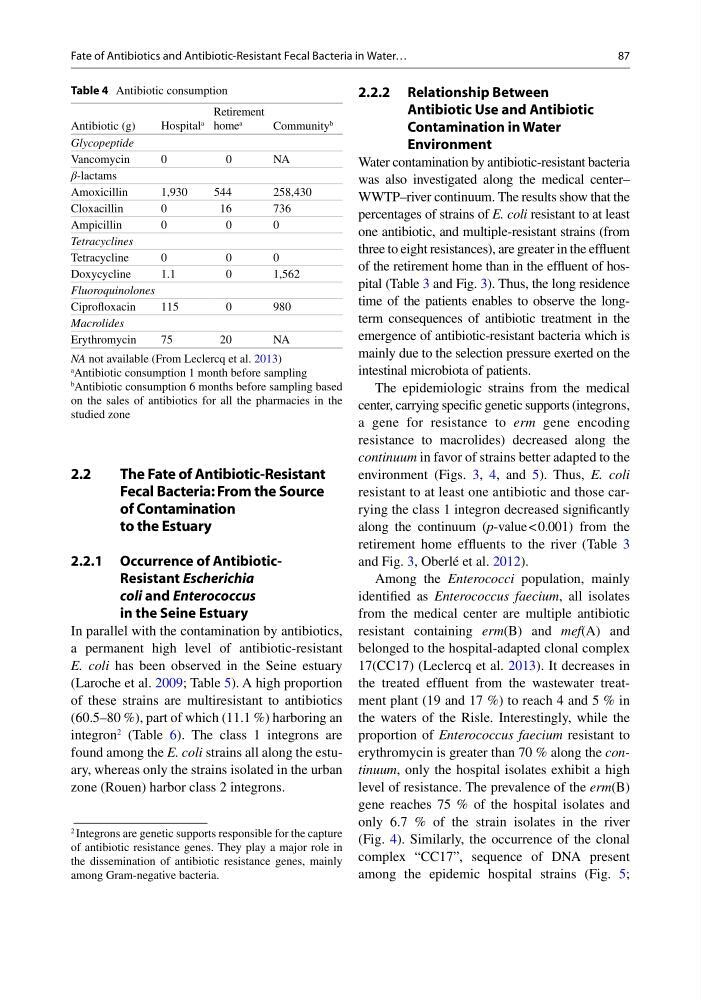
Table 4 Antibiotic consumption
Antibiotic (g)
Hospital
a
Retirement
home
a
Community
b
Glycopeptide
Vancomycin
0
0
NA
β- lactams
Amoxicillin
1,930
544
258,430
Cloxacillin
0
16
736
Ampicillin
0
0
0
Tetracyclines
Tetracycline
0
0
0
Doxycycline
1.1
0
1,562
Fluoroquinolones
Ciprofl oxacin
115
0
980
Macrolides
Erythromycin
75
20
NA
NA not available (From Leclercq et al. 2013 )
a
Antibiotic consumption 1 month before sampling
b
Antibiotic consumption 6 months before sampling based
on the sales of antibiotics for all the pharmacies in the
studied zone
Fate of Antibiotics and Antibiotic-Resistant Fecal Bacteria in Water…
2.2
The Fate of Antibiotic- Resistant
Fecal Bacteria: From the Source
of Contamination
to the Estuary
2.2.1 Occurrence of AntibioticResistant Escherichia
coli and Enterococcus
in the Seine Estuary
In parallel with the contamination by antibiotics,
a permanent high level of antibiotic-resistant
E. coli has been observed in the Seine estuary
(Laroche et al. 2009 ; Table 5 ). A high proportion
of these strains are multiresistant to antibiotics
(60.5–80 %), part of which (11.1 %) harboring an
integron
2 (Table 6 ). The class 1 integrons are
found among the E. coli strains all along the estuary, whereas only the strains isolated in the urban
zone (Rouen) harbor class 2 integrons.
2 Integrons are genetic supports responsible for the capture
of antibiotic resistance genes. They play a major role in
the dissemination of antibiotic resistance genes, mainly
among Gram-negative bacteria.
2.2.2 Relationship Between
Antibiotic Use and Antibiotic
Contamination in Water
Environment
Water contamination by antibiotic-resistant bacteria
was also investigated along the medical center–
WWTP–river continuum. The results show that the
percentages of strains of E. coli resistant to at least
one antibiotic, and multiple-resistant strains (from
three to eight resistances), are greater in the effl uent
of the retirement home than in the effl uent of hospital (Table 3 and Fig. 3 ). Thus, the long residence
time of the patients enables to observe the longterm consequences of antibiotic treatment in the
emergence of antibiotic-resistant bacteria which is
mainly due to the selection pressure exerted on the
intestinal microbiota of patients.
The epidemiologic strains from the medical
center, carrying specifi c genetic supports (integrons,
a gene for resistance to erm gene encoding
resistance to macrolides) decreased along the
continuum in favor of strains better adapted to the
environment (Figs. 3 , 4 , and 5 ). Thus, E. coli
resistant to at least one antibiotic and those carrying the class 1 integron decreased signifi cantly
along the continuum ( p -value < 0.001) from the
retirement home effl uents to the river (Table 3
and Fig. 3 , Oberlé et al. 2012 ).
Among the Enterococci population, mainly
identifi ed as Enterococcus faecium , all isolates
from the medical center are multiple antibiotic
resistant containing erm (B) and mef (A) and
belonged to the hospital-adapted clonal complex
17(CC17) (Leclercq et al. 2013 ). It decreases in
the treated effl uent from the wastewater treatment plant (19 and 17 %) to reach 4 and 5 % in
the waters of the Risle. Interestingly, while the
proportion of Enterococcus faecium resistant to
erythromycin is greater than 70 % along the continuum , only the hospital isolates exhibit a high
level of resistance. The prevalence of the erm (B)
gene reaches 75 % of the hospital isolates and
only 6.7 % of the strain isolates in the river
(Fig. 4 ). Similarly, the occurrence of the clonal
complex “CC17”, sequence of DNA present
among the epidemic hospital strains (Fig. 5 ;
Table 4 Antibiotic consumption
Antibiotic (g)
Hospital
a
Retirement
home
a
Community
b
Glycopeptide
Vancomycin
0
0
NA
β- lactams
Amoxicillin
1,930
544
258,430
Cloxacillin
0
16
736
Ampicillin
0
0
0
Tetracyclines
Tetracycline
0
0
0
Doxycycline
1.1
0
1,562
Fluoroquinolones
Ciprofl oxacin
115
0
980
Macrolides
Erythromycin
75
20
NA
NA not available (From Leclercq et al. 2013 )
a
Antibiotic consumption 1 month before sampling
b
Antibiotic consumption 6 months before sampling based
on the sales of antibiotics for all the pharmacies in the
studied zone
Fate of Antibiotics and Antibiotic-Resistant Fecal Bacteria in Water…