

81
Prescribed in human and veterinary medicine
depending on the legislation in force
1 , antibiotics
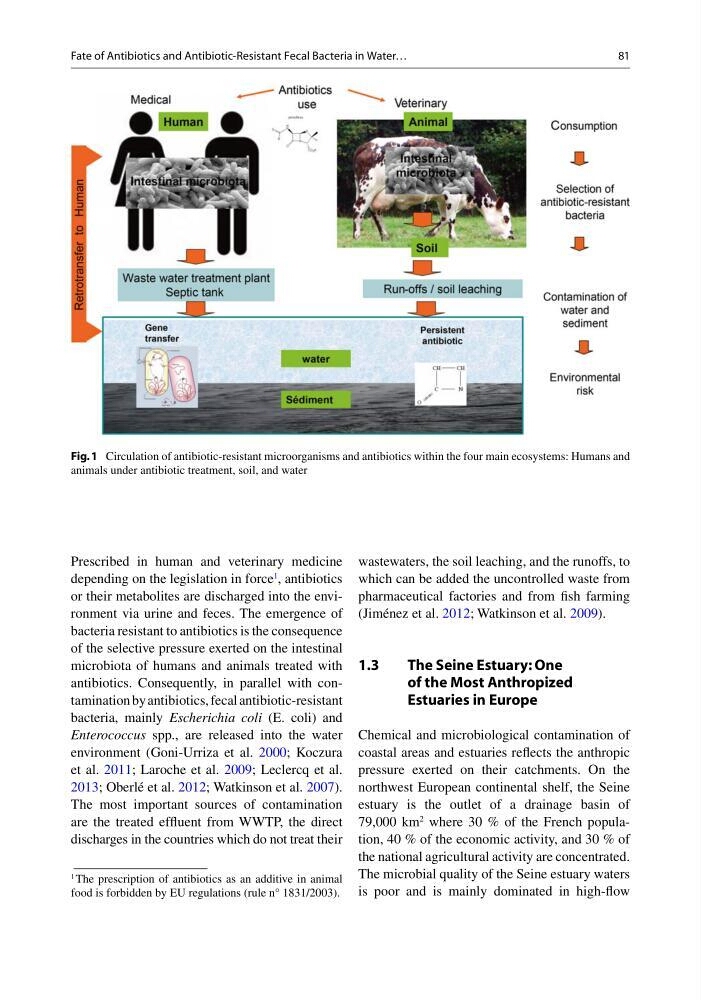
or their metabolites are discharged into the environment via urine and feces. The emergence of
bacteria resistant to antibiotics is the consequence
of the selective pressure exerted on the intestinal
microbiota of humans and animals treated with
antibiotics. Consequently, in parallel with contamination by antibiotics, fecal antibiotic- resistant
bacteria, mainly Escherichia coli (E. coli) and
Enterococcus spp., are released into the water
environment (Goni-Urriza et al. 2000 ; Koczura
et al. 2011 ; Laroche et al. 2009 ; Leclercq et al.
2013 ; Oberlé et al. 2012 ; Watkinson et al. 2007 ).
The most important sources of contamination
are the treated effl uent from WWTP, the direct
discharges in the countries which do not treat their
1 The prescription of antibiotics as an additive in animal
food is forbidden by EU regulations (rule n° 1831/2003).
wastewaters, the soil leaching, and the runoffs, to
which can be added the uncontrolled waste from
pharmaceutical factories and from fi sh farming
(Jiménez et al. 2012 ; Watkinson et al. 2009 ).
1.3
The Seine Estuary: One
of the Most Anthropized
Estuaries in Europe
Chemical and microbiological contamination of
coastal areas and estuaries refl ects the anthropic
pressure exerted on their catchments. On the
northwest European continental shelf, the Seine
estuary is the outlet of a drainage basin of
79,000 km
2 where 30 % of the French population, 40 % of the economic activity, and 30 % of
the national agricultural activity are concentrated.
The microbial quality of the Seine estuary waters
is poor and is mainly dominated in high-fl ow
Fig. 1 Circulation of antibiotic-resistant microorganisms and antibiotics within the four main ecosystems: Humans and
animals under antibiotic treatment, soil, and water
Fate of Antibiotics and Antibiotic-Resistant Fecal Bacteria in Water…
Prescribed in human and veterinary medicine
depending on the legislation in force
1 , antibiotics
or their metabolites are discharged into the environment via urine and feces. The emergence of
bacteria resistant to antibiotics is the consequence
of the selective pressure exerted on the intestinal
microbiota of humans and animals treated with
antibiotics. Consequently, in parallel with contamination by antibiotics, fecal antibiotic- resistant
bacteria, mainly Escherichia coli (E. coli) and
Enterococcus spp., are released into the water
environment (Goni-Urriza et al. 2000 ; Koczura
et al. 2011 ; Laroche et al. 2009 ; Leclercq et al.
2013 ; Oberlé et al. 2012 ; Watkinson et al. 2007 ).
The most important sources of contamination
are the treated effl uent from WWTP, the direct
discharges in the countries which do not treat their
1 The prescription of antibiotics as an additive in animal
food is forbidden by EU regulations (rule n° 1831/2003).
wastewaters, the soil leaching, and the runoffs, to
which can be added the uncontrolled waste from
pharmaceutical factories and from fi sh farming
(Jiménez et al. 2012 ; Watkinson et al. 2009 ).
1.3
The Seine Estuary: One
of the Most Anthropized
Estuaries in Europe
Chemical and microbiological contamination of
coastal areas and estuaries refl ects the anthropic
pressure exerted on their catchments. On the
northwest European continental shelf, the Seine
estuary is the outlet of a drainage basin of
79,000 km
2 where 30 % of the French population, 40 % of the economic activity, and 30 % of
the national agricultural activity are concentrated.
The microbial quality of the Seine estuary waters
is poor and is mainly dominated in high-fl ow
Fig. 1 Circulation of antibiotic-resistant microorganisms and antibiotics within the four main ecosystems: Humans and
animals under antibiotic treatment, soil, and water
Fate of Antibiotics and Antibiotic-Resistant Fecal Bacteria in Water…