

76
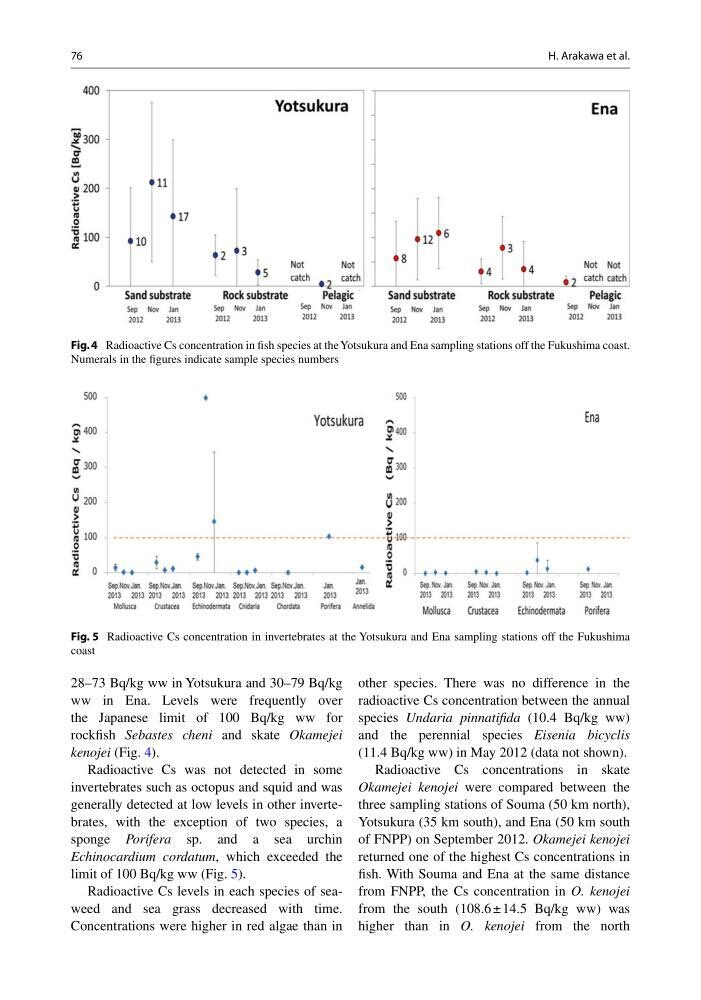
28–73 Bq/kg ww in Yotsukura and 30–79 Bq/kg
ww in Ena. Levels were frequently over
the Japanese limit of 100 Bq/kg ww for
rockfi sh Sebastes cheni and skate Okamejei
kenojei (Fig. 4 ).
Radioactive Cs was not detected in some
invertebrates such as octopus and squid and was
generally detected at low levels in other invertebrates, with the exception of two species, a
sponge Porifera sp. and a sea urchin
Echinocardium cordatum , which exceeded the
limit of 100 Bq/kg ww (Fig. 5 ).
Radioactive Cs levels in each species of seaweed and sea grass decreased with time.
Concentrations were higher in red algae than in
other species. There was no difference in the
radioactive Cs concentration between the annual
species Undaria pinnatifi da (10.4 Bq/kg ww)
and the perennial species Eisenia bicyclis
(11.4 Bq/kg ww) in May 2012 (data not shown).
Radioactive Cs concentrations in skate
Okamejei kenojei were compared between the
three sampling stations of Souma (50 km north),
Yotsukura (35 km south), and Ena (50 km south
of FNPP) on September 2012. Okamejei kenojei
returned one of the highest Cs concentrations in
fi sh. With Souma and Ena at the same distance
from FNPP, the Cs concentration in O. kenojei
from the south (108.6 ± 14.5 Bq/kg ww) was
higher than in O. kenojei from the north
Fig. 4 Radioactive Cs concentration in fi sh species at the Yotsukura and Ena sampling stations off the Fukushima coast.
Numerals in the fi gures indicate sample species numbers
Fig. 5 Radioactive Cs concentration in invertebrates at the Yotsukura and Ena sampling stations off the Fukushima
coast
H. Arakawa et al.
28–73 Bq/kg ww in Yotsukura and 30–79 Bq/kg
ww in Ena. Levels were frequently over
the Japanese limit of 100 Bq/kg ww for
rockfi sh Sebastes cheni and skate Okamejei
kenojei (Fig. 4 ).
Radioactive Cs was not detected in some
invertebrates such as octopus and squid and was
generally detected at low levels in other invertebrates, with the exception of two species, a
sponge Porifera sp. and a sea urchin
Echinocardium cordatum , which exceeded the
limit of 100 Bq/kg ww (Fig. 5 ).
Radioactive Cs levels in each species of seaweed and sea grass decreased with time.
Concentrations were higher in red algae than in
other species. There was no difference in the
radioactive Cs concentration between the annual
species Undaria pinnatifi da (10.4 Bq/kg ww)
and the perennial species Eisenia bicyclis
(11.4 Bq/kg ww) in May 2012 (data not shown).
Radioactive Cs concentrations in skate
Okamejei kenojei were compared between the
three sampling stations of Souma (50 km north),
Yotsukura (35 km south), and Ena (50 km south
of FNPP) on September 2012. Okamejei kenojei
returned one of the highest Cs concentrations in
fi sh. With Souma and Ena at the same distance
from FNPP, the Cs concentration in O. kenojei
from the south (108.6 ± 14.5 Bq/kg ww) was
higher than in O. kenojei from the north
Fig. 4 Radioactive Cs concentration in fi sh species at the Yotsukura and Ena sampling stations off the Fukushima coast.
Numerals in the fi gures indicate sample species numbers
Fig. 5 Radioactive Cs concentration in invertebrates at the Yotsukura and Ena sampling stations off the Fukushima
coast
H. Arakawa et al.