

75
sea area, receiving ultrasonic signals from a
transmitter implanted in a fi sh, and monitoring its
location and movement from the signal.
The selected fi sh species, rockfi sh ( Sebastes
cheni ; n = 4; body length, 22.3–26.0 cm) and
greenling ( Hexagrammos otakii ; n = 2; body
length, 27.0–32.5 cm), were monitored in an area
where high levels of radioactive Cs were detected.
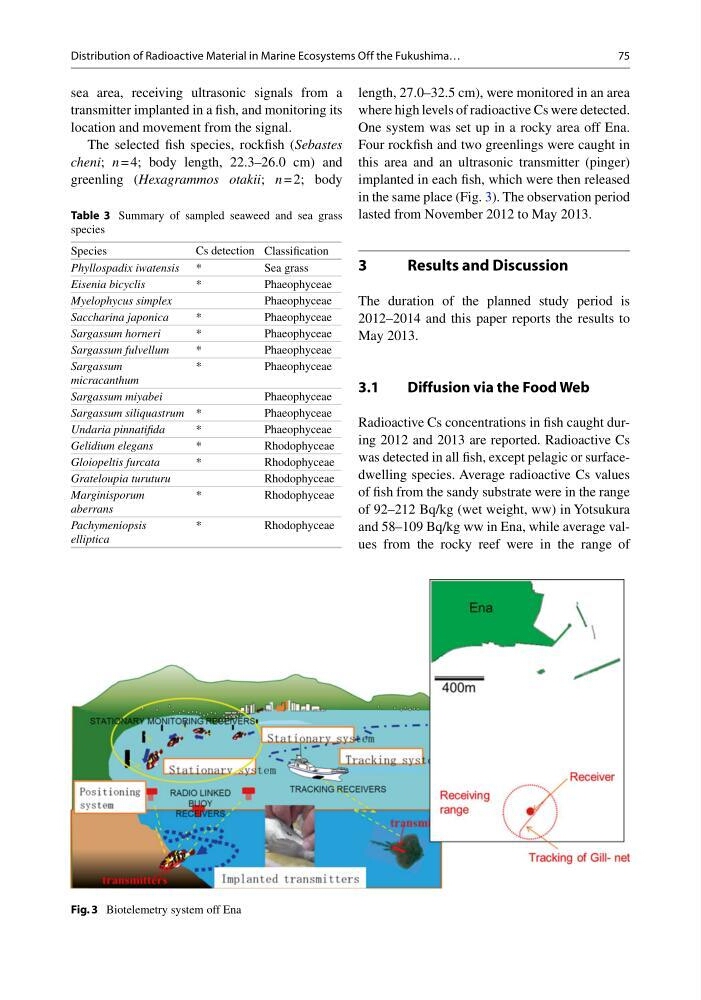
One system was set up in a rocky area off Ena.
Four rockfi sh and two greenlings were caught in
this area and an ultrasonic transmitter (pinger)
implanted in each fi sh, which were then released
in the same place (Fig. 3 ). The observation period
lasted from November 2012 to May 2013.
3
Results and Discussion
The duration of the planned study period is
2012–2014 and this paper reports the results to
May 2013.
3.1
Diffusion via the Food Web
Radioactive Cs concentrations in fi sh caught during 2012 and 2013 are reported. Radioactive Cs
was detected in all fi sh, except pelagic or surfacedwelling species. Average radioactive Cs values
of fi sh from the sandy substrate were in the range
of 92–212 Bq/kg (wet weight, ww) in Yotsukura
and 58–109 Bq/kg ww in Ena, while average values from the rocky reef were in the range of
Table 3 Summary of sampled seaweed and sea grass
species
Species
Cs detection Classifi cation
Phyllospadix iwatensis *
Sea grass
Eisenia bicyclis
*
Phaeophyceae
Myelophycus simplex
Phaeophyceae
Saccharina japonica
*
Phaeophyceae
Sargassum horneri
*
Phaeophyceae
Sargassum fulvellum
*
Phaeophyceae
Sargassum
micracanthum
*
Phaeophyceae
Sargassum miyabei
Phaeophyceae
Sargassum siliquastrum *
Phaeophyceae
Undaria pinnatifi da
*
Phaeophyceae
Gelidium elegans
*
Rhodophyceae
Gloiopeltis furcata
*
Rhodophyceae
Grateloupia turuturu
Rhodophyceae
Marginisporum
aberrans
*
Rhodophyceae
Pachymeniopsis
elliptica
*
Rhodophyceae
Fig. 3 Biotelemetry system off Ena
Distribution of Radioactive Material in Marine Ecosystems Off the Fukushima…
sea area, receiving ultrasonic signals from a
transmitter implanted in a fi sh, and monitoring its
location and movement from the signal.
The selected fi sh species, rockfi sh ( Sebastes
cheni ; n = 4; body length, 22.3–26.0 cm) and
greenling ( Hexagrammos otakii ; n = 2; body
length, 27.0–32.5 cm), were monitored in an area
where high levels of radioactive Cs were detected.
One system was set up in a rocky area off Ena.
Four rockfi sh and two greenlings were caught in
this area and an ultrasonic transmitter (pinger)
implanted in each fi sh, which were then released
in the same place (Fig. 3 ). The observation period
lasted from November 2012 to May 2013.
3
Results and Discussion
The duration of the planned study period is
2012–2014 and this paper reports the results to
May 2013.
3.1
Diffusion via the Food Web
Radioactive Cs concentrations in fi sh caught during 2012 and 2013 are reported. Radioactive Cs
was detected in all fi sh, except pelagic or surfacedwelling species. Average radioactive Cs values
of fi sh from the sandy substrate were in the range
of 92–212 Bq/kg (wet weight, ww) in Yotsukura
and 58–109 Bq/kg ww in Ena, while average values from the rocky reef were in the range of
Table 3 Summary of sampled seaweed and sea grass
species
Species
Cs detection Classifi cation
Phyllospadix iwatensis *
Sea grass
Eisenia bicyclis
*
Phaeophyceae
Myelophycus simplex
Phaeophyceae
Saccharina japonica
*
Phaeophyceae
Sargassum horneri
*
Phaeophyceae
Sargassum fulvellum
*
Phaeophyceae
Sargassum
micracanthum
*
Phaeophyceae
Sargassum miyabei
Phaeophyceae
Sargassum siliquastrum *
Phaeophyceae
Undaria pinnatifi da
*
Phaeophyceae
Gelidium elegans
*
Rhodophyceae
Gloiopeltis furcata
*
Rhodophyceae
Grateloupia turuturu
Rhodophyceae
Marginisporum
aberrans
*
Rhodophyceae
Pachymeniopsis
elliptica
*
Rhodophyceae
Fig. 3 Biotelemetry system off Ena
Distribution of Radioactive Material in Marine Ecosystems Off the Fukushima…