

26
2 Genetic Resources: Status, Development, Losses, and Conservation
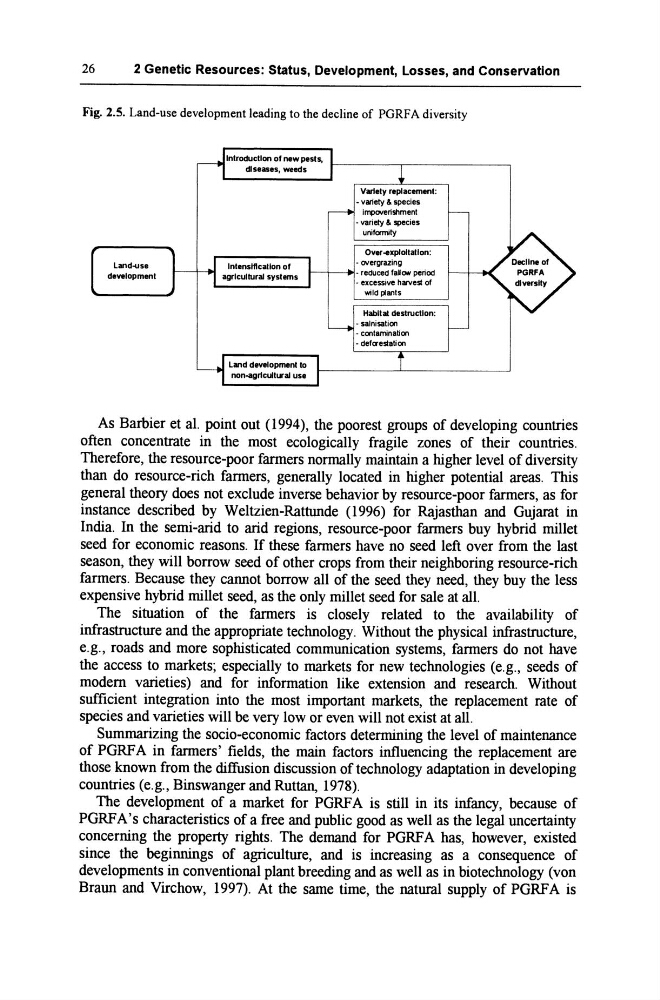
Fig. 2.5. Land-use development leading to the decline of PGRFA diversity
Land-use
development
Introduction of new pests. 1-------,------------,
diseases, weeds
Intenslflcatlon of
agricultural systems
Land development to
non-agncultural use
Variety replacement:
• variety & species
impoverishment
- variety & species
uniformity
Over-exploltatlon:
- overgrazing
I--t-~- reduced faUON period
- excessive harvest of
wild plants
Habitat destruction:
- salnisation
- contamination
- defaestation
As Barbier et al. point out (1994), the poorest groups of developing countries
often concentrate in the most ecologically fragile zones of their countries.
Therefore, the resource-poor farmers normally maintain a higher level of diversity
than do resource-rich farmers, generally located in higher potential areas. This
general theory does not exclude inverse behavior by resource-poor farmers, as for
instance described by Weltzien-Rattunde (1996) for Rajasthan and Gujarat in
India. In the semi-arid to arid regions, resource-poor farmers buy hybrid millet
seed for economic reasons. If these farmers have no seed left over from the last
season, they will borrow seed of other crops from their neighboring resource-rich
farmers. Because they cannot borrow all of the seed they need, they buy the less
expensive hybrid millet seed, as the only millet seed for sale at all.
The situation of the farmers is closely related to the availability of
infrastructure and the appropriate technology. Without the physical infrastructure,
e.g., roads and more sophisticated communication systems, farmers do not have
the access to markets; especially to markets for new technologies (e.g., seeds of
modern varieties) and for information like extension and research. Without
sufficient integration into the most important markets, the replacement rate of
species and varieties will be very low or even will not exist at all.
Summarizing the socio-economic factors determining the level of maintenance
of PGRFA in farmers' fields, the main factors influencing the replacement are
those known from the diffusion discussion of technology adaptation in developing
countries (e.g., Binswanger and Ruttan, 1978).
The development of a market for PGRF A is still in its infancy, because of
PGRF A's characteristics of a free and public good as well as the legal uncertainty
concerning the property rights. The demand for PGRF A has, however, existed
since the beginnings of agriculture, and is increasing as a consequence of
developments in conventional plant breeding and as well as in biotechnology (von
Braun and Virchow, 1997). At the same time, the natural supply of PGRFA is
2 Genetic Resources: Status, Development, Losses, and Conservation
Fig. 2.5. Land-use development leading to the decline of PGRFA diversity
Land-use
development
Introduction of new pests. 1-------,------------,
diseases, weeds
Intenslflcatlon of
agricultural systems
Land development to
non-agncultural use
Variety replacement:
• variety & species
impoverishment
- variety & species
uniformity
Over-exploltatlon:
- overgrazing
I--t-~- reduced faUON period
- excessive harvest of
wild plants
Habitat destruction:
- salnisation
- contamination
- defaestation
As Barbier et al. point out (1994), the poorest groups of developing countries
often concentrate in the most ecologically fragile zones of their countries.
Therefore, the resource-poor farmers normally maintain a higher level of diversity
than do resource-rich farmers, generally located in higher potential areas. This
general theory does not exclude inverse behavior by resource-poor farmers, as for
instance described by Weltzien-Rattunde (1996) for Rajasthan and Gujarat in
India. In the semi-arid to arid regions, resource-poor farmers buy hybrid millet
seed for economic reasons. If these farmers have no seed left over from the last
season, they will borrow seed of other crops from their neighboring resource-rich
farmers. Because they cannot borrow all of the seed they need, they buy the less
expensive hybrid millet seed, as the only millet seed for sale at all.
The situation of the farmers is closely related to the availability of
infrastructure and the appropriate technology. Without the physical infrastructure,
e.g., roads and more sophisticated communication systems, farmers do not have
the access to markets; especially to markets for new technologies (e.g., seeds of
modern varieties) and for information like extension and research. Without
sufficient integration into the most important markets, the replacement rate of
species and varieties will be very low or even will not exist at all.
Summarizing the socio-economic factors determining the level of maintenance
of PGRFA in farmers' fields, the main factors influencing the replacement are
those known from the diffusion discussion of technology adaptation in developing
countries (e.g., Binswanger and Ruttan, 1978).
The development of a market for PGRF A is still in its infancy, because of
PGRF A's characteristics of a free and public good as well as the legal uncertainty
concerning the property rights. The demand for PGRF A has, however, existed
since the beginnings of agriculture, and is increasing as a consequence of
developments in conventional plant breeding and as well as in biotechnology (von
Braun and Virchow, 1997). At the same time, the natural supply of PGRFA is