

210
10 Appendices
Appendix 19: Underlying calculation for the assessment of the total effectiveness of PGRF A
conservation
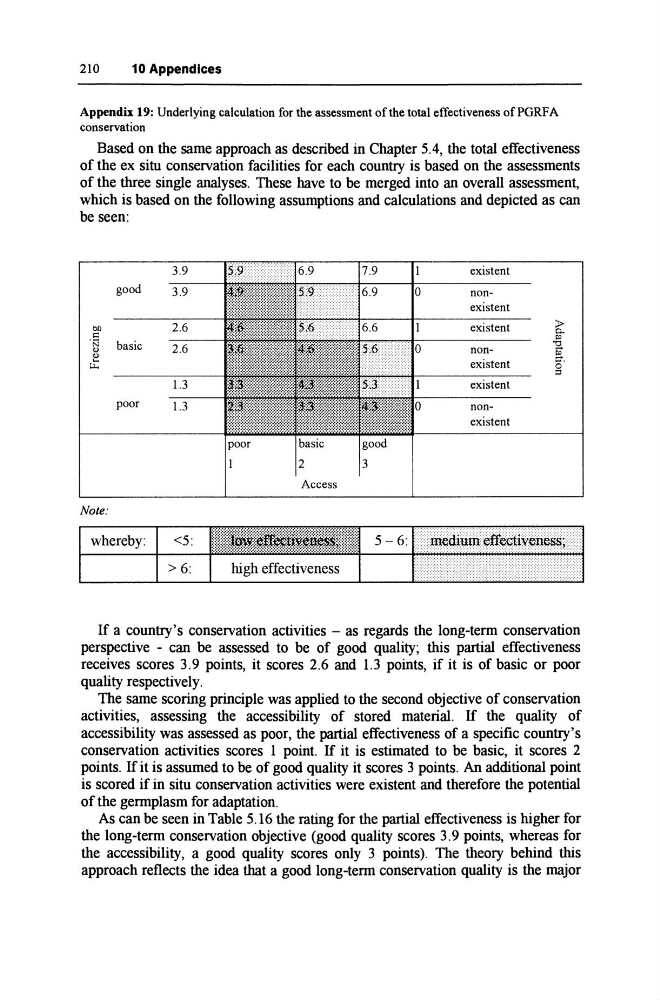
Based on the same approach as described in Chapter 5.4, the total effectiveness
of the ex situ conservation facilities for each country is based on the assessments
of the three single analyses. These have to be merged into an overall assessment,
which is based on the following assumptions and calculations and depicted as can
be seen:
good
0()
6:
c
' "
·N
basic
"t:l
"
g.
~
"' "'
0
:l
poor
Access
Note:
whereby:
<5:
>6:
If a country's conservation activities - as regards the long-term conservation
perspective - can be assessed to be of good quality; this partial effectiveness
receives scores 3.9 points, it scores 2.6 and 1.3 points, if it is of basic or poor
quality respectively.
The same scoring principle was applied to the second objective of conservation
activities, assessing the accessibility of stored material. If the quality of
accessibility was assessed as poor, the partial effectiveness of a specific country's
conservation activities scores 1 point. If it is estimated to be basic, it scores 2
points. If it is assumed to be of good quality it scores 3 points. An additional point
is scored if in situ conservation activities were existent and therefore the potential
of the germplasm for adaptation.
As can be seen in Table 5.16 the rating for the partial effectiveness is higher for
the long-term conservation objective (good quality scores 3.9 points, whereas for
the accessibility, a good quality scores only 3 points). The theory behind this
approach reflects the idea that a good long-term conservation quality is the major
10 Appendices
Appendix 19: Underlying calculation for the assessment of the total effectiveness of PGRF A
conservation
Based on the same approach as described in Chapter 5.4, the total effectiveness
of the ex situ conservation facilities for each country is based on the assessments
of the three single analyses. These have to be merged into an overall assessment,
which is based on the following assumptions and calculations and depicted as can
be seen:
good
0()
6:
c
' "
·N
basic
"t:l
"
g.
~
"' "'
0
:l
poor
Access
Note:
whereby:
<5:
>6:
If a country's conservation activities - as regards the long-term conservation
perspective - can be assessed to be of good quality; this partial effectiveness
receives scores 3.9 points, it scores 2.6 and 1.3 points, if it is of basic or poor
quality respectively.
The same scoring principle was applied to the second objective of conservation
activities, assessing the accessibility of stored material. If the quality of
accessibility was assessed as poor, the partial effectiveness of a specific country's
conservation activities scores 1 point. If it is estimated to be basic, it scores 2
points. If it is assumed to be of good quality it scores 3 points. An additional point
is scored if in situ conservation activities were existent and therefore the potential
of the germplasm for adaptation.
As can be seen in Table 5.16 the rating for the partial effectiveness is higher for
the long-term conservation objective (good quality scores 3.9 points, whereas for
the accessibility, a good quality scores only 3 points). The theory behind this
approach reflects the idea that a good long-term conservation quality is the major