

6.1 Indian Case Study
155
establishing storage facilities. NBPGR is also in touch with NGOs active in
PGRF A conservation, for instance the M.S. Swaminathan Research Foundation - a
nonprofit, political organization established in 1988. The foundation's work is
focused on environmentally sustainable and socially equitable development. The
foundation actively influences the Indian policy discussion in the area of PGRF A
conservation and has created a community genebank to store collected seeds
(Swaminathan, 1996d). The Honey Bee Network has the objectives to strengthen
the links between formal and informal knowledge systems. One major output is
the database on local innovations and traditional ecological and technological
knowledge. The organization is supported by the Society for Research and
Initiatives for Sustainable Technologies and Institutions as a NGO, and by the
Indian Institute of Management (lIMA) (Gupta, 1996).
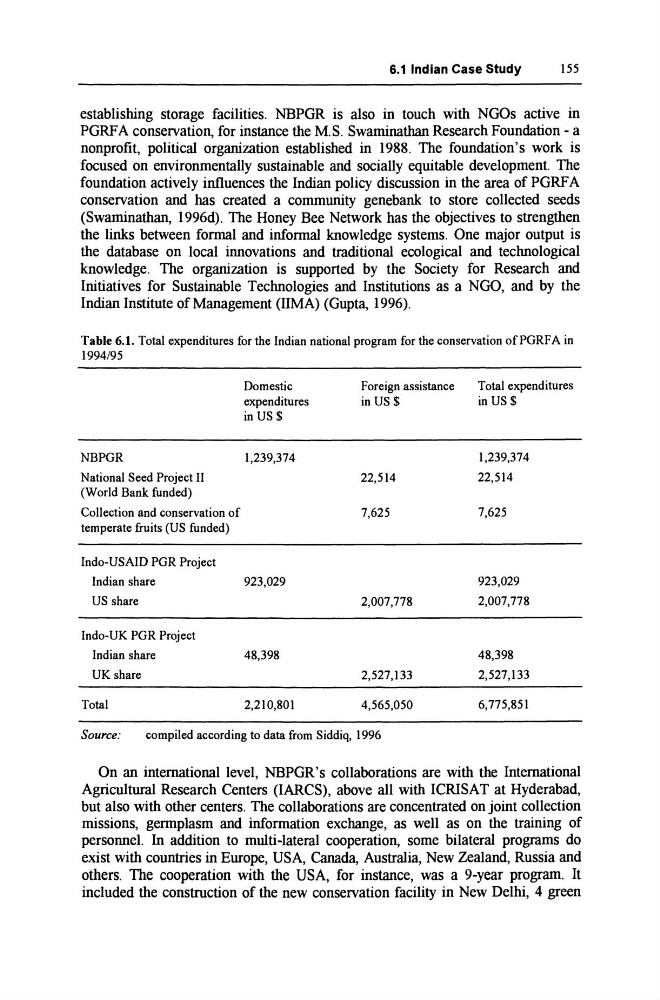
Table 6.1. Total expenditures for the Indian national program for the conservation ofPGRFA in
1994/95
Domestic
Foreign assistance
Total expenditures
expenditures
inUS$
in US$
inUS$
NBPGR
1,239,374
1,239,374
National Seed Project II
22,514
22,514
(World Bank funded)
Collection and conservation of
7,625
7,625
temperate fruits (US funded)
Indo-USAID PGR Project
Indian share
923,029
923,029
US share
2,007,778
2,007,778
Indo-UK PGR Project
Indian share
48,398
48,398
UK share
2,527,133
2,527,133
Total
2,210,801
4,565,050
6,775,851
Source:
compiled according to data from Siddiq, 1996
On an international level, NBPGR's collaborations are with the International
Agricultural Research Centers (IARCS), above all with ICRISAT at Hyderabad,
but also with other centers. The collaborations are concentrated on joint collection
missions, germplasm and information exchange, as well as on the training of
personnel. In addition to multi-lateral cooperation, some bilateral programs do
exist with countries in Europe, USA, Canada, Australia, New Zealand, Russia and
others. The cooperation with the USA, for instance, was a 9-year program. It
included the construction of the new conservation facility in New Delhi, 4 green
155
establishing storage facilities. NBPGR is also in touch with NGOs active in
PGRF A conservation, for instance the M.S. Swaminathan Research Foundation - a
nonprofit, political organization established in 1988. The foundation's work is
focused on environmentally sustainable and socially equitable development. The
foundation actively influences the Indian policy discussion in the area of PGRF A
conservation and has created a community genebank to store collected seeds
(Swaminathan, 1996d). The Honey Bee Network has the objectives to strengthen
the links between formal and informal knowledge systems. One major output is
the database on local innovations and traditional ecological and technological
knowledge. The organization is supported by the Society for Research and
Initiatives for Sustainable Technologies and Institutions as a NGO, and by the
Indian Institute of Management (lIMA) (Gupta, 1996).
Table 6.1. Total expenditures for the Indian national program for the conservation ofPGRFA in
1994/95
Domestic
Foreign assistance
Total expenditures
expenditures
inUS$
in US$
inUS$
NBPGR
1,239,374
1,239,374
National Seed Project II
22,514
22,514
(World Bank funded)
Collection and conservation of
7,625
7,625
temperate fruits (US funded)
Indo-USAID PGR Project
Indian share
923,029
923,029
US share
2,007,778
2,007,778
Indo-UK PGR Project
Indian share
48,398
48,398
UK share
2,527,133
2,527,133
Total
2,210,801
4,565,050
6,775,851
Source:
compiled according to data from Siddiq, 1996
On an international level, NBPGR's collaborations are with the International
Agricultural Research Centers (IARCS), above all with ICRISAT at Hyderabad,
but also with other centers. The collaborations are concentrated on joint collection
missions, germplasm and information exchange, as well as on the training of
personnel. In addition to multi-lateral cooperation, some bilateral programs do
exist with countries in Europe, USA, Canada, Australia, New Zealand, Russia and
others. The cooperation with the USA, for instance, was a 9-year program. It
included the construction of the new conservation facility in New Delhi, 4 green