

6.1 Indian Case Study
153
Plant Protection Directorate, Government of India. From the start, emphasis was
laid on the collection and conservation of crop plants from within the country as
well as the improvement of existing and utilized crops (Paroda, 1986).
Conservation is seen as means for immediate or near-distant utilization of genetic
resources in breeding; therefore, the need for an effective evaluation has been
identified (Arunachalam, 1986).
The main components of INPGRS are the PGRF A storage facilities, namely the
national genebank, the national facility for plant tissue culture (NFPTCR), and the
national seed museum and herbarium of cultivated plants and their wild relatives.
The genebank and the tissue culture facility hold base collections together
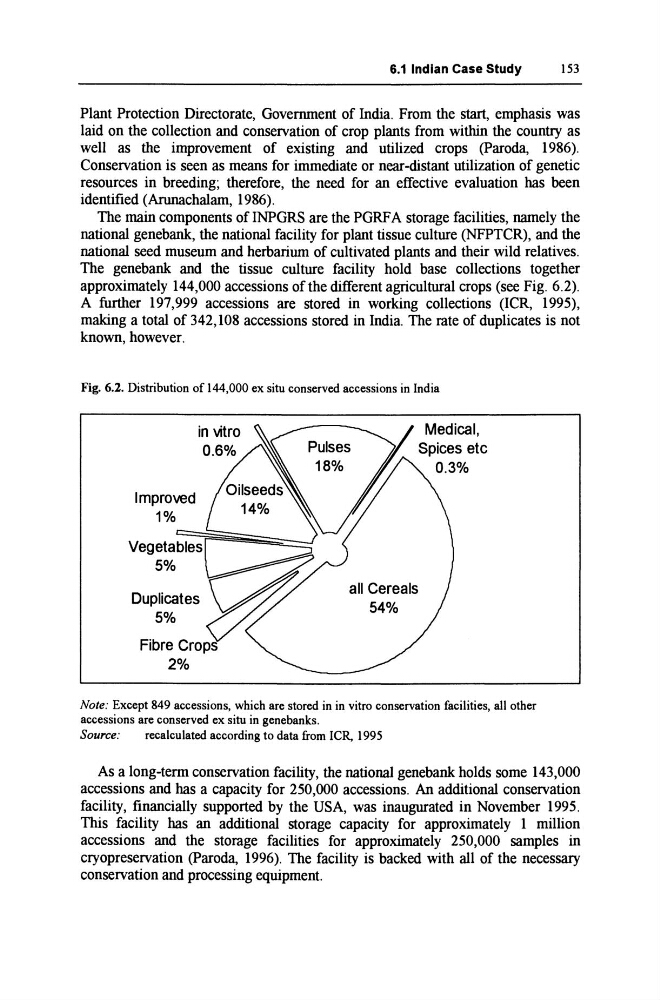
approximately 144,000 accessions of the different agricultural crops (see Fig. 6.2).
A further 197,999 accessions are stored in working collections (ICR, 1995),
making a total of 342,108 accessions stored in India. The rate of duplicates is not
known, however.
Fig. 6.2. Distribution of 144,000 ex situ conserved accessions in India
in vitro
0.6%
all Cereals
54%
Note: Except 849 accessions, which are stored in in vitro conservation facilities, all other
accessions are conserved ex situ in genebanks.
Source:
recalculated according to data from ICR, 1995
As a long-term conservation facility, the national genebank holds some 143,000
accessions and has a capacity for 250,000 accessions. An additional conservation
facility, financially supported by the USA, was inaugurated in November 1995.
This facility has an additional storage capacity for approximately 1 million
accessions and the storage facilities for approximately 250,000 samples in
cryopreservation (paroda, 1996). The facility is backed with all of the necessary
conservation and processing equipment.
153
Plant Protection Directorate, Government of India. From the start, emphasis was
laid on the collection and conservation of crop plants from within the country as
well as the improvement of existing and utilized crops (Paroda, 1986).
Conservation is seen as means for immediate or near-distant utilization of genetic
resources in breeding; therefore, the need for an effective evaluation has been
identified (Arunachalam, 1986).
The main components of INPGRS are the PGRF A storage facilities, namely the
national genebank, the national facility for plant tissue culture (NFPTCR), and the
national seed museum and herbarium of cultivated plants and their wild relatives.
The genebank and the tissue culture facility hold base collections together
approximately 144,000 accessions of the different agricultural crops (see Fig. 6.2).
A further 197,999 accessions are stored in working collections (ICR, 1995),
making a total of 342,108 accessions stored in India. The rate of duplicates is not
known, however.
Fig. 6.2. Distribution of 144,000 ex situ conserved accessions in India
in vitro
0.6%
all Cereals
54%
Note: Except 849 accessions, which are stored in in vitro conservation facilities, all other
accessions are conserved ex situ in genebanks.
Source:
recalculated according to data from ICR, 1995
As a long-term conservation facility, the national genebank holds some 143,000
accessions and has a capacity for 250,000 accessions. An additional conservation
facility, financially supported by the USA, was inaugurated in November 1995.
This facility has an additional storage capacity for approximately 1 million
accessions and the storage facilities for approximately 250,000 samples in
cryopreservation (paroda, 1996). The facility is backed with all of the necessary
conservation and processing equipment.