

152
6 Two Country Examples of PGRFA Conservation Systems
diversity can still be found in rice, with estimated 16,000 landraces in fanners'
fields (lCR, 1995).
6.1.1
Indian National Plant Genetic Resources System
The focal point of PGRF A conservation and management in India is the Indian
National Plant Genetic Resources System (lNPGRS), operated by the National
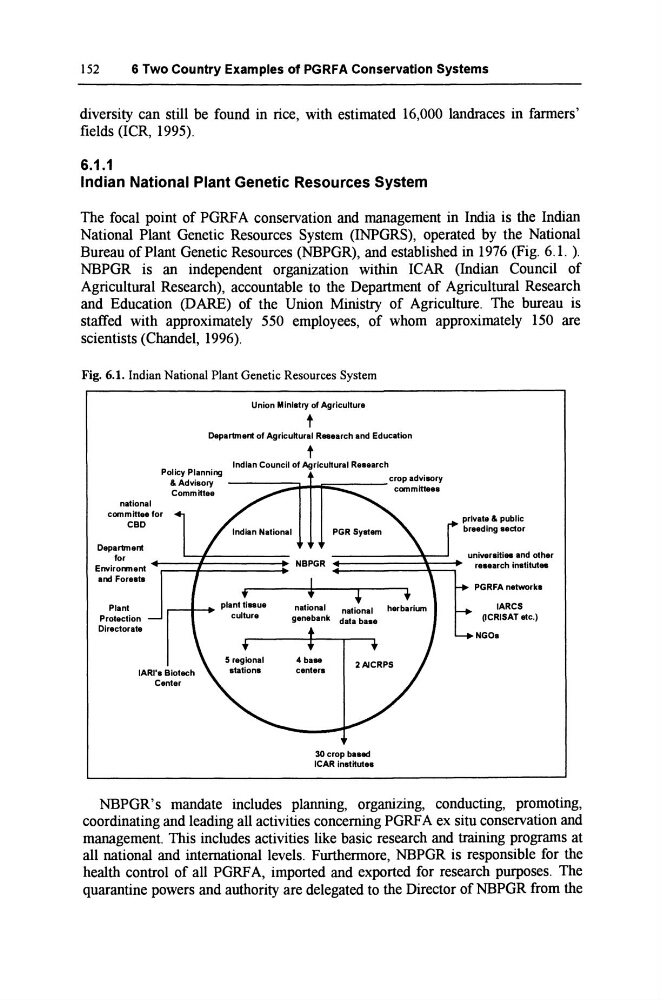
Bureau of Plant Genetic Resources (NBPGR), and established in 1976 (Fig. 6.1. ).
NBPGR is an independent organization within ICAR (Indian Council of
Agricultural Research), accountable to the Department of Agricultural Research
and Education (DARE) of the Union Ministry of Agriculture. The bureau is
staffed with approximately 550 employees, of whom approximately 150 are
scientists (Chandel, 1996).
Fig. 6.1. Indian National Plant Genetic Resources System
Union Ministry of Agriculture
t
Department of Agricultural Research and Education
t
Indian Council of Agricultural Research
Policy Planning
~:!;:~ ------:;~4-~~~---c~~~~:;
national
committe. for
CBO
PGR System
Oeparlment
for
"'"'-;:=~t-=====:
1:====~~~":i universities and other
Envirorment .....
NBPGR ~
r •• earch institutes
and Fore.ta
Plant
Protection
Directorate
•
.---+-_ Pla;~I!~eue
IARI'. Biotech
Center
+
national
national
ganG bank data baae
30 crop ba.ed
ICAR instHute.
..
PGRFA network •
IARCS
~CRISAT etc.)
NGO.
NBPGR's mandate includes planning, orgaruzmg, conducting, promoting,
coordinating and leading all activities concerning PGRF A ex situ conservation and
management. This includes activities like basic research and training programs at
all national and international levels. Furthermore, NBPGR is responsible for the
health control of all PGRF A, imported and exported for research purposes. The
quarantine powers and authority are delegated to the Director of NBPGR from the
6 Two Country Examples of PGRFA Conservation Systems
diversity can still be found in rice, with estimated 16,000 landraces in fanners'
fields (lCR, 1995).
6.1.1
Indian National Plant Genetic Resources System
The focal point of PGRF A conservation and management in India is the Indian
National Plant Genetic Resources System (lNPGRS), operated by the National
Bureau of Plant Genetic Resources (NBPGR), and established in 1976 (Fig. 6.1. ).
NBPGR is an independent organization within ICAR (Indian Council of
Agricultural Research), accountable to the Department of Agricultural Research
and Education (DARE) of the Union Ministry of Agriculture. The bureau is
staffed with approximately 550 employees, of whom approximately 150 are
scientists (Chandel, 1996).
Fig. 6.1. Indian National Plant Genetic Resources System
Union Ministry of Agriculture
t
Department of Agricultural Research and Education
t
Indian Council of Agricultural Research
Policy Planning
~:!;:~ ------:;~4-~~~---c~~~~:;
national
committe. for
CBO
PGR System
Oeparlment
for
"'"'-;:=~t-=====:
1:====~~~":i universities and other
Envirorment .....
NBPGR ~
r •• earch institutes
and Fore.ta
Plant
Protection
Directorate
•
.---+-_ Pla;~I!~eue
IARI'. Biotech
Center
+
national
national
ganG bank data baae
30 crop ba.ed
ICAR instHute.
..
PGRFA network •
IARCS
~CRISAT etc.)
NGO.
NBPGR's mandate includes planning, orgaruzmg, conducting, promoting,
coordinating and leading all activities concerning PGRF A ex situ conservation and
management. This includes activities like basic research and training programs at
all national and international levels. Furthermore, NBPGR is responsible for the
health control of all PGRF A, imported and exported for research purposes. The
quarantine powers and authority are delegated to the Director of NBPGR from the