

132
5 Conservation Costs of PGRFA
Table 5.13. International expenditures for the conservation ofPGRFA
Origin of expenditures
Technical Assistance
Funds a
Sub Total
lARS
Total:
Expenditures
according to received
information
in US $ '000 000
7
7
14
50
64
Expenditures according Share of
to received information
expenditures to
and some estimations
total
in US $ '000 000
7
26
33
50
83
8%
32%
60%
a: IFAD's and the World Bank's contributions were estimated
Source:
Virchow, 1996a
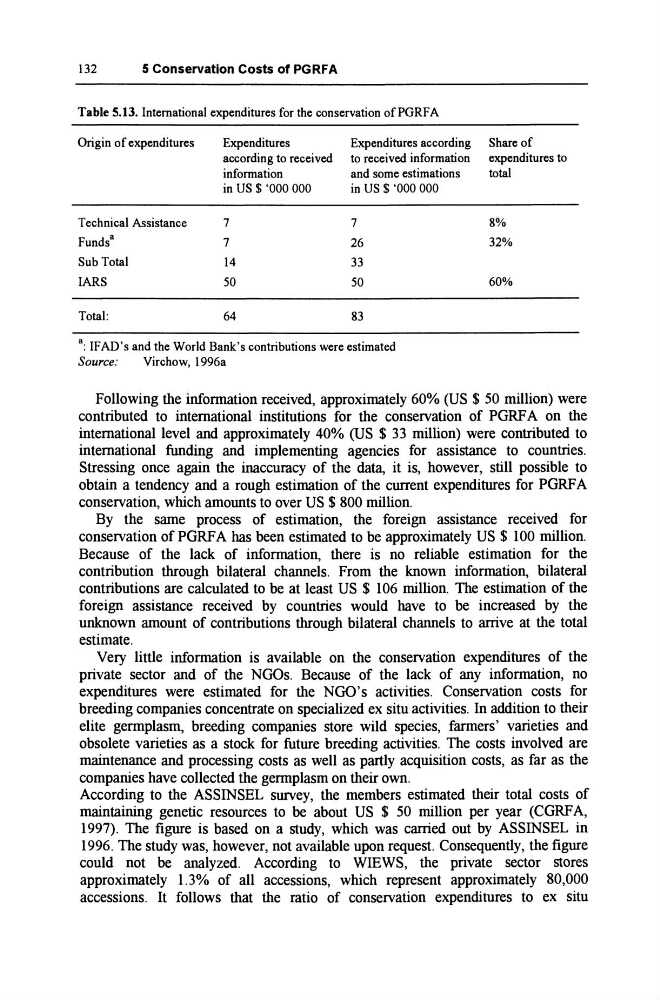
Following the infonnation received, approximately 60% (US $ 50 million) were
contributed to international institutions for the conservation of PGRF A on the
international level and approximately 40% (US $ 33 million) were contributed to
international funding and implementing agencies for assistance to countries.
Stressing once again the inaccuracy of the data, it is, however, still possible to
obtain a tendency and a rough estimation of the current expenditures for PGRF A
conservation, which amounts to over US $ 800 million.
By the same process of estimation, the foreign assistance received for
conservation of PGRF A has been estimated to be approximately US $ 100 million.
Because of the lack of infonnation, there is no reliable estimation for the
contribution through bilateral channels. From the known infonnation, bilateral
contributions are calculated to be at least US $ 106 million. The estimation of the
foreign assistance received by countries would have to be increased by the
unknown amount of contributions through bilateral channels to arrive at the total
estimate.
Very little infonnation is available on the conservation expenditures of the
private sector and of the NGOs. Because of the lack of any infonnation, no
expenditures were estimated for the NGO's activities. Conservation costs for
breeding companies concentrate on specialized ex situ activities. In addition to their
elite germplasm, breeding companies store wild species, farmers' varieties and
obsolete varieties as a stock for future breeding activities. The costs involved are
maintenance and processing costs as well as partly acquisition costs, as far as the
companies have collected the germplasm on their own.
According to the ASSINSEL survey, the members estimated their total costs of
maintaining genetic resources to be about US $ 50 million per year (CGRF A,
1997). The figure is based on a study, which was carried out by AS SINSEL in
1996. The study was, however, not available upon request. Consequently, the figure
could not be analyzed. According to WIEWS, the private sector stores
approximately 1.3% of all accessions, which represent approximately 80,000
accessions. It follows that the ratio of conservation expenditures to ex situ
5 Conservation Costs of PGRFA
Table 5.13. International expenditures for the conservation ofPGRFA
Origin of expenditures
Technical Assistance
Funds a
Sub Total
lARS
Total:
Expenditures
according to received
information
in US $ '000 000
7
7
14
50
64
Expenditures according Share of
to received information
expenditures to
and some estimations
total
in US $ '000 000
7
26
33
50
83
8%
32%
60%
a: IFAD's and the World Bank's contributions were estimated
Source:
Virchow, 1996a
Following the infonnation received, approximately 60% (US $ 50 million) were
contributed to international institutions for the conservation of PGRF A on the
international level and approximately 40% (US $ 33 million) were contributed to
international funding and implementing agencies for assistance to countries.
Stressing once again the inaccuracy of the data, it is, however, still possible to
obtain a tendency and a rough estimation of the current expenditures for PGRF A
conservation, which amounts to over US $ 800 million.
By the same process of estimation, the foreign assistance received for
conservation of PGRF A has been estimated to be approximately US $ 100 million.
Because of the lack of infonnation, there is no reliable estimation for the
contribution through bilateral channels. From the known infonnation, bilateral
contributions are calculated to be at least US $ 106 million. The estimation of the
foreign assistance received by countries would have to be increased by the
unknown amount of contributions through bilateral channels to arrive at the total
estimate.
Very little infonnation is available on the conservation expenditures of the
private sector and of the NGOs. Because of the lack of any infonnation, no
expenditures were estimated for the NGO's activities. Conservation costs for
breeding companies concentrate on specialized ex situ activities. In addition to their
elite germplasm, breeding companies store wild species, farmers' varieties and
obsolete varieties as a stock for future breeding activities. The costs involved are
maintenance and processing costs as well as partly acquisition costs, as far as the
companies have collected the germplasm on their own.
According to the ASSINSEL survey, the members estimated their total costs of
maintaining genetic resources to be about US $ 50 million per year (CGRF A,
1997). The figure is based on a study, which was carried out by AS SINSEL in
1996. The study was, however, not available upon request. Consequently, the figure
could not be analyzed. According to WIEWS, the private sector stores
approximately 1.3% of all accessions, which represent approximately 80,000
accessions. It follows that the ratio of conservation expenditures to ex situ