

120
5 Conservation Costs of PGRFA
Additionally, a country like Egypt may be seen as an example for those genetic
resource-poor countries, which still has a large agricultural sector. Agriculture in
these countries has to be undertaken under harsh conditions however.
Consequently, the need for the sustainable supply of crucial inputs must be taken
care of.
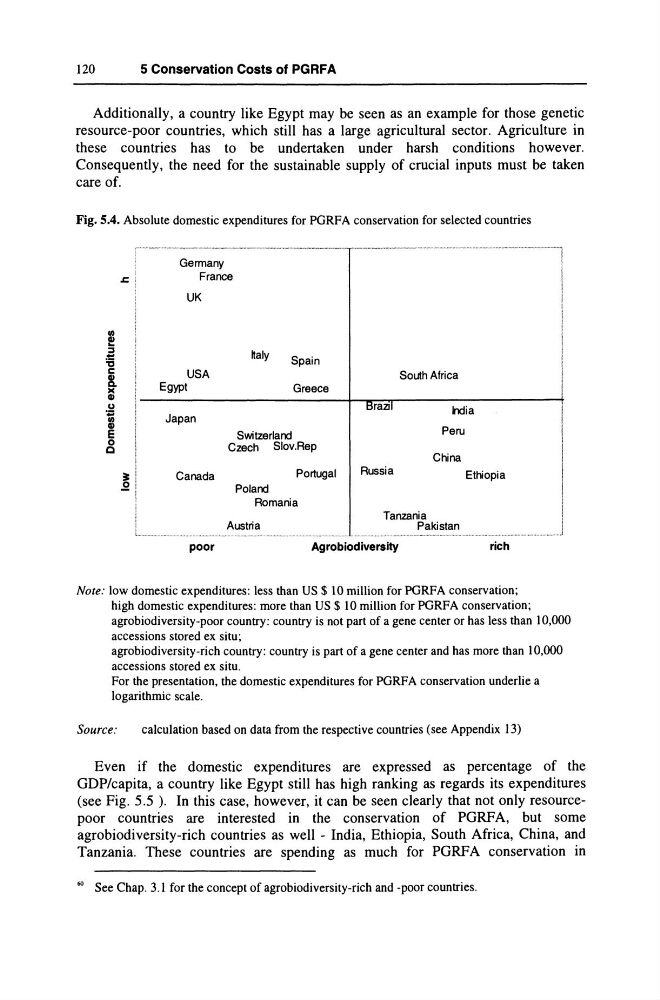
Fig. 5.4. Absolute domestic expenditures for PGRFA conservation for selected countries
Germany
France
UK
ftaly
Spain
USA
South Africa
Egypt
Greece
Brazil
h:lia
Japan
Switzerland
Peru
Czech Slov.Rep
China
Canada
Portugal
Russia
Ethiopia
Poland
Romania
Tanzania
Austria
Pakistan
poor
Agrobiodiversity
rich
Note: low domestic expenditures: less than US $ 10 million for PGRFA conservation;
high domestic expenditures: more than US $ 10 million for PGRFA conservation;
agrobiodiversity-poor country: country is not part of a gene center or has less than 10,000
accessions stored ex situ;
agrobiodiversity-rich country: country is part of a gene center and has more than 10,000
accessions stored ex situ.
For the presentation, the domestic expenditures for PGRFA conservation underlie a
logarithmic scale.
Source:
calculation based on data from the respective countries (see Appendix 13)
Even if the domestic expenditures are expressed as percentage of the
GOP/capita, a country like Egypt still has high ranking as regards its expenditures
(see Fig. 5.5). In this case, however, it can be seen clearly that not only resourcepoor countries are interested in the conservation of PGRFA, but some
agrobiodiversity-rich countries as well - India, Ethiopia, South Africa, China, and
Tanzania. These countries are spending as much for PGRFA conservation in
.. See Chap. 3.1 for the concept of agrobiodiversity-rich and -poor countries.
5 Conservation Costs of PGRFA
Additionally, a country like Egypt may be seen as an example for those genetic
resource-poor countries, which still has a large agricultural sector. Agriculture in
these countries has to be undertaken under harsh conditions however.
Consequently, the need for the sustainable supply of crucial inputs must be taken
care of.
Fig. 5.4. Absolute domestic expenditures for PGRFA conservation for selected countries
Germany
France
UK
ftaly
Spain
USA
South Africa
Egypt
Greece
Brazil
h:lia
Japan
Switzerland
Peru
Czech Slov.Rep
China
Canada
Portugal
Russia
Ethiopia
Poland
Romania
Tanzania
Austria
Pakistan
poor
Agrobiodiversity
rich
Note: low domestic expenditures: less than US $ 10 million for PGRFA conservation;
high domestic expenditures: more than US $ 10 million for PGRFA conservation;
agrobiodiversity-poor country: country is not part of a gene center or has less than 10,000
accessions stored ex situ;
agrobiodiversity-rich country: country is part of a gene center and has more than 10,000
accessions stored ex situ.
For the presentation, the domestic expenditures for PGRFA conservation underlie a
logarithmic scale.
Source:
calculation based on data from the respective countries (see Appendix 13)
Even if the domestic expenditures are expressed as percentage of the
GOP/capita, a country like Egypt still has high ranking as regards its expenditures
(see Fig. 5.5). In this case, however, it can be seen clearly that not only resourcepoor countries are interested in the conservation of PGRFA, but some
agrobiodiversity-rich countries as well - India, Ethiopia, South Africa, China, and
Tanzania. These countries are spending as much for PGRFA conservation in
.. See Chap. 3.1 for the concept of agrobiodiversity-rich and -poor countries.