

5.1 Analysis of the Costs for PGRFA Conservation
107
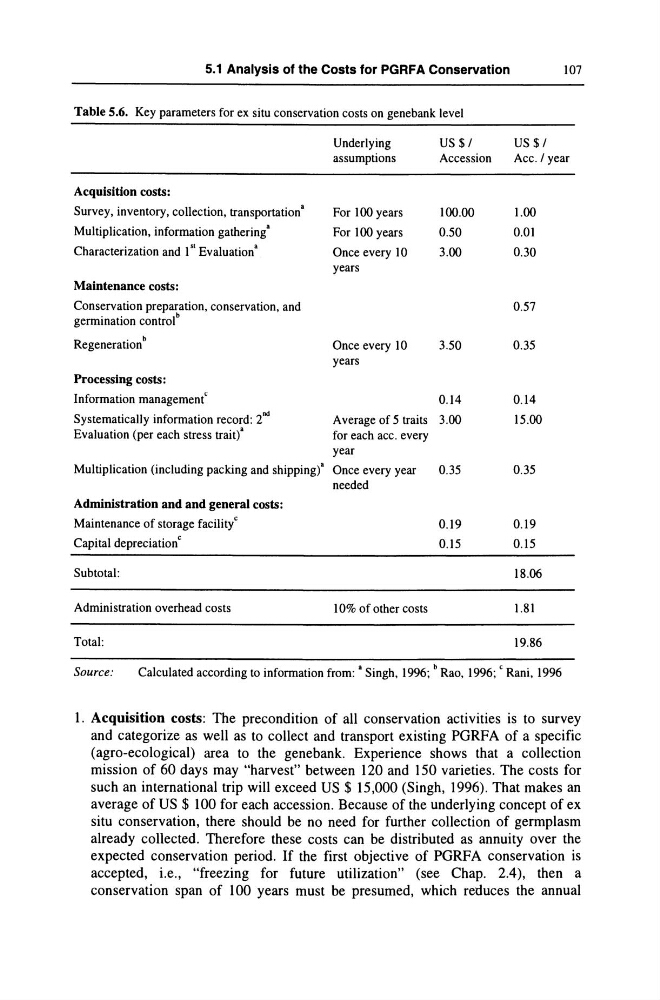
Table 5.6. Key parameters for ex situ conservation costs on genebank level
Acquisition costs:
Survey, inventory, collection, transportation"
Multiplication, information gathering"
Characterization and I" Evaluation"
Maintenance costs:
Conservation preparation, conservation, and
germination control
b
Regeneration b
Processing costs:
Information management'
Systematically information record: 2' 1<1
Evaluation (per each stress trait)"
Underlying
assumptions
For 100 years
For 100 years
Once every 10
years
Once every 10
years
US $!
Accession
100.00
0.50
3.00
3.50
0.14
Average of 5 traits 3.00
for each acc. every
year
Multiplication (including packing and shipping)" Once every year
needed
0.35
Administration and and general costs:
Maintenance of storage facilityC
Capital depreciation'
Subtotal:
Administration overhead costs
Total:
10% of other costs
0.19
0.15
US $!
Acc.! year
1.00
0.01
0.30
0.57
0.35
0.14
15.00
0.35
0.19
0.15
18.06
1.81
19.86
Source:
Calculated according to information from: " Singh, 1996; b Rao, 1996; c Rani, 1996
1. Acquisition costs: The precondition of all conservation activities is to survey
and categorize as well as to collect and transport existing PGRFA of a specific
(agro-ecological) area to the genebank. Experience shows that a collection
mission of 60 days may "harvest" between 120 and 150 varieties. The costs for
such an international trip will exceed US $ 15,000 (Singh, 1996). That makes an
average of US $ 100 for each accession. Because of the underlying concept of ex
situ conservation, there should be no need for further collection of germplasm
already collected. Therefore these costs can be distributed as annuity over the
expected conservation period. If the first objective of PGRFA conservation is
accepted, i.e., "freezing for future utilization" (see Chap. 2.4), then a
conservation span of 100 years must be presumed, which reduces the annual
107
Table 5.6. Key parameters for ex situ conservation costs on genebank level
Acquisition costs:
Survey, inventory, collection, transportation"
Multiplication, information gathering"
Characterization and I" Evaluation"
Maintenance costs:
Conservation preparation, conservation, and
germination control
b
Regeneration b
Processing costs:
Information management'
Systematically information record: 2' 1<1
Evaluation (per each stress trait)"
Underlying
assumptions
For 100 years
For 100 years
Once every 10
years
Once every 10
years
US $!
Accession
100.00
0.50
3.00
3.50
0.14
Average of 5 traits 3.00
for each acc. every
year
Multiplication (including packing and shipping)" Once every year
needed
0.35
Administration and and general costs:
Maintenance of storage facilityC
Capital depreciation'
Subtotal:
Administration overhead costs
Total:
10% of other costs
0.19
0.15
US $!
Acc.! year
1.00
0.01
0.30
0.57
0.35
0.14
15.00
0.35
0.19
0.15
18.06
1.81
19.86
Source:
Calculated according to information from: " Singh, 1996; b Rao, 1996; c Rani, 1996
1. Acquisition costs: The precondition of all conservation activities is to survey
and categorize as well as to collect and transport existing PGRFA of a specific
(agro-ecological) area to the genebank. Experience shows that a collection
mission of 60 days may "harvest" between 120 and 150 varieties. The costs for
such an international trip will exceed US $ 15,000 (Singh, 1996). That makes an
average of US $ 100 for each accession. Because of the underlying concept of ex
situ conservation, there should be no need for further collection of germplasm
already collected. Therefore these costs can be distributed as annuity over the
expected conservation period. If the first objective of PGRFA conservation is
accepted, i.e., "freezing for future utilization" (see Chap. 2.4), then a
conservation span of 100 years must be presumed, which reduces the annual