

106
5 Conservation Costs of PGRFA
industrialized countries - such as the DECD group - and the developing countries.
Even though the DECD countries hold a large share of the world's total ex situ
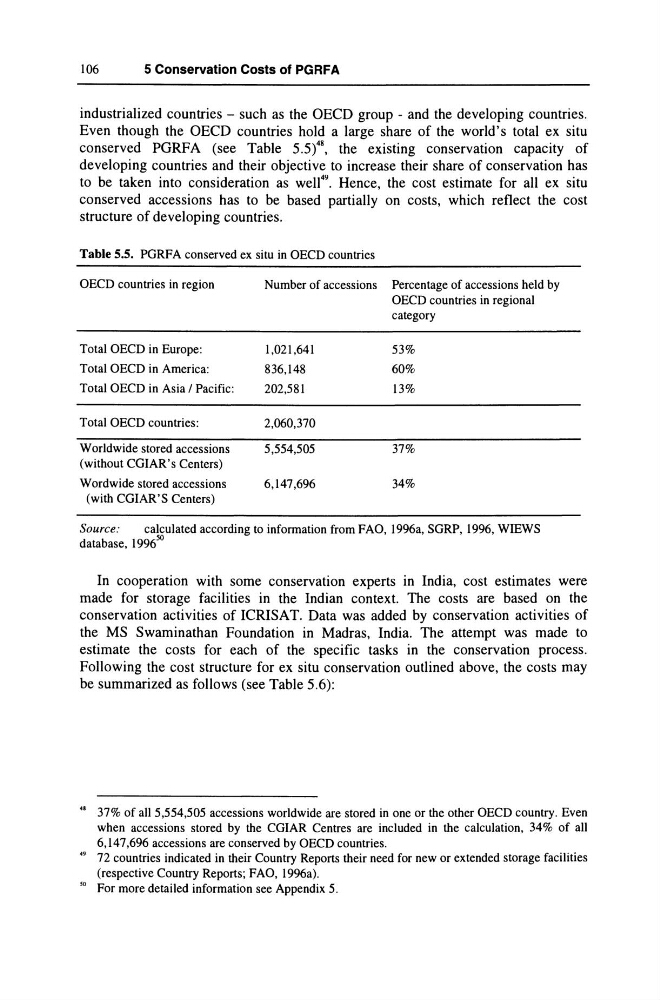
conserved PGRFA (see Table 5.5)411, the existing conservation capacity of
developing countries and their objective to increase their share of conservation has
to be taken into consideration as we1l 49 • Hence, the cost estimate for all ex situ
conserved accessions has to be based partially on costs, which reflect the cost
structure of developing countries.
Table 5.5. PGRFA conserved ex situ in OECD countries
OECD countries in region
Total OECD in Europe:
Total OECD in America:
Total OECD in Asia I Pacific:
Total OECD countries:
Worldwide stored accessions
(without CGIAR's Centers)
Wordwide stored accessions
(with CGIAR'S Centers)
Number of accessions Percentage of accessions held by
OECD countries in regional
category
1,021,641
53%
836,148
60%
202,581
13%
2,060,370
5,554,505
37%
6,147,696
34%
Source:
ca~~ulated according to information from FAO, 1996a, SGRP, 1996, WIEWS
database, 1996
In cooperation with some conservation experts in India, cost estimates were
made for storage facilities in the Indian context. The costs are based on the
conservation activities of ICRISAT. Data was added by conservation activities of
the MS Swaminathan Foundation in Madras, India. The attempt was made to
estimate the costs for each of the specific tasks in the conservation process.
Following the cost structure for ex situ conservation outlined above, the costs may
be summarized as follows (see Table 5.6):
.. 37% of all 5,554,505 accessions worldwide are stored in one or the other OECD country. Even
when accessions stored by the CGIAR Centres are included in the calculation, 34% of all
6,147,696 accessions are conserved by OECD countries.
.. 72 countries indicated in their Country Reports their need for new or extended storage facilities
(respective Country Reports; FAO, 1996a).
S.
For more detailed information see Appendix 5.
5 Conservation Costs of PGRFA
industrialized countries - such as the DECD group - and the developing countries.
Even though the DECD countries hold a large share of the world's total ex situ
conserved PGRFA (see Table 5.5)411, the existing conservation capacity of
developing countries and their objective to increase their share of conservation has
to be taken into consideration as we1l 49 • Hence, the cost estimate for all ex situ
conserved accessions has to be based partially on costs, which reflect the cost
structure of developing countries.
Table 5.5. PGRFA conserved ex situ in OECD countries
OECD countries in region
Total OECD in Europe:
Total OECD in America:
Total OECD in Asia I Pacific:
Total OECD countries:
Worldwide stored accessions
(without CGIAR's Centers)
Wordwide stored accessions
(with CGIAR'S Centers)
Number of accessions Percentage of accessions held by
OECD countries in regional
category
1,021,641
53%
836,148
60%
202,581
13%
2,060,370
5,554,505
37%
6,147,696
34%
Source:
ca~~ulated according to information from FAO, 1996a, SGRP, 1996, WIEWS
database, 1996
In cooperation with some conservation experts in India, cost estimates were
made for storage facilities in the Indian context. The costs are based on the
conservation activities of ICRISAT. Data was added by conservation activities of
the MS Swaminathan Foundation in Madras, India. The attempt was made to
estimate the costs for each of the specific tasks in the conservation process.
Following the cost structure for ex situ conservation outlined above, the costs may
be summarized as follows (see Table 5.6):
.. 37% of all 5,554,505 accessions worldwide are stored in one or the other OECD country. Even
when accessions stored by the CGIAR Centres are included in the calculation, 34% of all
6,147,696 accessions are conserved by OECD countries.
.. 72 countries indicated in their Country Reports their need for new or extended storage facilities
(respective Country Reports; FAO, 1996a).
S.
For more detailed information see Appendix 5.