

104
5 Conservation Costs of PGRFA
Furthermore, average total costs per accession seem the more adequate approach in
calculating national and international ex situ and in situ conservation costs and
aiming to obtain orders of magnitude of the current annual efforts.
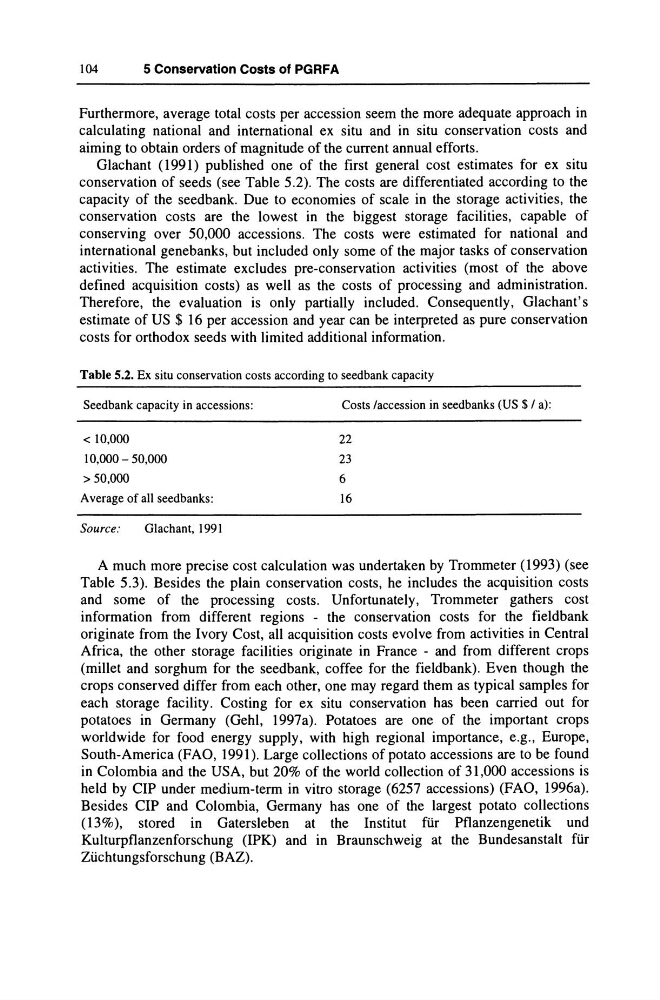
Glachant (1991) published one of the first general cost estimates for ex situ
conservation of seeds (see Table 5.2). The costs are differentiated according to the
capacity of the seedbank. Due to economies of scale in the storage activities, the
conservation costs are the lowest in the biggest storage facilities, capable of
conserving over 50,000 accessions. The costs were estimated for national and
international genebanks, but included only some of the major tasks of conservation
activities. The estimate excludes pre-conservation activities (most of the above
defined acquisition costs) as well as the costs of processing and administration.
Therefore, the evaluation is only partially included. Consequently, Glachant's
estimate of US $ 16 per accession and year can be interpreted as pure conservation
costs for orthodox seeds with limited additional information.
Table 5.2. Ex situ conservation costs according to seedbank capacity
Seedbank capacity in accessions:
< 10,000
10,000 - 50,000
> 50,000
Average of all seedbanks:
Source:
Glachant, 1991
Costs laccession in seedbanks (US $ I a):
22
23
6
16
A much more precise cost calculation was undertaken by Trommeter (1993) (see
Table 5.3). Besides the plain conservation costs, he includes the acquisition costs
and some of the processing costs. Unfortunately, Trommeter gathers cost
information from different regions - the conservation costs for the fieldbank
originate from the Ivory Cost, all acquisition costs evolve from activities in Central
Africa, the other storage facilities originate in France - and from different crops
(millet and sorghum for the seedbank, coffee for the fieldbank). Even though the
crops conserved differ from each other, one may regard them as typical samples for
each storage facility. Costing for ex situ conservation has been carried out for
potatoes in Germany (Gehl, 1997a). Potatoes are one of the important crops
worldwide for food energy supply, with high regional importance, e.g., Europe,
South-America (FAD, 1991). Large collections of potato accessions are to be found
in Colombia and the USA, but 20% of the world collection of 31,000 accessions is
held by CIP under medium-term in vitro storage (6257 accessions) (FAD, 1996a).
Besides CIP and Colombia, Germany has one of the largest potato collections
(13%), stored in Gatersleben at the Institut fur Pflanzengenetik und
Kulturpflanzenforschung (IPK) and in Braunschweig at the Bundesanstalt fUr
Zuchtungsforschung (BAZ).
5 Conservation Costs of PGRFA
Furthermore, average total costs per accession seem the more adequate approach in
calculating national and international ex situ and in situ conservation costs and
aiming to obtain orders of magnitude of the current annual efforts.
Glachant (1991) published one of the first general cost estimates for ex situ
conservation of seeds (see Table 5.2). The costs are differentiated according to the
capacity of the seedbank. Due to economies of scale in the storage activities, the
conservation costs are the lowest in the biggest storage facilities, capable of
conserving over 50,000 accessions. The costs were estimated for national and
international genebanks, but included only some of the major tasks of conservation
activities. The estimate excludes pre-conservation activities (most of the above
defined acquisition costs) as well as the costs of processing and administration.
Therefore, the evaluation is only partially included. Consequently, Glachant's
estimate of US $ 16 per accession and year can be interpreted as pure conservation
costs for orthodox seeds with limited additional information.
Table 5.2. Ex situ conservation costs according to seedbank capacity
Seedbank capacity in accessions:
< 10,000
10,000 - 50,000
> 50,000
Average of all seedbanks:
Source:
Glachant, 1991
Costs laccession in seedbanks (US $ I a):
22
23
6
16
A much more precise cost calculation was undertaken by Trommeter (1993) (see
Table 5.3). Besides the plain conservation costs, he includes the acquisition costs
and some of the processing costs. Unfortunately, Trommeter gathers cost
information from different regions - the conservation costs for the fieldbank
originate from the Ivory Cost, all acquisition costs evolve from activities in Central
Africa, the other storage facilities originate in France - and from different crops
(millet and sorghum for the seedbank, coffee for the fieldbank). Even though the
crops conserved differ from each other, one may regard them as typical samples for
each storage facility. Costing for ex situ conservation has been carried out for
potatoes in Germany (Gehl, 1997a). Potatoes are one of the important crops
worldwide for food energy supply, with high regional importance, e.g., Europe,
South-America (FAD, 1991). Large collections of potato accessions are to be found
in Colombia and the USA, but 20% of the world collection of 31,000 accessions is
held by CIP under medium-term in vitro storage (6257 accessions) (FAD, 1996a).
Besides CIP and Colombia, Germany has one of the largest potato collections
(13%), stored in Gatersleben at the Institut fur Pflanzengenetik und
Kulturpflanzenforschung (IPK) and in Braunschweig at the Bundesanstalt fUr
Zuchtungsforschung (BAZ).