

Expression Analysis of Te1omerase-Genes hTERT and hTR by Quantitative peR on LightCycler n
copies is given by the manufacturer. Additional positive controls for hTERT or
hTR, respectively, and PBGD are included.
As the procedure for each reaction is very similar and the reactions are optimized for the same conditions, the procedures for the hTERT and hTR kit are
described together.
Depending on the gene to be quantified, two master mixes are needed: one for
hTERT or hTR and one for PBGD. The setup for each run on the LightCycler
instrument is as follows:
• Five capillaries for standards (hTR or hTERT, respectively)
• Four capillaries for hTR or hTERT ~nd PBGD positive and negative controls
• Twice the number of samples (n), for hTR or hTERT and PBGD
• hTR: for detecting DNA contamination, prepare a third master mix without RT Notes
(-RT) for each sample. Three capillaries for each sample are then required.
• hTERT and hTR are the most interesting known telomerase genes, and one can
use these kits to quantify both genes on one LightCycler run. This will save
time and material, as the quantification of the housekeeping gene and the dilution of the sample is performed only once.
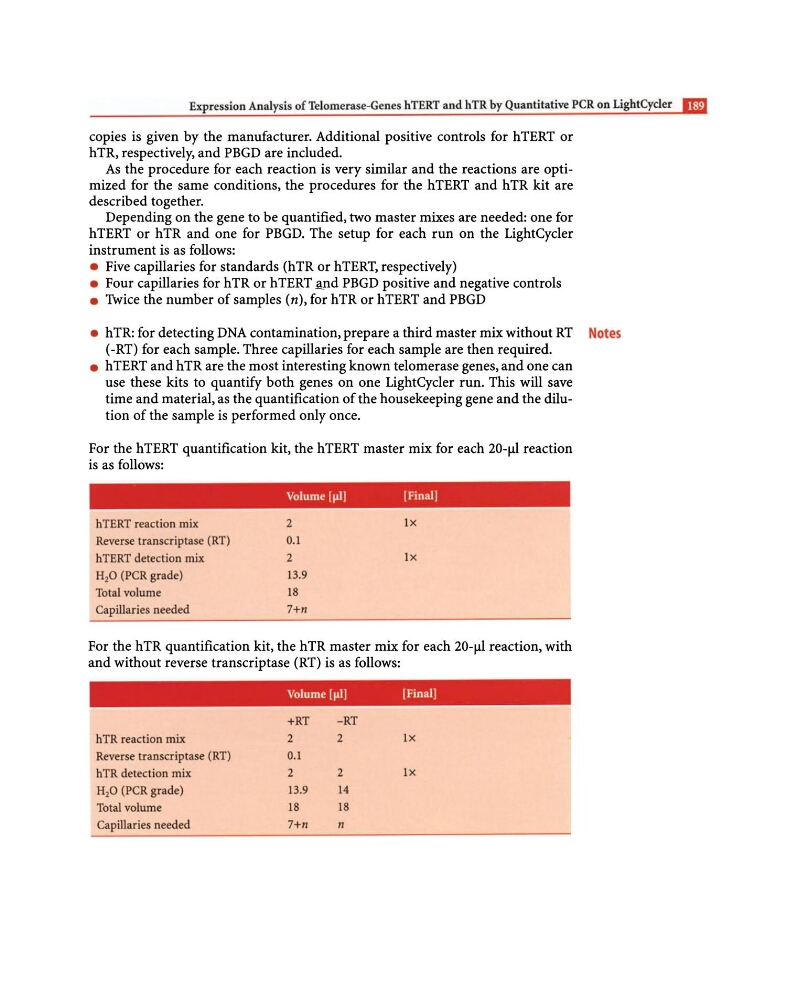
For the hTERT quantification kit, the hTERT master mix for each 20-!Jl reaction
is as follows:
Volume [Ill)
[Final)
hTERT reaction mix
2
Ix
Reverse transcriptase (RT)
0.1
hTERT detection mix
2
Ix
H20 (peR grade)
13.9
Total volume
18
Capillaries needed
7+n
For the hTR quantification kit, the hTR master mix for each 20-!Jl reaction, with
and without reverse transcriptase (RT) is as follows:
Volume [IlII
[Final)
+RT
- RT
hTR reaction mix
2
2
Ix
Reverse transcriptase (RT)
0.1
hTR detection mix
2
2
I x
H20 (PCR grade)
13.9
14
Total volume
18
18
Capillaries needed
7+n
n
copies is given by the manufacturer. Additional positive controls for hTERT or
hTR, respectively, and PBGD are included.
As the procedure for each reaction is very similar and the reactions are optimized for the same conditions, the procedures for the hTERT and hTR kit are
described together.
Depending on the gene to be quantified, two master mixes are needed: one for
hTERT or hTR and one for PBGD. The setup for each run on the LightCycler
instrument is as follows:
• Five capillaries for standards (hTR or hTERT, respectively)
• Four capillaries for hTR or hTERT ~nd PBGD positive and negative controls
• Twice the number of samples (n), for hTR or hTERT and PBGD
• hTR: for detecting DNA contamination, prepare a third master mix without RT Notes
(-RT) for each sample. Three capillaries for each sample are then required.
• hTERT and hTR are the most interesting known telomerase genes, and one can
use these kits to quantify both genes on one LightCycler run. This will save
time and material, as the quantification of the housekeeping gene and the dilution of the sample is performed only once.
For the hTERT quantification kit, the hTERT master mix for each 20-!Jl reaction
is as follows:
Volume [Ill)
[Final)
hTERT reaction mix
2
Ix
Reverse transcriptase (RT)
0.1
hTERT detection mix
2
Ix
H20 (peR grade)
13.9
Total volume
18
Capillaries needed
7+n
For the hTR quantification kit, the hTR master mix for each 20-!Jl reaction, with
and without reverse transcriptase (RT) is as follows:
Volume [IlII
[Final)
+RT
- RT
hTR reaction mix
2
2
Ix
Reverse transcriptase (RT)
0.1
hTR detection mix
2
2
I x
H20 (PCR grade)
13.9
14
Total volume
18
18
Capillaries needed
7+n
n