

I'FIiI Applications in Oncology
phenol-chloroform procedure. For purification purposes, samples were Ethanol
precipitated using traditional procedure. Following Ethanol precipitation, each
pellet was resuspended in 100111 of IX TE' (10mM Tris pH 8.0, O.lmM EDTA), vortexed vigorously and transferred to a 1.5ml microfuge tube. The DNA was boiled
in a water bath at 98°C for 10 minutes with the microfuge lid opened. Samples
were cooled and placed in the freezer at -20°C until tested.
The high risk amplification primers and probes were obtained from the Human
Papillomavirus Detection kit #4.
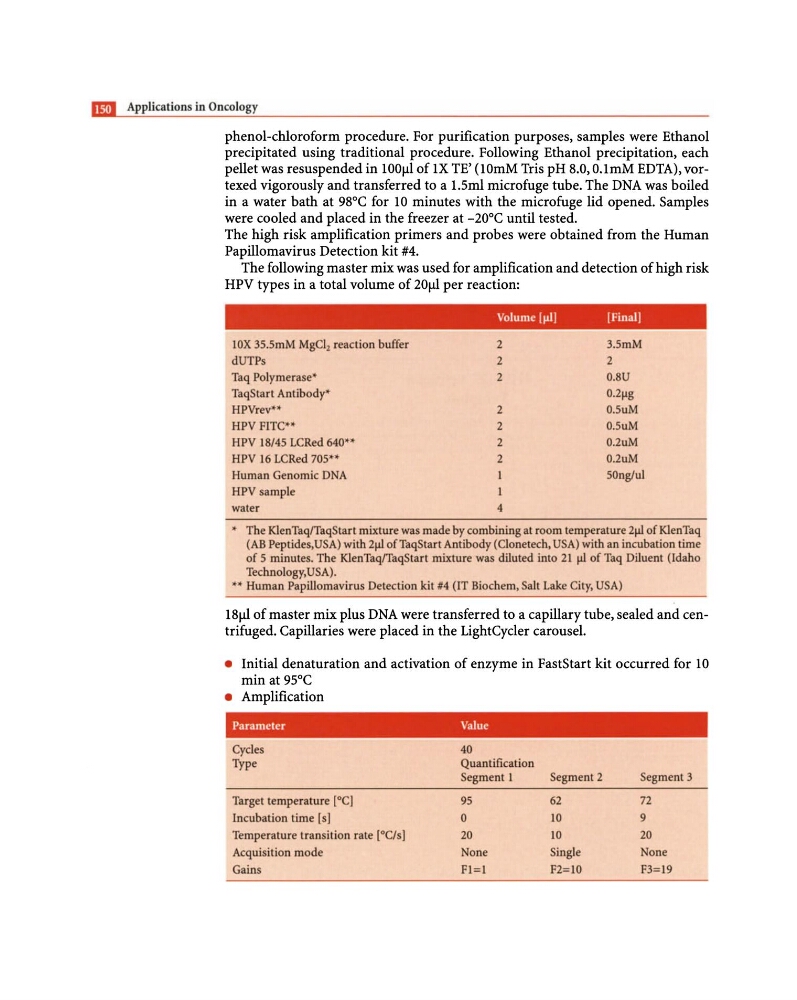
The following master mix was used for amplification and detection of high risk
HPV types in a total volume of 20111 per reaction:
Volume [Ill]
[Final]
lOX 3S.5mM MgCl2 reaction buffer
2
3.5mM
dUTPs
2
2
Taq Polymerase"
2
O.SU
TaqStart Antibody"
0.21lg
HPVreV""
2
O.SuM
HPVFITC""
2
O.SuM
HPV IS/4S LCRed 640*"
2
0.2uM
HPV 16 LCRed 70S'"
2
0.2uM
Human Genomic DNA
SOngful
HPV sample
I
water
4
" The KlenTaq/TaqStart mixture was made by combining at room temperature 2fll of KlenTaq
(AS Peptides,USA) with 2fll of TaqStart Antibody (Clonetech, USA) with an incubation time
of S minutes. The KlenTaqITaqStart mixture was diluted into 21 fll of Taq Diluent (Idaho
Technology,USA).
,.,. Human Papillomavirus Detection kit #4 (IT Biochem, Salt Lake City, USA)
18111 of master mix plus DNA were transferred to a capillary tube, sealed and centrifuged. Capillaries were placed in the LightCyder carousel.
• Initial denaturation and activation of enzyme in FastStart kit occurred for 10
min at 95°C
• Amplification
Parameter
Value
Cycles
40
Type
Quantification
Segment I
Segment 2
Segment 3
Target temperature [0C)
95
62
72
Incubation time [s]
0
10
9
Temperature transition rate [OC/s]
20
10
20
Acquisition mode
None
Single
None
Gains
PI=l
P2=10
F3=19
phenol-chloroform procedure. For purification purposes, samples were Ethanol
precipitated using traditional procedure. Following Ethanol precipitation, each
pellet was resuspended in 100111 of IX TE' (10mM Tris pH 8.0, O.lmM EDTA), vortexed vigorously and transferred to a 1.5ml microfuge tube. The DNA was boiled
in a water bath at 98°C for 10 minutes with the microfuge lid opened. Samples
were cooled and placed in the freezer at -20°C until tested.
The high risk amplification primers and probes were obtained from the Human
Papillomavirus Detection kit #4.
The following master mix was used for amplification and detection of high risk
HPV types in a total volume of 20111 per reaction:
Volume [Ill]
[Final]
lOX 3S.5mM MgCl2 reaction buffer
2
3.5mM
dUTPs
2
2
Taq Polymerase"
2
O.SU
TaqStart Antibody"
0.21lg
HPVreV""
2
O.SuM
HPVFITC""
2
O.SuM
HPV IS/4S LCRed 640*"
2
0.2uM
HPV 16 LCRed 70S'"
2
0.2uM
Human Genomic DNA
SOngful
HPV sample
I
water
4
" The KlenTaq/TaqStart mixture was made by combining at room temperature 2fll of KlenTaq
(AS Peptides,USA) with 2fll of TaqStart Antibody (Clonetech, USA) with an incubation time
of S minutes. The KlenTaqITaqStart mixture was diluted into 21 fll of Taq Diluent (Idaho
Technology,USA).
,.,. Human Papillomavirus Detection kit #4 (IT Biochem, Salt Lake City, USA)
18111 of master mix plus DNA were transferred to a capillary tube, sealed and centrifuged. Capillaries were placed in the LightCyder carousel.
• Initial denaturation and activation of enzyme in FastStart kit occurred for 10
min at 95°C
• Amplification
Parameter
Value
Cycles
40
Type
Quantification
Segment I
Segment 2
Segment 3
Target temperature [0C)
95
62
72
Incubation time [s]
0
10
9
Temperature transition rate [OC/s]
20
10
20
Acquisition mode
None
Single
None
Gains
PI=l
P2=10
F3=19