

Analysis of Microsatellite Instability by Melting Peak Analysis with BAT26 and BAT2S Specific en
and were complementary to upstream sequences adjacent to repetitive poly
adeninosine (BAT26) and poly thymidine (BAT2S) stretches within the hMSH2
and c-kit gene, respectively. Acceptor probes were designed to hybridize to
repetitive poly thymidine sequences and to at least one unique base at the s' and
3' ends of the repetitive stretches. The BAT26 and BAT2S acceptor probes were
labeled with LCRed640 and LCRed70S, respectively. When hybridized to the
templates, donor and acceptor probes have a distance of three (BAT26) and four
(BAT2S) bases.
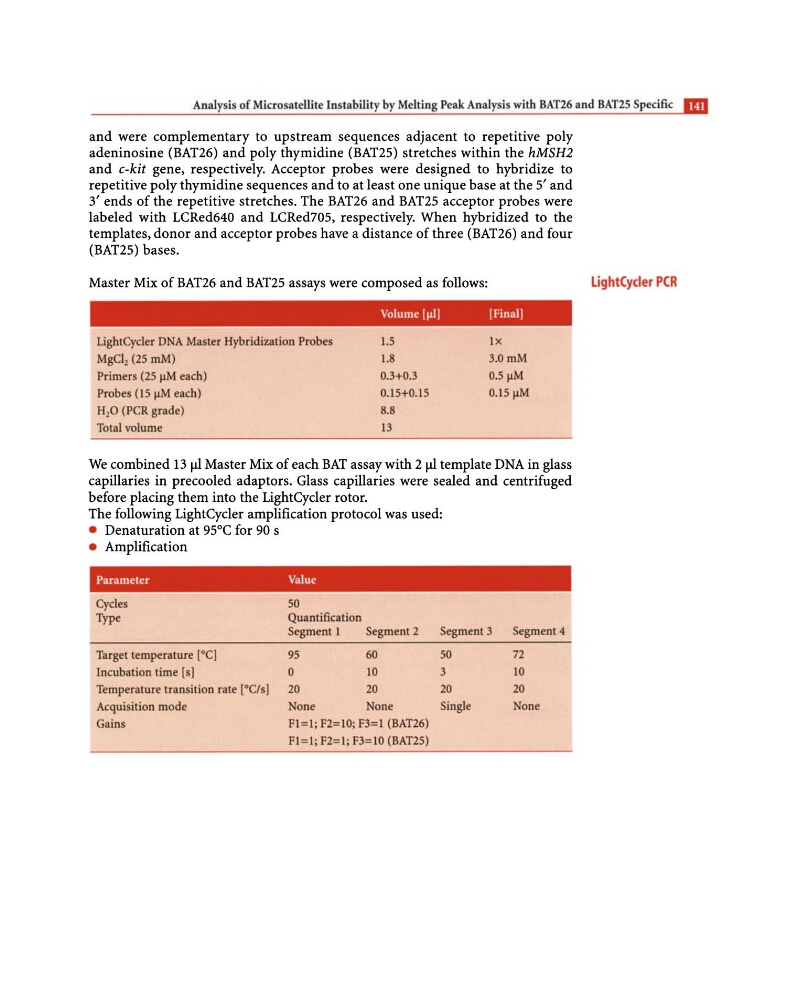
Master Mix of BAT26 and BAT2S assays were composed as follows:
Volume (111)
[Final)
LightCycler DNA Master Hybridization Probes
MgCl 2 (25 mM)
Primers (25 f!M each)
Probes (15 f!M each)
H20 (PCR grade)
Total volume
1.5
\.8
0.3+0.3
0.15+0.15
8.8
13
Ix
3.0mM
0.5 f!M
0. 15 f!M
We combined 13 J.1l Master Mix of each BAT assay with 2 jJl template DNA in glass
capillaries in precooled adaptors. Glass capillaries were sealed and centrifuged
before placing them into the LightCyder rotor.
The following LightCyder amplification protocol was used:
• Denaturation at 9S0C for 90 s
• Amplification
Parameter
Value
Cycles
SO
Type
Quantification
Segment 1
Segment 2
Segment 3
Segment 4
Target temperature (0C]
95
60
SO
72
Incubation time [s]
0
10
3
10
Temperature transition rate [OCls)
20
20
20
20
Acquisition mode
one
None
Single
one
Gains
Fl=I; F2=10; F3=1 (BA126)
FI=I; F2=1; F3= 10 (BAT2S)
LightCycier peR
and were complementary to upstream sequences adjacent to repetitive poly
adeninosine (BAT26) and poly thymidine (BAT2S) stretches within the hMSH2
and c-kit gene, respectively. Acceptor probes were designed to hybridize to
repetitive poly thymidine sequences and to at least one unique base at the s' and
3' ends of the repetitive stretches. The BAT26 and BAT2S acceptor probes were
labeled with LCRed640 and LCRed70S, respectively. When hybridized to the
templates, donor and acceptor probes have a distance of three (BAT26) and four
(BAT2S) bases.
Master Mix of BAT26 and BAT2S assays were composed as follows:
Volume (111)
[Final)
LightCycler DNA Master Hybridization Probes
MgCl 2 (25 mM)
Primers (25 f!M each)
Probes (15 f!M each)
H20 (PCR grade)
Total volume
1.5
\.8
0.3+0.3
0.15+0.15
8.8
13
Ix
3.0mM
0.5 f!M
0. 15 f!M
We combined 13 J.1l Master Mix of each BAT assay with 2 jJl template DNA in glass
capillaries in precooled adaptors. Glass capillaries were sealed and centrifuged
before placing them into the LightCyder rotor.
The following LightCyder amplification protocol was used:
• Denaturation at 9S0C for 90 s
• Amplification
Parameter
Value
Cycles
SO
Type
Quantification
Segment 1
Segment 2
Segment 3
Segment 4
Target temperature (0C]
95
60
SO
72
Incubation time [s]
0
10
3
10
Temperature transition rate [OCls)
20
20
20
20
Acquisition mode
one
None
Single
one
Gains
Fl=I; F2=10; F3=1 (BA126)
FI=I; F2=1; F3= 10 (BAT2S)
LightCycier peR