

578
K. M. G. Mostofa et al.
formation of H 2 O 2 in the alkaline medium with pH 12.4 (Lobanov et al. 2008;
Bruskov and Masalimov 2002). Formation of H 2 O 2 from Chl can generally be
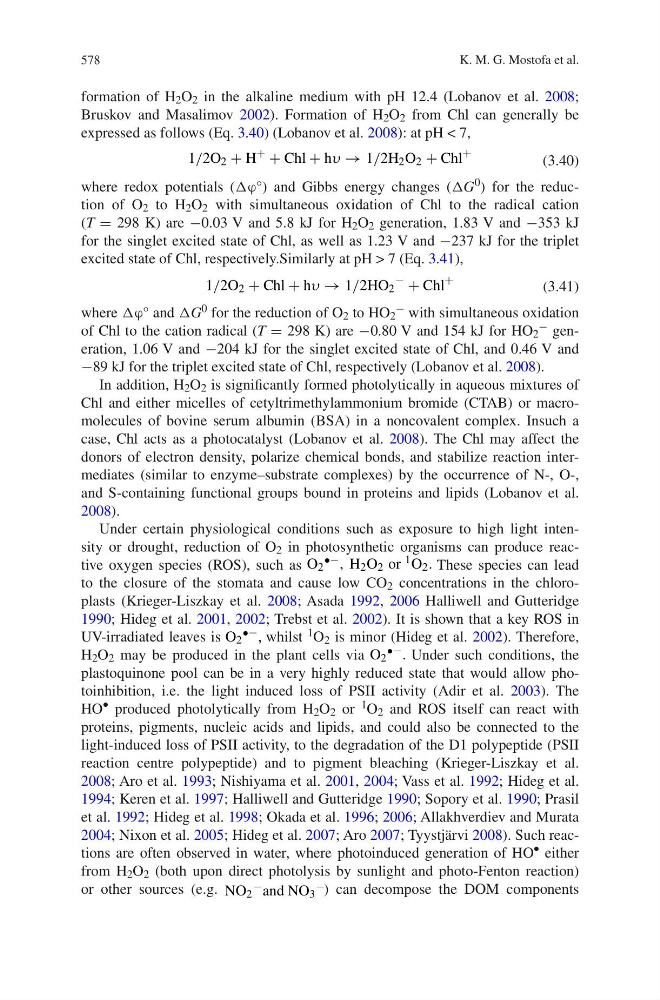
expressed as follows (Eq. 3.40) (Lobanov et al. 2008): at pH < 7,
where redox potentials (Δϕ°) and Gibbs energy changes (ΔG 0 ) for the reduction of O 2 to H 2 O 2 with simultaneous oxidation of Chl to the radical cation
(T = 298 K) are −0.03 V and 5.8 kJ for H 2 O 2 generation, 1.83 V and −353 kJ
for the singlet excited state of Chl, as well as 1.23 V and −237 kJ for the triplet
excited state of Chl, respectively.Similarly at pH > 7 (Eq. 3.41),
where Δϕ° and ΔG 0 for the reduction of O 2 to HO 2
− with simultaneous oxidation
of Chl to the cation radical (T = 298 K) are −0.80 V and 154 kJ for HO 2
− generation, 1.06 V and −204 kJ for the singlet excited state of Chl, and 0.46 V and
−89 kJ for the triplet excited state of Chl, respectively (Lobanov et al. 2008).
In addition, H 2 O 2 is significantly formed photolytically in aqueous mixtures of
Chl and either micelles of cetyltrimethylammonium bromide (CTAB) or macromolecules of bovine serum albumin (BSA) in a noncovalent complex. Insuch a
case, Chl acts as a photocatalyst (Lobanov et al. 2008). The Chl may affect the
donors of electron density, polarize chemical bonds, and stabilize reaction intermediates (similar to enzyme–substrate complexes) by the occurrence of N-, O-,
and S-containing functional groups bound in proteins and lipids (Lobanov et al.
2008).
Under certain physiological conditions such as exposure to high light intensity or drought, reduction of O 2 in photosynthetic organisms can produce reactive oxygen species (ROS), such as O 2
•− , H 2 O 2 or 1 O 2 . These species can lead
to the closure of the stomata and cause low CO 2 concentrations in the chloroplasts (Krieger-Liszkay et al. 2008; Asada 1992, 2006 Halliwell and Gutteridge
1990; Hideg et al. 2001, 2002; Trebst et al. 2002). It is shown that a key ROS in
UV-irradiated leaves is O 2
•− , whilst 1 O 2 is minor (Hideg et al. 2002). Therefore,
H 2 O 2 may be produced in the plant cells via O 2
•− . Under such conditions, the
plastoquinone pool can be in a very highly reduced state that would allow photoinhibition, i.e. the light induced loss of PSII activity (Adir et al. 2003). The
HO
• produced photolytically from H 2 O 2 or 1 O 2 and ROS itself can react with
proteins, pigments, nucleic acids and lipids, and could also be connected to the
light-induced loss of PSII activity, to the degradation of the D1 polypeptide (PSII
reaction centre polypeptide) and to pigment bleaching (Krieger-Liszkay et al.
2008; Aro et al. 1993; Nishiyama et al. 2001, 2004; Vass et al. 1992; Hideg et al.
1994; Keren et al. 1997; Halliwell and Gutteridge 1990; Sopory et al. 1990; Prasil
et al. 1992; Hideg et al. 1998; Okada et al. 1996; 2006; Allakhverdiev and Murata
2004; Nixon et al. 2005; Hideg et al. 2007; Aro 2007; Tyystjärvi 2008). Such reactions are often observed in water, where photoinduced generation of HO
• either
from H 2 O 2 (both upon direct photolysis by sunlight and photo-Fenton reaction)
or other sources (e.g. NO 2
− and NO 3
− ) can decompose the DOM components
(3.40)
1/2O 2 + H
+ + Chl + hυ → 1/2H 2 O 2 + Chl
+
(3.41)
1/2O 2 + Chl + hυ → 1/2HO 2
− + Chl
+