

577
Photosynthesis in Nature: A New Look
plant cells. Terrestrial plants can receive high concentrations of rainwater H 2 O 2
(0–199,000 nM: see Table 2 in chapter “Photoinduced and Microbial Generation
of Hydrogen Peroxide and Organic Peroxides in Natural Waters”), which is a vital
source of exogenous H 2 O 2 and is susceptible to promote photosynthesis in plants
and algae (Komissarov 1994, 1995, 2003; Mostofa et al. 2009). Experimental
studies demonstrate that H 2 O 2 concentrations (up to 10 −5 M) in culture media
can stimulate plant growth (Komissarov 1994, 1995, 2003). In addition, H 2 O 2 can
inhibit growth at concentrations as low as 10 −5 –10 −4 M under the conditions of a
dialysis culture (Samuilov et al. 2001). H 2 O 2 can inhibit the photosynthetic electron transport in cells of cyanobacteria (Samuilov et al. 2001, 2004) and can also
destroy the function of the oxygen-evolving complex (OEC) in some chloroplasts
and photosystem II preparations. In such a case it would cause the release of manganese from cyanobacterial cells, which inhibits the OEC activity.
3.5 H 2 O 2 Formation in Water, Lipid and Protein
Environments in the Presence of Chlorophyll
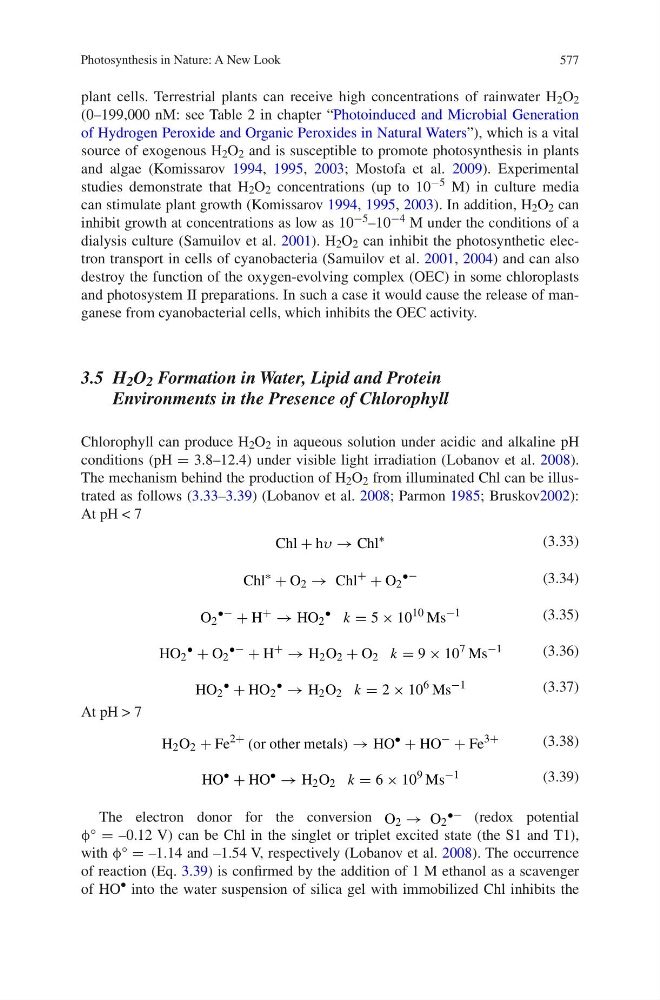
Chlorophyll can produce H 2 O 2 in aqueous solution under acidic and alkaline pH
conditions (pH = 3.8–12.4) under visible light irradiation (Lobanov et al. 2008).
The mechanism behind the production of H 2 O 2 from illuminated Chl can be illustrated as follows (3.33–3.39) (Lobanov et al. 2008; Parmon 1985; Bruskov2002):
At pH < 7
At pH > 7
The electron donor for the conversion O 2 → O 2
•− (redox potential
φ° = –0.12 V) can be Chl in the singlet or triplet excited state (the S1 and T1),
with φ° = –1.14 and –1.54 V, respectively (Lobanov et al. 2008). The occurrence
of reaction (Eq. 3.39) is confirmed by the addition of 1 M ethanol as a scavenger
of HO
• into the water suspension of silica gel with immobilized Chl inhibits the
(3.33)
Chl + hυ → Chl
∗
(3.34)
Chl
∗ + O 2 → Chl
+ + O 2
•−
(3.35)
O 2
•− + H
+ → HO 2
• k = 5 × 10
10 Ms
−1
(3.36)
HO 2
• + O 2
•− + H
+ → H 2 O 2 + O 2 k = 9 × 10
7 Ms
−1
(3.37)
HO 2
• + HO 2
• → H 2 O 2 k = 2 × 10
6 Ms
−1
(3.38)
H 2 O 2 + Fe
2+ (or other metals) → HO
• + HO
− + Fe
3+
(3.39)
HO
• + HO
• → H 2 O 2 k = 6 × 10
9 Ms
−1