

491
Fluorescent Dissolved Organic Matter in Natural Waters
and two peaks at Ex/Em = 230/340 and 230/305 nm (peak T UV -region) (Determann
et al. 1998). Note that green algae have been collected from surface waters of Lake
Hongfeng (China) during the summer season using GF/F filters, and their EEM
properties have been determined after re-suspension in Milli-Q and river waters.
Chlorophyll a and Chlorophyll b
Chlorophyll a (Chl a) shows fluorescence at Ex/Em = 431/670 nm and chlorophyll b at Ex/Em = 435/659 nm (Moberg et al. 2001). The molecular formula of
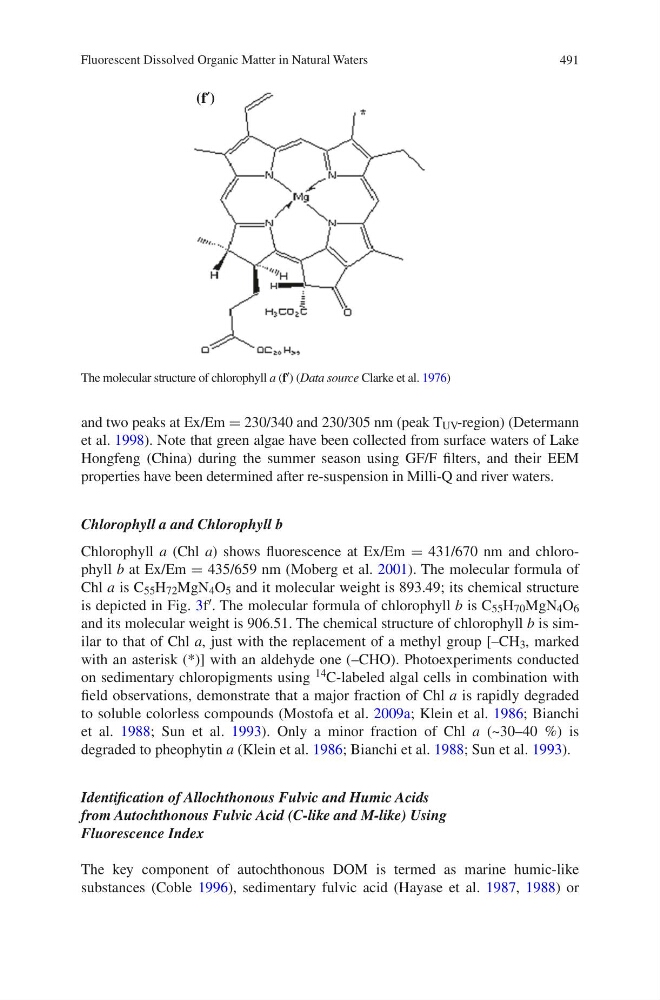
Chl a is C 55 H 72 MgN 4 O 5 and it molecular weight is 893.49; its chemical structure
is depicted in Fig. 3f′. The molecular formula of chlorophyll b is C 55 H 70 MgN 4 O 6
and its molecular weight is 906.51. The chemical structure of chlorophyll b is similar to that of Chl a, just with the replacement of a methyl group [–CH 3 , marked
with an asterisk (*)] with an aldehyde one (–CHO). Photoexperiments conducted
on sedimentary chloropigments using 14 C-labeled algal cells in combination with
field observations, demonstrate that a major fraction of Chl a is rapidly degraded
to soluble colorless compounds (Mostofa et al. 2009a; Klein et al. 1986; Bianchi
et al. 1988; Sun et al. 1993). Only a minor fraction of Chl a (~30–40 %) is
degraded to pheophytin a (Klein et al. 1986; Bianchi et al. 1988; Sun et al. 1993).
Identification of Allochthonous Fulvic and Humic Acids
from Autochthonous Fulvic Acid (C-like and M-like) Using
Fluorescence Index
The key component of autochthonous DOM is termed as marine humic-like
substances (Coble 1996), sedimentary fulvic acid (Hayase et al. 1987, 1988) or
(f′)
The molecular structure of chlorophyll a (f′) (Data source Clarke et al. 1976)
Fluorescent Dissolved Organic Matter in Natural Waters
and two peaks at Ex/Em = 230/340 and 230/305 nm (peak T UV -region) (Determann
et al. 1998). Note that green algae have been collected from surface waters of Lake
Hongfeng (China) during the summer season using GF/F filters, and their EEM
properties have been determined after re-suspension in Milli-Q and river waters.
Chlorophyll a and Chlorophyll b
Chlorophyll a (Chl a) shows fluorescence at Ex/Em = 431/670 nm and chlorophyll b at Ex/Em = 435/659 nm (Moberg et al. 2001). The molecular formula of
Chl a is C 55 H 72 MgN 4 O 5 and it molecular weight is 893.49; its chemical structure
is depicted in Fig. 3f′. The molecular formula of chlorophyll b is C 55 H 70 MgN 4 O 6
and its molecular weight is 906.51. The chemical structure of chlorophyll b is similar to that of Chl a, just with the replacement of a methyl group [–CH 3 , marked
with an asterisk (*)] with an aldehyde one (–CHO). Photoexperiments conducted
on sedimentary chloropigments using 14 C-labeled algal cells in combination with
field observations, demonstrate that a major fraction of Chl a is rapidly degraded
to soluble colorless compounds (Mostofa et al. 2009a; Klein et al. 1986; Bianchi
et al. 1988; Sun et al. 1993). Only a minor fraction of Chl a (~30–40 %) is
degraded to pheophytin a (Klein et al. 1986; Bianchi et al. 1988; Sun et al. 1993).
Identification of Allochthonous Fulvic and Humic Acids
from Autochthonous Fulvic Acid (C-like and M-like) Using
Fluorescence Index
The key component of autochthonous DOM is termed as marine humic-like
substances (Coble 1996), sedimentary fulvic acid (Hayase et al. 1987, 1988) or
(f′)
The molecular structure of chlorophyll a (f′) (Data source Clarke et al. 1976)