

489
Fluorescent Dissolved Organic Matter in Natural Waters
with two fluorescence peaks at Ex/Em = 335–345/430–437 nm (peak C-region)
and at 240–255/425–447 nm (peak A-region), respectively (Fig. 3b′). The second fluorescent component is denoted as detergent component (T UV -like), with a
fluorescence peak at Ex/Em = 225–230/287–296 nm (peak T UV -region) (Fig. 3c′;
Table 2). Detergent component (C-like) has been detected at Ex/Em = 345/430–
435 and 240/427–433 nm for household detergents (Nafine Chem Ind Ltd and
Nice group Co Ltd, China) dissolved in Milli-Q water; at 335–350/432–437 and
at 250–255/425–447 nm in river waters; at 335–345/422–437 and 240–250/422–
443 nm in sewerage waters; and at 340/440 and 250/440 nm in drinking water
treatment plants (Tables 1, 2) (Mostofa et al. 2010; Baghoth et al. 2010; Guo et al.
2010). The detergent component (T UV -like) has been detected at Ex/Em = 225–
230/291–296 nm in sewerage waters (Table 2) (Mostofa et al. 2010). Household
detergents are generally detected by EEM spectroscopy (Mostofa et al. 2005a,
2010; Komaki and Yabe 1982) and other spectroscopic methods (Kramer et al.
1996) in effluent discharged by households located in towns. The detergent component (C-like) is rapidly decomposed by natural sunlight whist it is refractory
to microbial degradation (Mostofa et al. 2010). On the other hand, the detergent
250
300
350
300
350
400
450
(z)
(a′)
(b′)
(c′)
Peak W
Peak A
(y)
Peak W
Peak A
Peak T UV
Peak T
Peak T UV
(d′)
( e′)
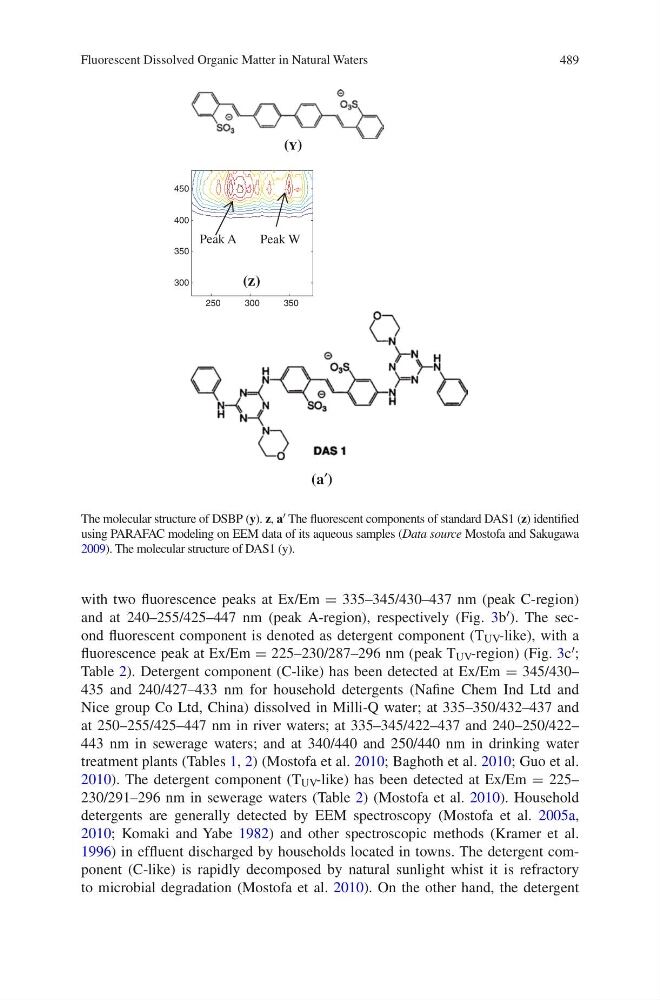
The molecular structure of DSBP (y). z, a′ The fluorescent components of standard DAS1 (z) identified
using PARAFAC modeling on EEM data of its aqueous samples (Data source Mostofa and Sakugawa
2009). The molecular structure of DAS1 (y).
Fluorescent Dissolved Organic Matter in Natural Waters
with two fluorescence peaks at Ex/Em = 335–345/430–437 nm (peak C-region)
and at 240–255/425–447 nm (peak A-region), respectively (Fig. 3b′). The second fluorescent component is denoted as detergent component (T UV -like), with a
fluorescence peak at Ex/Em = 225–230/287–296 nm (peak T UV -region) (Fig. 3c′;
Table 2). Detergent component (C-like) has been detected at Ex/Em = 345/430–
435 and 240/427–433 nm for household detergents (Nafine Chem Ind Ltd and
Nice group Co Ltd, China) dissolved in Milli-Q water; at 335–350/432–437 and
at 250–255/425–447 nm in river waters; at 335–345/422–437 and 240–250/422–
443 nm in sewerage waters; and at 340/440 and 250/440 nm in drinking water
treatment plants (Tables 1, 2) (Mostofa et al. 2010; Baghoth et al. 2010; Guo et al.
2010). The detergent component (T UV -like) has been detected at Ex/Em = 225–
230/291–296 nm in sewerage waters (Table 2) (Mostofa et al. 2010). Household
detergents are generally detected by EEM spectroscopy (Mostofa et al. 2005a,
2010; Komaki and Yabe 1982) and other spectroscopic methods (Kramer et al.
1996) in effluent discharged by households located in towns. The detergent component (C-like) is rapidly decomposed by natural sunlight whist it is refractory
to microbial degradation (Mostofa et al. 2010). On the other hand, the detergent
250
300
350
300
350
400
450
(z)
(a′)
(b′)
(c′)
Peak W
Peak A
(y)
Peak W
Peak A
Peak T UV
Peak T
Peak T UV
(d′)
( e′)
The molecular structure of DSBP (y). z, a′ The fluorescent components of standard DAS1 (z) identified
using PARAFAC modeling on EEM data of its aqueous samples (Data source Mostofa and Sakugawa
2009). The molecular structure of DAS1 (y).