

379
Colored and Chromophoric Dissolved Organic Matter in Natural Waters
On the other hand, the absorption coefficients (l/g/cm) of whole humic acid
extracted from sediment pore waters are much higher at 320 than at 480 nm, but
absorption is much higher in low molecular weight fractions (<10 kDa) and typically decreases with increasing molecular weight up to >300 kDa (Fig. 3) (Hayase
and Tsubota 1985). A small peak shoulder is observed for molecular weight fractions of humic acid of 50–100 kDa (Fig. 3), which might account for the shoulder detected in whole humic acid absorbance spectra (Ishiwatari 1973; Hayase
and Tsubota 1985). Therefore, the absorption coefficient (l/g/cm) of humic acid
decreases whilst that of fulvic acid increases with increasing molecular weight.
Similarly, soil fulvic acid shows a parallel increase in absorption coefficients with
molecular weight (Dubach et al. 1964). Such opposite trends of the absorption
coefficients between fulvic and humic acids may result from the difference in their
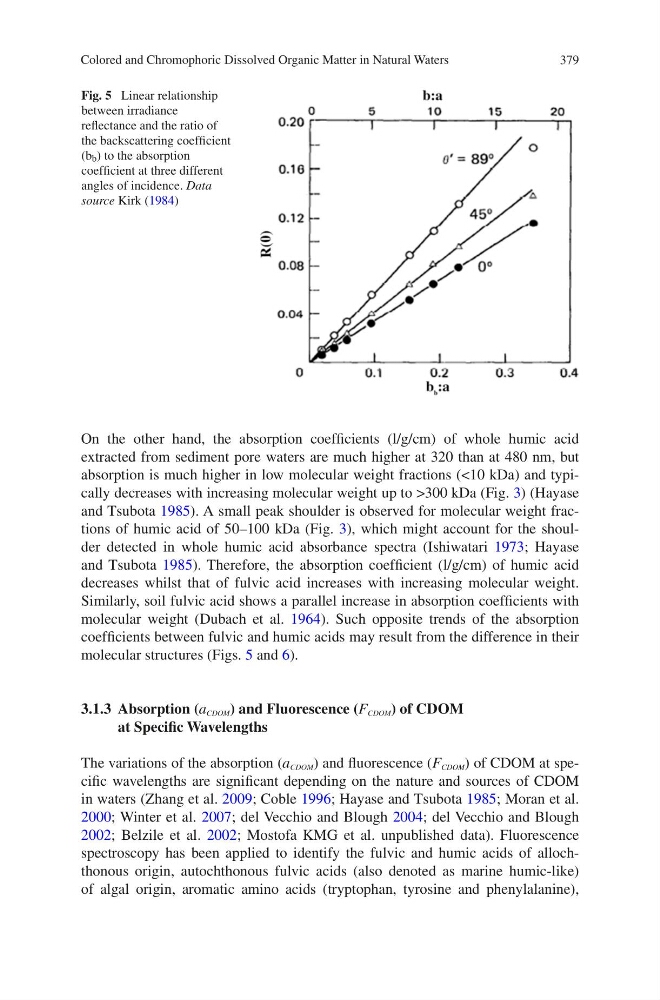
molecular structures (Figs. 5 and 6).
3.1.3 Absorption (a cdom ) and Fluorescence (F cdom ) of CDOM
at Specific Wavelengths
The variations of the absorption (a cdom ) and fluorescence (F cdom ) of CDOM at specific wavelengths are significant depending on the nature and sources of CDOM
in waters (Zhang et al. 2009; Coble 1996; Hayase and Tsubota 1985; Moran et al.
2000; Winter et al. 2007; del Vecchio and Blough 2004; del Vecchio and Blough
2002; Belzile et al. 2002; Mostofa KMG et al. unpublished data). Fluorescence
spectroscopy has been applied to identify the fulvic and humic acids of allochthonous origin, autochthonous fulvic acids (also denoted as marine humic-like)
of algal origin, aromatic amino acids (tryptophan, tyrosine and phenylalanine),
Fig. 5 Linear relationship
between irradiance
reflectance and the ratio of
the backscattering coefficient
(b b ) to the absorption
coefficient at three different
angles of incidence. Data
source Kirk (1984)
Colored and Chromophoric Dissolved Organic Matter in Natural Waters
On the other hand, the absorption coefficients (l/g/cm) of whole humic acid
extracted from sediment pore waters are much higher at 320 than at 480 nm, but
absorption is much higher in low molecular weight fractions (<10 kDa) and typically decreases with increasing molecular weight up to >300 kDa (Fig. 3) (Hayase
and Tsubota 1985). A small peak shoulder is observed for molecular weight fractions of humic acid of 50–100 kDa (Fig. 3), which might account for the shoulder detected in whole humic acid absorbance spectra (Ishiwatari 1973; Hayase
and Tsubota 1985). Therefore, the absorption coefficient (l/g/cm) of humic acid
decreases whilst that of fulvic acid increases with increasing molecular weight.
Similarly, soil fulvic acid shows a parallel increase in absorption coefficients with
molecular weight (Dubach et al. 1964). Such opposite trends of the absorption
coefficients between fulvic and humic acids may result from the difference in their
molecular structures (Figs. 5 and 6).
3.1.3 Absorption (a cdom ) and Fluorescence (F cdom ) of CDOM
at Specific Wavelengths
The variations of the absorption (a cdom ) and fluorescence (F cdom ) of CDOM at specific wavelengths are significant depending on the nature and sources of CDOM
in waters (Zhang et al. 2009; Coble 1996; Hayase and Tsubota 1985; Moran et al.
2000; Winter et al. 2007; del Vecchio and Blough 2004; del Vecchio and Blough
2002; Belzile et al. 2002; Mostofa KMG et al. unpublished data). Fluorescence
spectroscopy has been applied to identify the fulvic and humic acids of allochthonous origin, autochthonous fulvic acids (also denoted as marine humic-like)
of algal origin, aromatic amino acids (tryptophan, tyrosine and phenylalanine),
Fig. 5 Linear relationship
between irradiance
reflectance and the ratio of
the backscattering coefficient
(b b ) to the absorption
coefficient at three different
angles of incidence. Data
source Kirk (1984)