

341
Photoinduced and Microbial Degradation
C and N is a thermodynamic anomaly that provides a major source of energy to drive
aquatic and terrestrial ecosystems (Salonen et al. 1992; Wetzel 1984, 1992; Hedges et
al. 2000; Tranvik 1992). Therefore, any changes in energy during the photoinduced
degradation of DOM are thermodynamically vital for all the living organisms and for
the natural water ecosystem. Photoinduced degradation of DOM in natural waters is
thus interlinked with production of free radicals, microbial processes, photosynthesis,
autochthonous DOM, nutrients, end photoproducts and their utilization as food for
microorganisms. A conceptual schematic diagram for the photoinduced and microbial
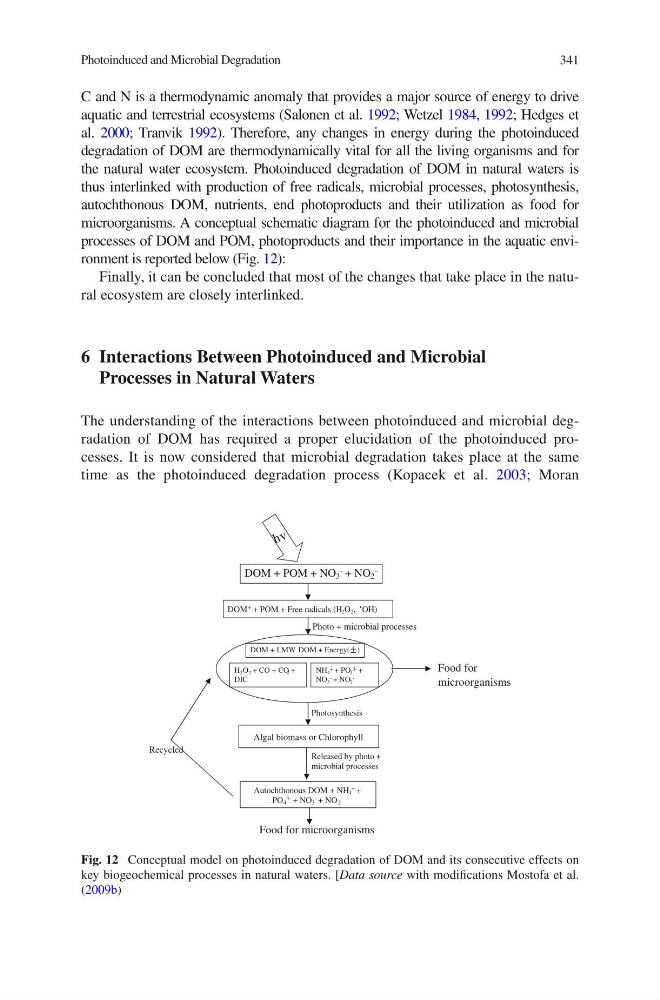
processes of DOM and POM, photoproducts and their importance in the aquatic environment is reported below (Fig. 12):
Finally, it can be concluded that most of the changes that take place in the natural ecosystem are closely interlinked.
6 Interactions Between Photoinduced and Microbial
Processes in Natural Waters
The understanding of the interactions between photoinduced and microbial degradation of DOM has required a proper elucidation of the photoinduced processes. It is now considered that microbial degradation takes place at the same
time as the photoinduced degradation process (Kopacek et al. 2003; Moran
Recycled
Algal biomass or Chlorophyll
DOM + LMW DOM + Energy( ± )
H2O2 + CO + CO2 +
DIC
NH4 + + PO4 3- +
NO3 - + NO2 -
Photosynthesis
Released by photo +
microbial processes
Autochthonous DOM + NH4
+ +
PO4 3- + NO3 - + NO2 -
DOM + POM + NO 3
- + NO 2
-
DOM + + POM + Free radicals (H2O2, . OH)
Photo + microbial processes
Food for
microorganisms
Food for microorganisms
Fig. 12 Conceptual model on photoinduced degradation of DOM and its consecutive effects on
key biogeochemical processes in natural waters. [Data source with modifications Mostofa et al.
(2009b)
Photoinduced and Microbial Degradation
C and N is a thermodynamic anomaly that provides a major source of energy to drive
aquatic and terrestrial ecosystems (Salonen et al. 1992; Wetzel 1984, 1992; Hedges et
al. 2000; Tranvik 1992). Therefore, any changes in energy during the photoinduced
degradation of DOM are thermodynamically vital for all the living organisms and for
the natural water ecosystem. Photoinduced degradation of DOM in natural waters is
thus interlinked with production of free radicals, microbial processes, photosynthesis,
autochthonous DOM, nutrients, end photoproducts and their utilization as food for
microorganisms. A conceptual schematic diagram for the photoinduced and microbial
processes of DOM and POM, photoproducts and their importance in the aquatic environment is reported below (Fig. 12):
Finally, it can be concluded that most of the changes that take place in the natural ecosystem are closely interlinked.
6 Interactions Between Photoinduced and Microbial
Processes in Natural Waters
The understanding of the interactions between photoinduced and microbial degradation of DOM has required a proper elucidation of the photoinduced processes. It is now considered that microbial degradation takes place at the same
time as the photoinduced degradation process (Kopacek et al. 2003; Moran
Recycled
Algal biomass or Chlorophyll
DOM + LMW DOM + Energy( ± )
H2O2 + CO + CO2 +
DIC
NH4 + + PO4 3- +
NO3 - + NO2 -
Photosynthesis
Released by photo +
microbial processes
Autochthonous DOM + NH4
+ +
PO4 3- + NO3 - + NO2 -
DOM + POM + NO 3
- + NO 2
-
DOM + + POM + Free radicals (H2O2, . OH)
Photo + microbial processes
Food for
microorganisms
Food for microorganisms
Fig. 12 Conceptual model on photoinduced degradation of DOM and its consecutive effects on
key biogeochemical processes in natural waters. [Data source with modifications Mostofa et al.
(2009b)