

248
K. M. G. Mostofa et al.
where k ′
1 = k[H 2 O 2 ]. The reaction is quite fast at high temperature and pH, and
it becomes quite difficult to be examined at 25 °C and pH 8. The reaction at 5 °C
and pH 3.5 followed first-order kinetics with respect to Fe(II) for seawater samples, giving k′ = 0.0385 ± 0.0009 min −1 and log k = 1.50 ± 0.02 (k in M −1 s –1 )
(Millero and Sotolongo 1989). At higher pH and temperature, the second-order
reaction rate constants have been determined at the stoichiometric ratio [Fe(II)]/
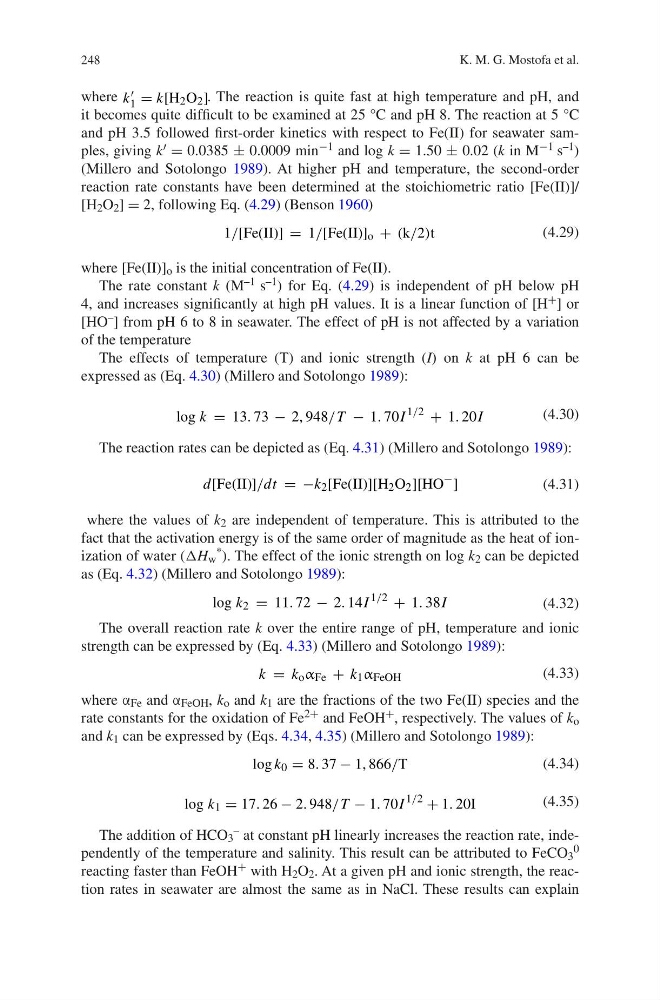
[H 2 O 2 ] = 2, following Eq. (4.29) (Benson 1960)
where [Fe(II)] o is the initial concentration of Fe(II).
The rate constant k (M –1 s –1 ) for Eq. (4.29) is independent of pH below pH
4, and increases significantly at high pH values. It is a linear function of [H + ] or
[HO – ] from pH 6 to 8 in seawater. The effect of pH is not affected by a variation
of the temperature
The effects of temperature (T) and ionic strength (I) on k at pH 6 can be
expressed as (Eq. 4.30) (Millero and Sotolongo 1989):
The reaction rates can be depicted as (Eq. 4.31) (Millero and Sotolongo 1989):
where the values of k 2 are independent of temperature. This is attributed to the
fact that the activation energy is of the same order of magnitude as the heat of ionization of water (ΔH w
* ). The effect of the ionic strength on log k 2 can be depicted
as (Eq. 4.32) (Millero and Sotolongo 1989):
The overall reaction rate k over the entire range of pH, temperature and ionic
strength can be expressed by (Eq. 4.33) (Millero and Sotolongo 1989):
where α Fe and α FeOH , k o and k 1 are the fractions of the two Fe(II) species and the
rate constants for the oxidation of Fe 2+ and FeOH + , respectively. The values of k o
and k 1 can be expressed by (Eqs. 4.34, 4.35) (Millero and Sotolongo 1989):
The addition of HCO 3
– at constant pH linearly increases the reaction rate, independently of the temperature and salinity. This result can be attributed to FeCO 3
0
reacting faster than FeOH + with H 2 O 2 . At a given pH and ionic strength, the reaction rates in seawater are almost the same as in NaCl. These results can explain
(4.29)
1/[Fe(II)] = 1/[Fe(II)] o + (k/2)t
(4.30)
log k = 13. 73 − 2, 948/T − 1. 70I
1/2 + 1. 20I
(4.31)
d[Fe(II)]/dt = −k 2 [Fe(II)][H 2 O 2 ][HO
− ]
(4.32)
log k 2 = 11. 72 − 2. 14I
1/2 + 1. 38I
(4.33)
k = k o α Fe + k 1 α FeOH
(4.34)
log k 0 = 8. 37 − 1, 866/T
(4.35)
log k 1 = 17. 26 − 2. 948/T − 1. 70I
1/2 + 1. 20I
K. M. G. Mostofa et al.
where k ′
1 = k[H 2 O 2 ]. The reaction is quite fast at high temperature and pH, and
it becomes quite difficult to be examined at 25 °C and pH 8. The reaction at 5 °C
and pH 3.5 followed first-order kinetics with respect to Fe(II) for seawater samples, giving k′ = 0.0385 ± 0.0009 min −1 and log k = 1.50 ± 0.02 (k in M −1 s –1 )
(Millero and Sotolongo 1989). At higher pH and temperature, the second-order
reaction rate constants have been determined at the stoichiometric ratio [Fe(II)]/
[H 2 O 2 ] = 2, following Eq. (4.29) (Benson 1960)
where [Fe(II)] o is the initial concentration of Fe(II).
The rate constant k (M –1 s –1 ) for Eq. (4.29) is independent of pH below pH
4, and increases significantly at high pH values. It is a linear function of [H + ] or
[HO – ] from pH 6 to 8 in seawater. The effect of pH is not affected by a variation
of the temperature
The effects of temperature (T) and ionic strength (I) on k at pH 6 can be
expressed as (Eq. 4.30) (Millero and Sotolongo 1989):
The reaction rates can be depicted as (Eq. 4.31) (Millero and Sotolongo 1989):
where the values of k 2 are independent of temperature. This is attributed to the
fact that the activation energy is of the same order of magnitude as the heat of ionization of water (ΔH w
* ). The effect of the ionic strength on log k 2 can be depicted
as (Eq. 4.32) (Millero and Sotolongo 1989):
The overall reaction rate k over the entire range of pH, temperature and ionic
strength can be expressed by (Eq. 4.33) (Millero and Sotolongo 1989):
where α Fe and α FeOH , k o and k 1 are the fractions of the two Fe(II) species and the
rate constants for the oxidation of Fe 2+ and FeOH + , respectively. The values of k o
and k 1 can be expressed by (Eqs. 4.34, 4.35) (Millero and Sotolongo 1989):
The addition of HCO 3
– at constant pH linearly increases the reaction rate, independently of the temperature and salinity. This result can be attributed to FeCO 3
0
reacting faster than FeOH + with H 2 O 2 . At a given pH and ionic strength, the reaction rates in seawater are almost the same as in NaCl. These results can explain
(4.29)
1/[Fe(II)] = 1/[Fe(II)] o + (k/2)t
(4.30)
log k = 13. 73 − 2, 948/T − 1. 70I
1/2 + 1. 20I
(4.31)
d[Fe(II)]/dt = −k 2 [Fe(II)][H 2 O 2 ][HO
− ]
(4.32)
log k 2 = 11. 72 − 2. 14I
1/2 + 1. 38I
(4.33)
k = k o α Fe + k 1 α FeOH
(4.34)
log k 0 = 8. 37 − 1, 866/T
(4.35)
log k 1 = 17. 26 − 2. 948/T − 1. 70I
1/2 + 1. 20I