

247
Photoinduced Generation of Hydroxyl Radical in Natural Waters
to pH 8.5. This is because PW 12 O 40
3− forms a soluble complex with iron that
converts H 2 O 2 into HO
• (Lee and Sedlak 2009). The Fenton reaction for the
catalytic oxidation of organic compounds is usually limited to the acidic pH
region, due to the low solubility of Fe(III) and the low efficiency of oxidant
production at neutral pH values. The coordination of Fe 2+ by PW 12 O 40
3− can
alter the mechanism of the reaction of Fe(II) with H 2 O 2 at neutral pH, yielding a reactive species capable of oxidizing aromatic compounds (Lee and
Sedlak 2009).
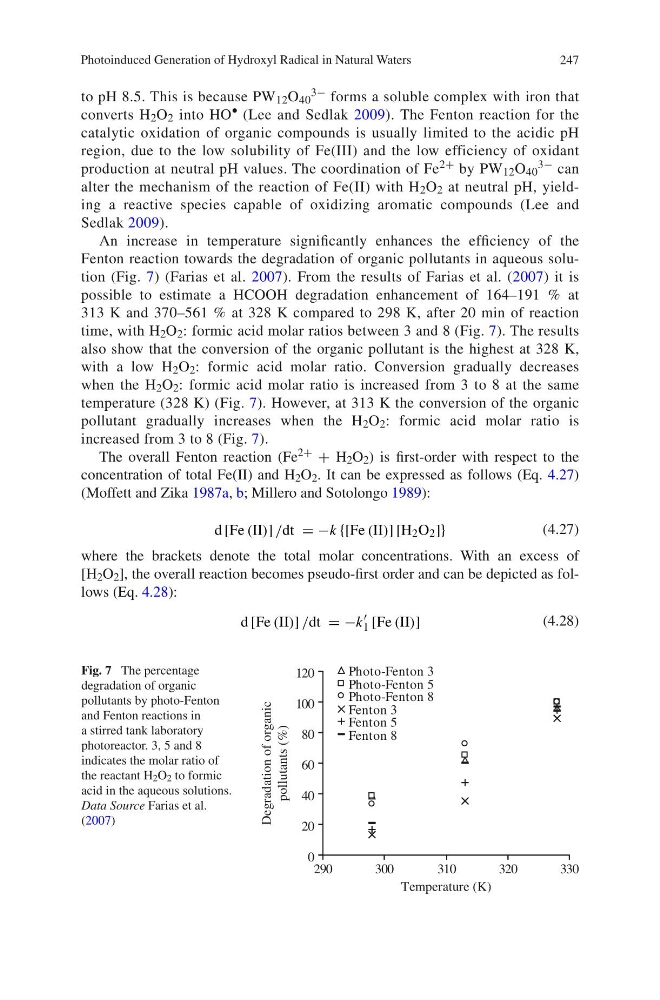
An increase in temperature significantly enhances the efficiency of the
Fenton reaction towards the degradation of organic pollutants in aqueous solution (Fig. 7) (Farias et al. 2007). From the results of Farias et al. (2007) it is
possible to estimate a HCOOH degradation enhancement of 164–191 % at
313 K and 370–561 % at 328 K compared to 298 K, after 20 min of reaction
time, with H 2 O 2 : formic acid molar ratios between 3 and 8 (Fig. 7). The results
also show that the conversion of the organic pollutant is the highest at 328 K,
with a low H 2 O 2 : formic acid molar ratio. Conversion gradually decreases
when the H 2 O 2 : formic acid molar ratio is increased from 3 to 8 at the same
temperature (328 K) (Fig. 7). However, at 313 K the conversion of the organic
pollutant gradually increases when the H 2 O 2 : formic acid molar ratio is
increased from 3 to 8 (Fig. 7).
The overall Fenton reaction (Fe 2+ + H 2 O 2 ) is first-order with respect to the
concentration of total Fe(II) and H 2 O 2 . It can be expressed as follows (Eq. 4.27)
(Moffett and Zika 1987a, b; Millero and Sotolongo 1989):
where the brackets denote the total molar concentrations. With an excess of
[H 2 O 2 ], the overall reaction becomes pseudo-first order and can be depicted as follows (Eq. 4.28):
(4.27)
d [Fe (II)] /dt = −k {[Fe (II)] [H 2 O 2 ]}
(4.28)
d [Fe (II)] /dt = −k
′
1 [Fe (II)]
Fig. 7 The percentage
degradation of organic
pollutants by photo-Fenton
and Fenton reactions in
a stirred tank laboratory
photoreactor. 3, 5 and 8
indicates the molar ratio of
the reactant H 2 O 2 to formic
acid in the aqueous solutions.
Data Source Farias et al.
(2007)
Degradation of organic
pollutants (%)
0
20
40
60
80
100
120
290
300
310
320
330
Photo-Fenton 3
Photo-Fenton 5
Photo-Fenton 8
Fenton 3
Fenton 5
Fenton 8
Temperature (K)
Photoinduced Generation of Hydroxyl Radical in Natural Waters
to pH 8.5. This is because PW 12 O 40
3− forms a soluble complex with iron that
converts H 2 O 2 into HO
• (Lee and Sedlak 2009). The Fenton reaction for the
catalytic oxidation of organic compounds is usually limited to the acidic pH
region, due to the low solubility of Fe(III) and the low efficiency of oxidant
production at neutral pH values. The coordination of Fe 2+ by PW 12 O 40
3− can
alter the mechanism of the reaction of Fe(II) with H 2 O 2 at neutral pH, yielding a reactive species capable of oxidizing aromatic compounds (Lee and
Sedlak 2009).
An increase in temperature significantly enhances the efficiency of the
Fenton reaction towards the degradation of organic pollutants in aqueous solution (Fig. 7) (Farias et al. 2007). From the results of Farias et al. (2007) it is
possible to estimate a HCOOH degradation enhancement of 164–191 % at
313 K and 370–561 % at 328 K compared to 298 K, after 20 min of reaction
time, with H 2 O 2 : formic acid molar ratios between 3 and 8 (Fig. 7). The results
also show that the conversion of the organic pollutant is the highest at 328 K,
with a low H 2 O 2 : formic acid molar ratio. Conversion gradually decreases
when the H 2 O 2 : formic acid molar ratio is increased from 3 to 8 at the same
temperature (328 K) (Fig. 7). However, at 313 K the conversion of the organic
pollutant gradually increases when the H 2 O 2 : formic acid molar ratio is
increased from 3 to 8 (Fig. 7).
The overall Fenton reaction (Fe 2+ + H 2 O 2 ) is first-order with respect to the
concentration of total Fe(II) and H 2 O 2 . It can be expressed as follows (Eq. 4.27)
(Moffett and Zika 1987a, b; Millero and Sotolongo 1989):
where the brackets denote the total molar concentrations. With an excess of
[H 2 O 2 ], the overall reaction becomes pseudo-first order and can be depicted as follows (Eq. 4.28):
(4.27)
d [Fe (II)] /dt = −k {[Fe (II)] [H 2 O 2 ]}
(4.28)
d [Fe (II)] /dt = −k
′
1 [Fe (II)]
Fig. 7 The percentage
degradation of organic
pollutants by photo-Fenton
and Fenton reactions in
a stirred tank laboratory
photoreactor. 3, 5 and 8
indicates the molar ratio of
the reactant H 2 O 2 to formic
acid in the aqueous solutions.
Data Source Farias et al.
(2007)
Degradation of organic
pollutants (%)
0
20
40
60
80
100
120
290
300
310
320
330
Photo-Fenton 3
Photo-Fenton 5
Photo-Fenton 8
Fenton 3
Fenton 5
Fenton 8
Temperature (K)