

240
K. M. G. Mostofa et al.
4.4 Dependence on NO 2
– and NO 3
– Photolysis: Effect
of Wavelength Spectrum, Temperature, and pH
The photoinduced generation of HO
• largely depends on the presence of NO 2
–
and NO 3
– in natural waters (Zafiriou and True 1979a, b; Takeda et al. 2004;
Zafiriou and Bonneau 1987; Zepp et al. 1987; Zellner et al. 1990; Brezonik and
Fulkerson-Brekken 1998; Mack and Bolton 1999). The quantum yield of HO
•
(Φ HO ) for NO 2
– and NO 3
– photolysis significantly depends on the temperature,
wavelength and pH in the aqueous solution (Tables 4 and 5) (Zepp et al. 1987;
Zellner et al. 1990; Goldstein and Rabani 2008; Matykiewiczová et al. 2007;
Treinin and Hayon 1970; Strehlow and Wagner 1982; Warneck and Wurzinger
1988; Mark et al. 1996; Vione et al. 2001; Chu and Anastasio 2003). The Φ HO
of NO 2
– photolysis has been determined for a NO 2
– concentration of 3 × 10 –3
M, for 4 ≤ pH ≤ 11 and temperatures between 278–353 K at 308 nm (Table 4)
(Zellner et al. 1990). The absorption coefficient of NO 2
– at 308 nm is ε 308 = 4.1
L mol –1 cm –1 (Strickler and Kasha 1963). For the same solution, Φ HO has also
been determined in the temperature range of 278–358 K, for pH 8 and under
351 nm irradiation (Table 4). Note that the absorption coefficient of NO 2
– is
ε 351 = 9.4 L mol –1 cm –1 (Strickler and Kasha 1963). The results have demonstrated that Φ HO generally increases with temperature and decreases with pH
(Fig. 4).
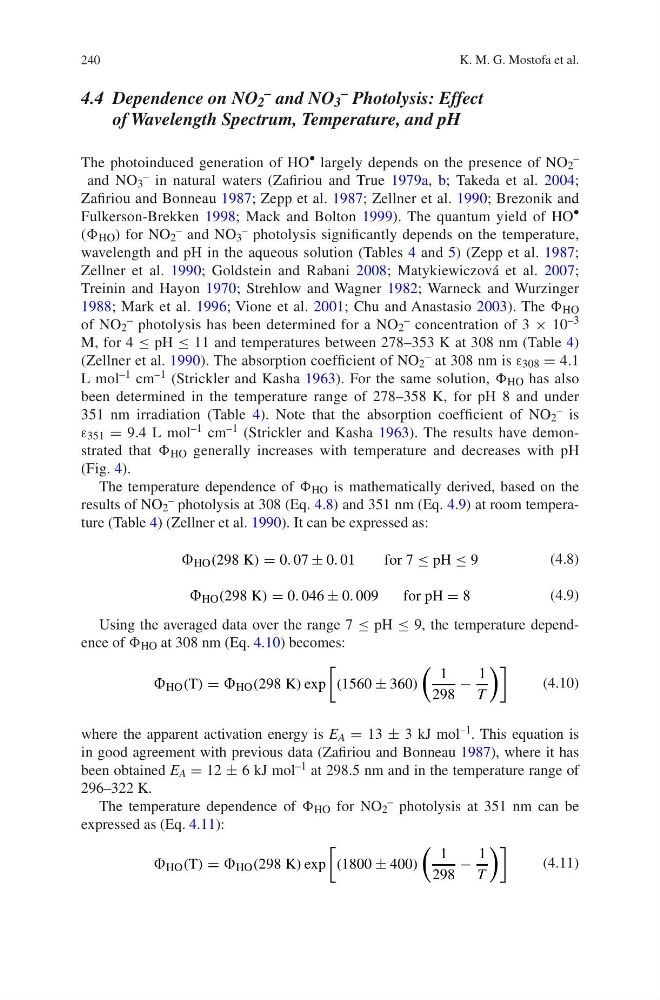
The temperature dependence of Φ HO is mathematically derived, based on the
results of NO 2
– photolysis at 308 (Eq. 4.8) and 351 nm (Eq. 4.9) at room temperature (Table 4) (Zellner et al. 1990). It can be expressed as:
Using the averaged data over the range 7 ≤ pH ≤ 9, the temperature dependence of Φ HO at 308 nm (Eq. 4.10) becomes:
where the apparent activation energy is E A = 13 ± 3 kJ mol –1 . This equation is
in good agreement with previous data (Zafiriou and Bonneau 1987), where it has
been obtained E A = 12 ± 6 kJ mol –1 at 298.5 nm and in the temperature range of
296–322 K.
The temperature dependence of Φ HO for NO 2
– photolysis at 351 nm can be
expressed as (Eq. 4.11):
(4.8)
Φ HO (298 K) = 0. 07 ± 0. 01
for 7 ≤ pH ≤ 9
(4.9)
Φ HO (298 K) = 0. 046 ± 0. 009
for pH = 8
(4.10)
Φ HO (T) = Φ HO (298 K) exp
(1560 ± 360)
1
298
−
1
T
(4.11)
Φ HO (T) = Φ HO (298 K) exp
(1800 ± 400)
1
298
−
1
T
K. M. G. Mostofa et al.
4.4 Dependence on NO 2
– and NO 3
– Photolysis: Effect
of Wavelength Spectrum, Temperature, and pH
The photoinduced generation of HO
• largely depends on the presence of NO 2
–
and NO 3
– in natural waters (Zafiriou and True 1979a, b; Takeda et al. 2004;
Zafiriou and Bonneau 1987; Zepp et al. 1987; Zellner et al. 1990; Brezonik and
Fulkerson-Brekken 1998; Mack and Bolton 1999). The quantum yield of HO
•
(Φ HO ) for NO 2
– and NO 3
– photolysis significantly depends on the temperature,
wavelength and pH in the aqueous solution (Tables 4 and 5) (Zepp et al. 1987;
Zellner et al. 1990; Goldstein and Rabani 2008; Matykiewiczová et al. 2007;
Treinin and Hayon 1970; Strehlow and Wagner 1982; Warneck and Wurzinger
1988; Mark et al. 1996; Vione et al. 2001; Chu and Anastasio 2003). The Φ HO
of NO 2
– photolysis has been determined for a NO 2
– concentration of 3 × 10 –3
M, for 4 ≤ pH ≤ 11 and temperatures between 278–353 K at 308 nm (Table 4)
(Zellner et al. 1990). The absorption coefficient of NO 2
– at 308 nm is ε 308 = 4.1
L mol –1 cm –1 (Strickler and Kasha 1963). For the same solution, Φ HO has also
been determined in the temperature range of 278–358 K, for pH 8 and under
351 nm irradiation (Table 4). Note that the absorption coefficient of NO 2
– is
ε 351 = 9.4 L mol –1 cm –1 (Strickler and Kasha 1963). The results have demonstrated that Φ HO generally increases with temperature and decreases with pH
(Fig. 4).
The temperature dependence of Φ HO is mathematically derived, based on the
results of NO 2
– photolysis at 308 (Eq. 4.8) and 351 nm (Eq. 4.9) at room temperature (Table 4) (Zellner et al. 1990). It can be expressed as:
Using the averaged data over the range 7 ≤ pH ≤ 9, the temperature dependence of Φ HO at 308 nm (Eq. 4.10) becomes:
where the apparent activation energy is E A = 13 ± 3 kJ mol –1 . This equation is
in good agreement with previous data (Zafiriou and Bonneau 1987), where it has
been obtained E A = 12 ± 6 kJ mol –1 at 298.5 nm and in the temperature range of
296–322 K.
The temperature dependence of Φ HO for NO 2
– photolysis at 351 nm can be
expressed as (Eq. 4.11):
(4.8)
Φ HO (298 K) = 0. 07 ± 0. 01
for 7 ≤ pH ≤ 9
(4.9)
Φ HO (298 K) = 0. 046 ± 0. 009
for pH = 8
(4.10)
Φ HO (T) = Φ HO (298 K) exp
(1560 ± 360)
1
298
−
1
T
(4.11)
Φ HO (T) = Φ HO (298 K) exp
(1800 ± 400)
1
298
−
1
T