

239
Photoinduced Generation of Hydroxyl Radical in Natural Waters
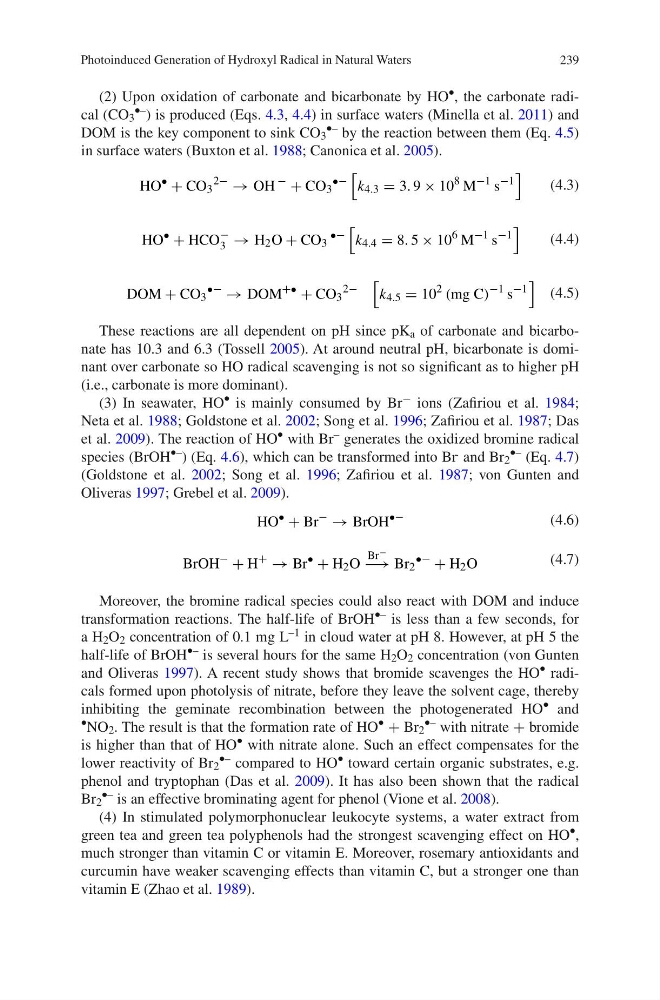
(2) Upon oxidation of carbonate and bicarbonate by HO
•
, the carbonate radical (CO 3
•– ) is produced (Eqs. 4.3, 4.4) in surface waters (Minella et al. 2011) and
DOM is the key component to sink CO 3
•– by the reaction between them (Eq. 4.5)
in surface waters (Buxton et al. 1988; Canonica et al. 2005).
These reactions are all dependent on pH since pK a of carbonate and bicarbonate has 10.3 and 6.3 (Tossell 2005). At around neutral pH, bicarbonate is dominant over carbonate so HO radical scavenging is not so significant as to higher pH
(i.e., carbonate is more dominant).
(3) In seawater, HO
• is mainly consumed by Br − ions (Zafiriou et al. 1984;
Neta et al. 1988; Goldstone et al. 2002; Song et al. 1996; Zafiriou et al. 1987; Das
et al. 2009). The reaction of HO
• with Br – generates the oxidized bromine radical
species (BrOH
•–
) (Eq. 4.6), which can be transformed into Br . and Br 2
•– (Eq. 4.7)
(Goldstone et al. 2002; Song et al. 1996; Zafiriou et al. 1987; von Gunten and
Oliveras 1997; Grebel et al. 2009).
Moreover, the bromine radical species could also react with DOM and induce
transformation reactions. The half-life of BrOH
•– is less than a few seconds, for
a H 2 O 2 concentration of 0.1 mg L –1 in cloud water at pH 8. However, at pH 5 the
half-life of BrOH
•– is several hours for the same H 2 O 2 concentration (von Gunten
and Oliveras 1997). A recent study shows that bromide scavenges the HO
• radicals formed upon photolysis of nitrate, before they leave the solvent cage, thereby
inhibiting the geminate recombination between the photogenerated HO
• and
• NO 2 . The result is that the formation rate of HO
• + Br 2
•– with nitrate + bromide
is higher than that of HO
• with nitrate alone. Such an effect compensates for the
lower reactivity of Br 2
•– compared to HO
• toward certain organic substrates, e.g.
phenol and tryptophan (Das et al. 2009). It has also been shown that the radical
Br 2
•– is an effective brominating agent for phenol (Vione et al. 2008).
(4) In stimulated polymorphonuclear leukocyte systems, a water extract from
green tea and green tea polyphenols had the strongest scavenging effect on HO
• ,
much stronger than vitamin C or vitamin E. Moreover, rosemary antioxidants and
curcumin have weaker scavenging effects than vitamin C, but a stronger one than
vitamin E (Zhao et al. 1989).
(4.3)
HO
• + CO 3
2− → OH
− + CO 3
•−
k 4.3 = 3. 9 × 10
8 M
−1 s
−1
(4.4)
HO
• + HCO
−
3 → H 2 O + CO 3
•−
k 4.4 = 8. 5 × 10
6 M
−1 s
−1
(4.5)
DOM + CO 3
•− → DOM
+• + CO 3
2−
k 4.5 = 10
2 (mg C)
−1 s
−1
(4.6)
HO
• + Br
− → BrOH
•−
(4.7)
BrOH
− + H
+ → Br
• + H 2 O
Br −
−→ Br 2
•− + H 2 O
Photoinduced Generation of Hydroxyl Radical in Natural Waters
(2) Upon oxidation of carbonate and bicarbonate by HO
•
, the carbonate radical (CO 3
•– ) is produced (Eqs. 4.3, 4.4) in surface waters (Minella et al. 2011) and
DOM is the key component to sink CO 3
•– by the reaction between them (Eq. 4.5)
in surface waters (Buxton et al. 1988; Canonica et al. 2005).
These reactions are all dependent on pH since pK a of carbonate and bicarbonate has 10.3 and 6.3 (Tossell 2005). At around neutral pH, bicarbonate is dominant over carbonate so HO radical scavenging is not so significant as to higher pH
(i.e., carbonate is more dominant).
(3) In seawater, HO
• is mainly consumed by Br − ions (Zafiriou et al. 1984;
Neta et al. 1988; Goldstone et al. 2002; Song et al. 1996; Zafiriou et al. 1987; Das
et al. 2009). The reaction of HO
• with Br – generates the oxidized bromine radical
species (BrOH
•–
) (Eq. 4.6), which can be transformed into Br . and Br 2
•– (Eq. 4.7)
(Goldstone et al. 2002; Song et al. 1996; Zafiriou et al. 1987; von Gunten and
Oliveras 1997; Grebel et al. 2009).
Moreover, the bromine radical species could also react with DOM and induce
transformation reactions. The half-life of BrOH
•– is less than a few seconds, for
a H 2 O 2 concentration of 0.1 mg L –1 in cloud water at pH 8. However, at pH 5 the
half-life of BrOH
•– is several hours for the same H 2 O 2 concentration (von Gunten
and Oliveras 1997). A recent study shows that bromide scavenges the HO
• radicals formed upon photolysis of nitrate, before they leave the solvent cage, thereby
inhibiting the geminate recombination between the photogenerated HO
• and
• NO 2 . The result is that the formation rate of HO
• + Br 2
•– with nitrate + bromide
is higher than that of HO
• with nitrate alone. Such an effect compensates for the
lower reactivity of Br 2
•– compared to HO
• toward certain organic substrates, e.g.
phenol and tryptophan (Das et al. 2009). It has also been shown that the radical
Br 2
•– is an effective brominating agent for phenol (Vione et al. 2008).
(4) In stimulated polymorphonuclear leukocyte systems, a water extract from
green tea and green tea polyphenols had the strongest scavenging effect on HO
• ,
much stronger than vitamin C or vitamin E. Moreover, rosemary antioxidants and
curcumin have weaker scavenging effects than vitamin C, but a stronger one than
vitamin E (Zhao et al. 1989).
(4.3)
HO
• + CO 3
2− → OH
− + CO 3
•−
k 4.3 = 3. 9 × 10
8 M
−1 s
−1
(4.4)
HO
• + HCO
−
3 → H 2 O + CO 3
•−
k 4.4 = 8. 5 × 10
6 M
−1 s
−1
(4.5)
DOM + CO 3
•− → DOM
+• + CO 3
2−
k 4.5 = 10
2 (mg C)
−1 s
−1
(4.6)
HO
• + Br
− → BrOH
•−
(4.7)
BrOH
− + H
+ → Br
• + H 2 O
Br −
−→ Br 2
•− + H 2 O