

229
Photoinduced Generation of Hydroxyl Radical in Natural Waters
As far as NO 3
– photolysis is concerned (Eq. 3.8), the process can be expressed
as follows (Zepp et al. 1987; Mack and Bolton 1999):
This stoichiometry can be followed in the absence of HO
• scavengers, over the
entire pH range and at irradiation wavelength around 200 nm (Shuali et al. 1969;
Wagner et al. 1980). However, irradiation above 280 nm results into two primary
photoinduced pathways (Zepp et al. 1987; Mack and Bolton 1999):
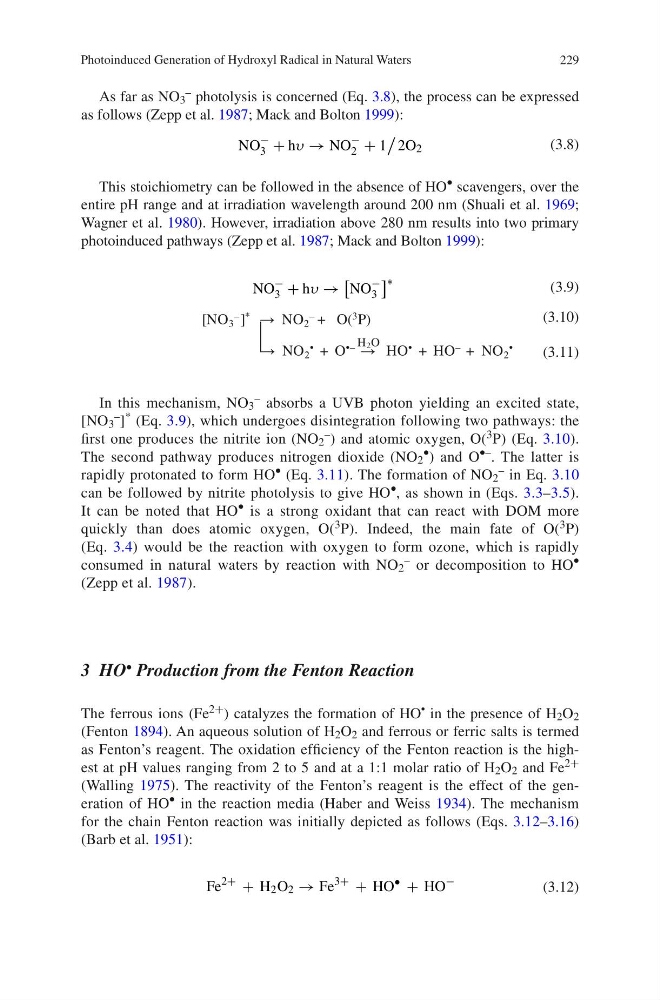
In this mechanism, NO 3
– absorbs a UVB photon yielding an excited state,
[NO 3
– ] * (Eq. 3.9), which undergoes disintegration following two pathways: the
first one produces the nitrite ion (NO 2
– ) and atomic oxygen, O( 3 P) (Eq. 3.10).
The second pathway produces nitrogen dioxide (NO 2
• ) and O
•– . The latter is
rapidly protonated to form HO
• (Eq. 3.11). The formation of NO 2
– in Eq. 3.10
can be followed by nitrite photolysis to give HO
•
, as shown in (Eqs. 3.3–3.5).
It can be noted that HO
• is a strong oxidant that can react with DOM more
quickly than does atomic oxygen, O( 3 P). Indeed, the main fate of O( 3 P)
(Eq. 3.4) would be the reaction with oxygen to form ozone, which is rapidly
consumed in natural waters by reaction with NO 2
– or decomposition to HO
•
(Zepp et al. 1987).
3 HO
•
Production from the Fenton Reaction
The ferrous ions (Fe 2+ ) catalyzes the formation of HO • in the presence of H 2 O 2
(Fenton 1894). An aqueous solution of H 2 O 2 and ferrous or ferric salts is termed
as Fenton’s reagent. The oxidation efficiency of the Fenton reaction is the highest at pH values ranging from 2 to 5 and at a 1:1 molar ratio of H 2 O 2 and Fe 2+
(Walling 1975). The reactivity of the Fenton’s reagent is the effect of the generation of HO
• in the reaction media (Haber and Weiss 1934). The mechanism
for the chain Fenton reaction was initially depicted as follows (Eqs. 3.12–3.16)
(Barb et al. 1951):
(3.8)
NO
−
3 + hυ → NO
−
2 + 1
2O 2
(3.9)
NO
−
3 + hυ →
NO
−
3
∗
(3.10)
[NO 3
– ] *
NO 2
– + O( 3 P)
(3.11)
NO 2
• + O •–
HO • + HO – + NO 2
•
H 2 O
(3.12)
Fe
2+ + H 2 O 2 → Fe
3+ + HO
• + HO
−
Photoinduced Generation of Hydroxyl Radical in Natural Waters
As far as NO 3
– photolysis is concerned (Eq. 3.8), the process can be expressed
as follows (Zepp et al. 1987; Mack and Bolton 1999):
This stoichiometry can be followed in the absence of HO
• scavengers, over the
entire pH range and at irradiation wavelength around 200 nm (Shuali et al. 1969;
Wagner et al. 1980). However, irradiation above 280 nm results into two primary
photoinduced pathways (Zepp et al. 1987; Mack and Bolton 1999):
In this mechanism, NO 3
– absorbs a UVB photon yielding an excited state,
[NO 3
– ] * (Eq. 3.9), which undergoes disintegration following two pathways: the
first one produces the nitrite ion (NO 2
– ) and atomic oxygen, O( 3 P) (Eq. 3.10).
The second pathway produces nitrogen dioxide (NO 2
• ) and O
•– . The latter is
rapidly protonated to form HO
• (Eq. 3.11). The formation of NO 2
– in Eq. 3.10
can be followed by nitrite photolysis to give HO
•
, as shown in (Eqs. 3.3–3.5).
It can be noted that HO
• is a strong oxidant that can react with DOM more
quickly than does atomic oxygen, O( 3 P). Indeed, the main fate of O( 3 P)
(Eq. 3.4) would be the reaction with oxygen to form ozone, which is rapidly
consumed in natural waters by reaction with NO 2
– or decomposition to HO
•
(Zepp et al. 1987).
3 HO
•
Production from the Fenton Reaction
The ferrous ions (Fe 2+ ) catalyzes the formation of HO • in the presence of H 2 O 2
(Fenton 1894). An aqueous solution of H 2 O 2 and ferrous or ferric salts is termed
as Fenton’s reagent. The oxidation efficiency of the Fenton reaction is the highest at pH values ranging from 2 to 5 and at a 1:1 molar ratio of H 2 O 2 and Fe 2+
(Walling 1975). The reactivity of the Fenton’s reagent is the effect of the generation of HO
• in the reaction media (Haber and Weiss 1934). The mechanism
for the chain Fenton reaction was initially depicted as follows (Eqs. 3.12–3.16)
(Barb et al. 1951):
(3.8)
NO
−
3 + hυ → NO
−
2 + 1
2O 2
(3.9)
NO
−
3 + hυ →
NO
−
3
∗
(3.10)
[NO 3
– ] *
NO 2
– + O( 3 P)
(3.11)
NO 2
• + O •–
HO • + HO – + NO 2
•
H 2 O
(3.12)
Fe
2+ + H 2 O 2 → Fe
3+ + HO
• + HO
−