

219
Photoinduced Generation of Hydroxyl Radical in Natural Waters
where r P is the photo-formation rate of phenol obtained experimentally
(M s –1 ), F B,HO is the fraction of HO radicals that react with benzene [i.e., k HO/
Ph × C HO × C Ph /(k HO/Ph × C HO × C Ph + ∑ k i C HO C i ), where i is scavenger], and Y P is the yield of phenol formed per benzene oxidized by HO
•
. It is
Y P = 0.75 ± 0.07 in natural waters (Arakaki and Faust 1998). The F B,OH values
are much variable for a variety of natural waters, also depending on the concentration of added benzene and on the amount of the natural HO
• scavengers. For
addition of 1.2 mM benzene it has been found F B,HO = 0.94 for cloud waters
(Arakaki and Faust 1998), 0.92 and 0.99 for rivers, and 0.68 for seawaters (Takeda
et al. 2004). The high values of F B,HO in rivers and cloud suggest that most of
the HO radicals formed photolytically reacts with benzene. In contrast, the low
value in seawater samples suggests the 32–34 % of photolytically formed HO radicals reacts with various scavengers of HO radical other than benzene. There are
many scavengers, DOM components, HCO 3
– , CO 3
2– , NO 2
– , halides (X − , but chloride only in acidic medium) etc. that can interact with HO
• in aqueous solution
(Zafiriou 1974; Mopper and Zhou 1990; Vione et al. 2006; Zepp et al. 1987;
Voelker and Sulzberger 1996; Minakata et al. 2009). In seawater, the bromide ion
(Br − ) alone scavenges approximately 93 % of photo-generated HO
• (Mopper and
Zhou 1990).
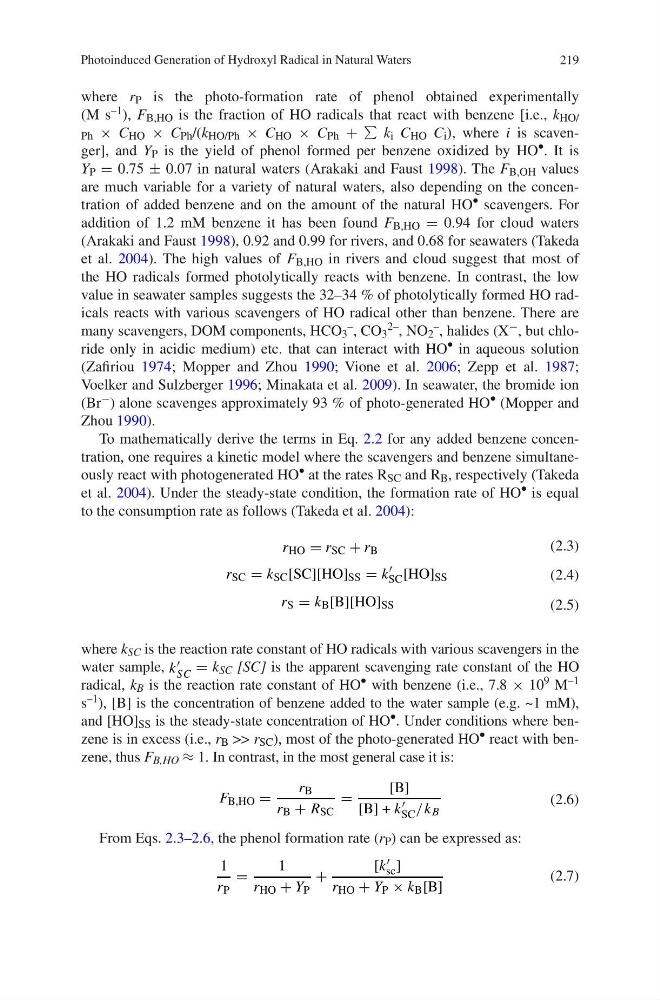
To mathematically derive the terms in Eq. 2.2 for any added benzene concentration, one requires a kinetic model where the scavengers and benzene simultaneously react with photogenerated HO
• at the rates R SC and R B , respectively (Takeda
et al. 2004). Under the steady-state condition, the formation rate of HO
• is equal
to the consumption rate as follows (Takeda et al. 2004):
where k SC is the reaction rate constant of HO radicals with various scavengers in the
water sample, k ′
SC
= k SC [SC] is the apparent scavenging rate constant of the HO
radical, k B is the reaction rate constant of HO
• with benzene (i.e., 7.8 × 10 9 M –1
s –1 ), [B] is the concentration of benzene added to the water sample (e.g. ~1 mM),
and [HO] SS is the steady-state concentration of HO
•
. Under conditions where benzene is in excess (i.e., r B >> r SC ), most of the photo-generated HO
• react with benzene, thus F B,HO ≈ 1. In contrast, in the most general case it is:
From Eqs. 2.3–2.6, the phenol formation rate (r P ) can be expressed as:
(2.3)
r HO = r SC + r B
(2.4)
r SC = k SC [SC][HO] SS = k
′
SC [HO] SS
(2.5)
r S = k B [B][HO] SS
(2.6)
F B,HO =
r B
r B + R SC
=
[B]
[B] + k ′
SC /k B
(2.7)
1
r P
=
1
r HO + Y P
+
[k ′
sc ]
r HO + Y P × k B [B]
Photoinduced Generation of Hydroxyl Radical in Natural Waters
where r P is the photo-formation rate of phenol obtained experimentally
(M s –1 ), F B,HO is the fraction of HO radicals that react with benzene [i.e., k HO/
Ph × C HO × C Ph /(k HO/Ph × C HO × C Ph + ∑ k i C HO C i ), where i is scavenger], and Y P is the yield of phenol formed per benzene oxidized by HO
•
. It is
Y P = 0.75 ± 0.07 in natural waters (Arakaki and Faust 1998). The F B,OH values
are much variable for a variety of natural waters, also depending on the concentration of added benzene and on the amount of the natural HO
• scavengers. For
addition of 1.2 mM benzene it has been found F B,HO = 0.94 for cloud waters
(Arakaki and Faust 1998), 0.92 and 0.99 for rivers, and 0.68 for seawaters (Takeda
et al. 2004). The high values of F B,HO in rivers and cloud suggest that most of
the HO radicals formed photolytically reacts with benzene. In contrast, the low
value in seawater samples suggests the 32–34 % of photolytically formed HO radicals reacts with various scavengers of HO radical other than benzene. There are
many scavengers, DOM components, HCO 3
– , CO 3
2– , NO 2
– , halides (X − , but chloride only in acidic medium) etc. that can interact with HO
• in aqueous solution
(Zafiriou 1974; Mopper and Zhou 1990; Vione et al. 2006; Zepp et al. 1987;
Voelker and Sulzberger 1996; Minakata et al. 2009). In seawater, the bromide ion
(Br − ) alone scavenges approximately 93 % of photo-generated HO
• (Mopper and
Zhou 1990).
To mathematically derive the terms in Eq. 2.2 for any added benzene concentration, one requires a kinetic model where the scavengers and benzene simultaneously react with photogenerated HO
• at the rates R SC and R B , respectively (Takeda
et al. 2004). Under the steady-state condition, the formation rate of HO
• is equal
to the consumption rate as follows (Takeda et al. 2004):
where k SC is the reaction rate constant of HO radicals with various scavengers in the
water sample, k ′
SC
= k SC [SC] is the apparent scavenging rate constant of the HO
radical, k B is the reaction rate constant of HO
• with benzene (i.e., 7.8 × 10 9 M –1
s –1 ), [B] is the concentration of benzene added to the water sample (e.g. ~1 mM),
and [HO] SS is the steady-state concentration of HO
•
. Under conditions where benzene is in excess (i.e., r B >> r SC ), most of the photo-generated HO
• react with benzene, thus F B,HO ≈ 1. In contrast, in the most general case it is:
From Eqs. 2.3–2.6, the phenol formation rate (r P ) can be expressed as:
(2.3)
r HO = r SC + r B
(2.4)
r SC = k SC [SC][HO] SS = k
′
SC [HO] SS
(2.5)
r S = k B [B][HO] SS
(2.6)
F B,HO =
r B
r B + R SC
=
[B]
[B] + k ′
SC /k B
(2.7)
1
r P
=
1
r HO + Y P
+
[k ′
sc ]
r HO + Y P × k B [B]