

218
K. M. G. Mostofa et al.
Fang et al. 1996). Other substrates, such as benzoic acid and nitrobenzene are less
suitable as HO
• probe molecules (Vione et al. 2010). The photoinduced generation
of HO
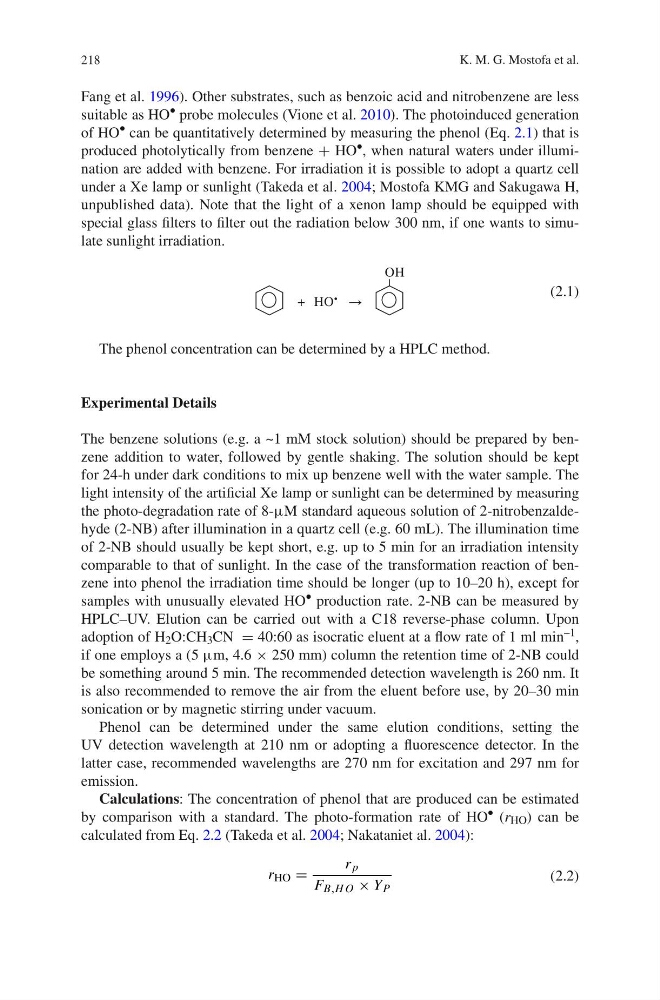
• can be quantitatively determined by measuring the phenol (Eq. 2.1) that is
produced photolytically from benzene + HO
• , when natural waters under illumination are added with benzene. For irradiation it is possible to adopt a quartz cell
under a Xe lamp or sunlight (Takeda et al. 2004; Mostofa KMG and Sakugawa H,
unpublished data). Note that the light of a xenon lamp should be equipped with
special glass filters to filter out the radiation below 300 nm, if one wants to simulate sunlight irradiation.
The phenol concentration can be determined by a HPLC method.
Experimental Details
The benzene solutions (e.g. a ~1 mM stock solution) should be prepared by benzene addition to water, followed by gentle shaking. The solution should be kept
for 24-h under dark conditions to mix up benzene well with the water sample. The
light intensity of the artificial Xe lamp or sunlight can be determined by measuring
the photo-degradation rate of 8-μM standard aqueous solution of 2-nitrobenzaldehyde (2-NB) after illumination in a quartz cell (e.g. 60 mL). The illumination time
of 2-NB should usually be kept short, e.g. up to 5 min for an irradiation intensity
comparable to that of sunlight. In the case of the transformation reaction of benzene into phenol the irradiation time should be longer (up to 10–20 h), except for
samples with unusually elevated HO
• production rate. 2-NB can be measured by
HPLC–UV. Elution can be carried out with a C18 reverse-phase column. Upon
adoption of H 2 O:CH 3 CN = 40:60 as isocratic eluent at a flow rate of 1 ml min –1 ,
if one employs a (5 μm, 4.6 × 250 mm) column the retention time of 2-NB could
be something around 5 min. The recommended detection wavelength is 260 nm. It
is also recommended to remove the air from the eluent before use, by 20–30 min
sonication or by magnetic stirring under vacuum.
Phenol can be determined under the same elution conditions, setting the
UV detection wavelength at 210 nm or adopting a fluorescence detector. In the
latter case, recommended wavelengths are 270 nm for excitation and 297 nm for
emission.
Calculations: The concentration of phenol that are produced can be estimated
by comparison with a standard. The photo-formation rate of HO
• (r HO ) can be
calculated from Eq. 2.2 (Takeda et al. 2004; Nakataniet al. 2004):
(2.1)
+ HO •
OH
(2.2)
r HO =
r p
F B,H O × Y P
K. M. G. Mostofa et al.
Fang et al. 1996). Other substrates, such as benzoic acid and nitrobenzene are less
suitable as HO
• probe molecules (Vione et al. 2010). The photoinduced generation
of HO
• can be quantitatively determined by measuring the phenol (Eq. 2.1) that is
produced photolytically from benzene + HO
• , when natural waters under illumination are added with benzene. For irradiation it is possible to adopt a quartz cell
under a Xe lamp or sunlight (Takeda et al. 2004; Mostofa KMG and Sakugawa H,
unpublished data). Note that the light of a xenon lamp should be equipped with
special glass filters to filter out the radiation below 300 nm, if one wants to simulate sunlight irradiation.
The phenol concentration can be determined by a HPLC method.
Experimental Details
The benzene solutions (e.g. a ~1 mM stock solution) should be prepared by benzene addition to water, followed by gentle shaking. The solution should be kept
for 24-h under dark conditions to mix up benzene well with the water sample. The
light intensity of the artificial Xe lamp or sunlight can be determined by measuring
the photo-degradation rate of 8-μM standard aqueous solution of 2-nitrobenzaldehyde (2-NB) after illumination in a quartz cell (e.g. 60 mL). The illumination time
of 2-NB should usually be kept short, e.g. up to 5 min for an irradiation intensity
comparable to that of sunlight. In the case of the transformation reaction of benzene into phenol the irradiation time should be longer (up to 10–20 h), except for
samples with unusually elevated HO
• production rate. 2-NB can be measured by
HPLC–UV. Elution can be carried out with a C18 reverse-phase column. Upon
adoption of H 2 O:CH 3 CN = 40:60 as isocratic eluent at a flow rate of 1 ml min –1 ,
if one employs a (5 μm, 4.6 × 250 mm) column the retention time of 2-NB could
be something around 5 min. The recommended detection wavelength is 260 nm. It
is also recommended to remove the air from the eluent before use, by 20–30 min
sonication or by magnetic stirring under vacuum.
Phenol can be determined under the same elution conditions, setting the
UV detection wavelength at 210 nm or adopting a fluorescence detector. In the
latter case, recommended wavelengths are 270 nm for excitation and 297 nm for
emission.
Calculations: The concentration of phenol that are produced can be estimated
by comparison with a standard. The photo-formation rate of HO
• (r HO ) can be
calculated from Eq. 2.2 (Takeda et al. 2004; Nakataniet al. 2004):
(2.1)
+ HO •
OH
(2.2)
r HO =
r p
F B,H O × Y P