

191
Photoinduced and Microbial Generation of Hydrogen Peroxide
thus contribute to the good health and efficient growth of plants. However, high
concentrations of H 2 O 2 (50–100 μM) in the presence of iron (Fe) and oxalate can
generate HO • that would decrease the plant productivity and growth (Kobayashi et
al. 2002). Furthermore, the ability of H 2 O 2 and ROOH compounds to act as antibacterial and anti-fungal agents additionally suggests that an optimal level of peroxides could play a positive role toward good health and efficient growth of earth’s
plants.
5.7 Role of H 2 O 2 in Oxygen Production by Photosynthesis
Photosynthetic O 2 evolution involves different stages that carry out a gradual accumulation of oxidizing equivalents in the Mn-containing water-oxidizing complex
(WOC) (Samuilov et al. 2001). The WOC can exist in different oxidation states
(S n , where high n indicates the most oxidised states), which can be probed by
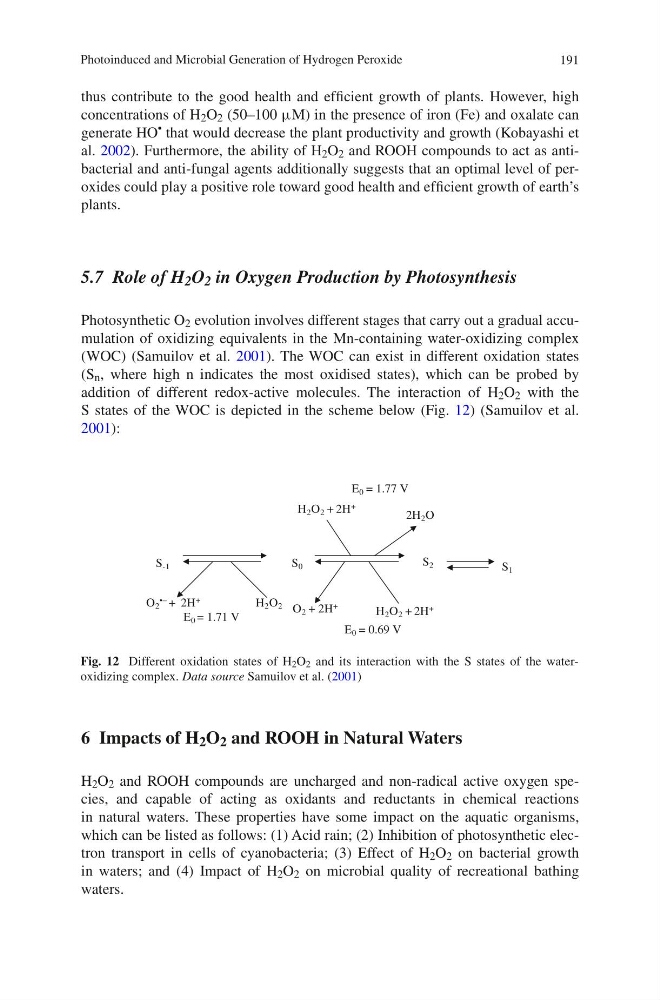
addition of different redox-active molecules. The interaction of H 2 O 2 with the
S states of the WOC is depicted in the scheme below (Fig. 12) (Samuilov et al.
2001):
6 Impacts of H 2 O 2 and ROOH in Natural Waters
H 2 O 2 and ROOH compounds are uncharged and non-radical active oxygen species, and capable of acting as oxidants and reductants in chemical reactions
in natural waters. These properties have some impact on the aquatic organisms,
which can be listed as follows: (1) Acid rain; (2) Inhibition of photosynthetic electron transport in cells of cyanobacteria; (3) Effect of H 2 O 2 on bacterial growth
in waters; and (4) Impact of H 2 O 2 on microbial quality of recreational bathing
waters.
S -1
O 2
•– + 2H +
H 2 O 2
E 0 = 1.71 V
S 0
2H 2 O
H 2 O 2 + 2H +
O 2 + 2H +
H 2 O 2 + 2H +
S 2
S 1
E 0 = 0.69 V
E 0 = 1.77 V
Fig. 12 Different oxidation states of H 2 O 2 and its interaction with the S states of the wateroxidizing complex. Data source Samuilov et al. (2001)
Photoinduced and Microbial Generation of Hydrogen Peroxide
thus contribute to the good health and efficient growth of plants. However, high
concentrations of H 2 O 2 (50–100 μM) in the presence of iron (Fe) and oxalate can
generate HO • that would decrease the plant productivity and growth (Kobayashi et
al. 2002). Furthermore, the ability of H 2 O 2 and ROOH compounds to act as antibacterial and anti-fungal agents additionally suggests that an optimal level of peroxides could play a positive role toward good health and efficient growth of earth’s
plants.
5.7 Role of H 2 O 2 in Oxygen Production by Photosynthesis
Photosynthetic O 2 evolution involves different stages that carry out a gradual accumulation of oxidizing equivalents in the Mn-containing water-oxidizing complex
(WOC) (Samuilov et al. 2001). The WOC can exist in different oxidation states
(S n , where high n indicates the most oxidised states), which can be probed by
addition of different redox-active molecules. The interaction of H 2 O 2 with the
S states of the WOC is depicted in the scheme below (Fig. 12) (Samuilov et al.
2001):
6 Impacts of H 2 O 2 and ROOH in Natural Waters
H 2 O 2 and ROOH compounds are uncharged and non-radical active oxygen species, and capable of acting as oxidants and reductants in chemical reactions
in natural waters. These properties have some impact on the aquatic organisms,
which can be listed as follows: (1) Acid rain; (2) Inhibition of photosynthetic electron transport in cells of cyanobacteria; (3) Effect of H 2 O 2 on bacterial growth
in waters; and (4) Impact of H 2 O 2 on microbial quality of recreational bathing
waters.
S -1
O 2
•– + 2H +
H 2 O 2
E 0 = 1.71 V
S 0
2H 2 O
H 2 O 2 + 2H +
O 2 + 2H +
H 2 O 2 + 2H +
S 2
S 1
E 0 = 0.69 V
E 0 = 1.77 V
Fig. 12 Different oxidation states of H 2 O 2 and its interaction with the S states of the wateroxidizing complex. Data source Samuilov et al. (2001)