

190
K. M. G. Mostofa et al.
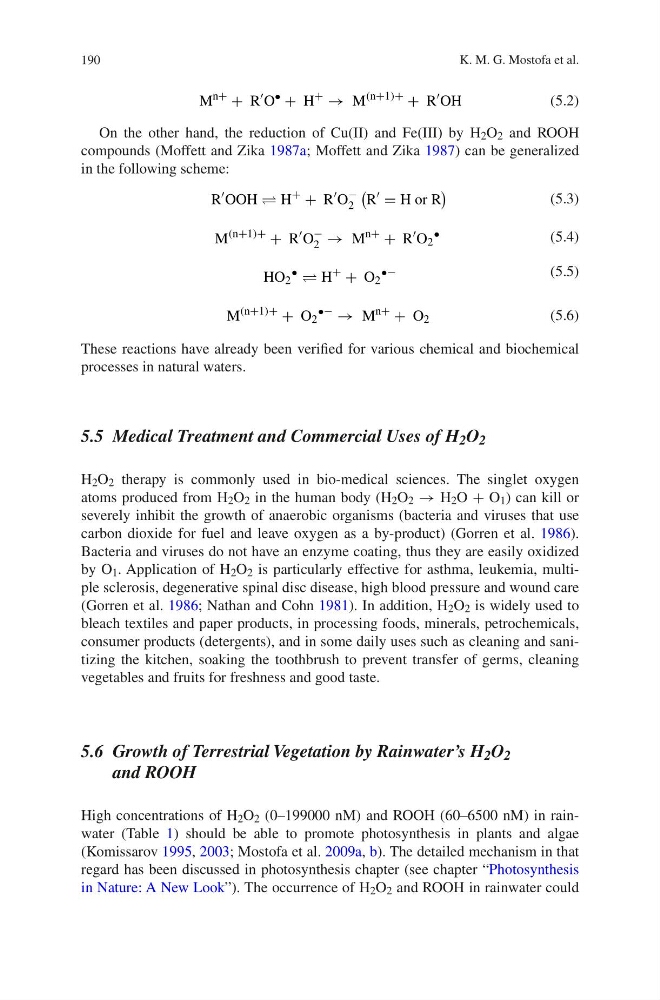
On the other hand, the reduction of Cu(II) and Fe(III) by H 2 O 2 and ROOH
compounds (Moffett and Zika 1987a; Moffett and Zika 1987) can be generalized
in the following scheme:
These reactions have already been verified for various chemical and biochemical
processes in natural waters.
5.5 Medical Treatment and Commercial Uses of H 2 O 2
H 2 O 2 therapy is commonly used in bio-medical sciences. The singlet oxygen
atoms produced from H 2 O 2 in the human body (H 2 O 2 → H 2 O + O 1 ) can kill or
severely inhibit the growth of anaerobic organisms (bacteria and viruses that use
carbon dioxide for fuel and leave oxygen as a by-product) (Gorren et al. 1986).
Bacteria and viruses do not have an enzyme coating, thus they are easily oxidized
by O 1 . Application of H 2 O 2 is particularly effective for asthma, leukemia, multiple sclerosis, degenerative spinal disc disease, high blood pressure and wound care
(Gorren et al. 1986; Nathan and Cohn 1981). In addition, H 2 O 2 is widely used to
bleach textiles and paper products, in processing foods, minerals, petrochemicals,
consumer products (detergents), and in some daily uses such as cleaning and sanitizing the kitchen, soaking the toothbrush to prevent transfer of germs, cleaning
vegetables and fruits for freshness and good taste.
5.6 Growth of Terrestrial Vegetation by Rainwater’s H 2 O 2
and ROOH
High concentrations of H 2 O 2 (0–199000 nM) and ROOH (60–6500 nM) in rainwater (Table 1) should be able to promote photosynthesis in plants and algae
(Komissarov 1995, 2003; Mostofa et al. 2009a, b). The detailed mechanism in that
regard has been discussed in photosynthesis chapter (see chapter “Photosynthesis
in Nature: A New Look”). The occurrence of H 2 O 2 and ROOH in rainwater could
(5.2)
M
n+ + R
′ O
• + H
+ → M
(n+1)+ + R
′ OH
(5.3)
R
′ OOH ⇋ H
+ + R
′ O
−
2
R
′ = H or R
(5.4)
M
(n+1)+ + R
′ O
−
2 → M
n+ + R
′ O 2
•
(5.5)
HO 2
• ⇋ H
+ + O 2
•−
(5.6)
M
(n+1)+ + O 2
•− → M
n+ + O 2
K. M. G. Mostofa et al.
On the other hand, the reduction of Cu(II) and Fe(III) by H 2 O 2 and ROOH
compounds (Moffett and Zika 1987a; Moffett and Zika 1987) can be generalized
in the following scheme:
These reactions have already been verified for various chemical and biochemical
processes in natural waters.
5.5 Medical Treatment and Commercial Uses of H 2 O 2
H 2 O 2 therapy is commonly used in bio-medical sciences. The singlet oxygen
atoms produced from H 2 O 2 in the human body (H 2 O 2 → H 2 O + O 1 ) can kill or
severely inhibit the growth of anaerobic organisms (bacteria and viruses that use
carbon dioxide for fuel and leave oxygen as a by-product) (Gorren et al. 1986).
Bacteria and viruses do not have an enzyme coating, thus they are easily oxidized
by O 1 . Application of H 2 O 2 is particularly effective for asthma, leukemia, multiple sclerosis, degenerative spinal disc disease, high blood pressure and wound care
(Gorren et al. 1986; Nathan and Cohn 1981). In addition, H 2 O 2 is widely used to
bleach textiles and paper products, in processing foods, minerals, petrochemicals,
consumer products (detergents), and in some daily uses such as cleaning and sanitizing the kitchen, soaking the toothbrush to prevent transfer of germs, cleaning
vegetables and fruits for freshness and good taste.
5.6 Growth of Terrestrial Vegetation by Rainwater’s H 2 O 2
and ROOH
High concentrations of H 2 O 2 (0–199000 nM) and ROOH (60–6500 nM) in rainwater (Table 1) should be able to promote photosynthesis in plants and algae
(Komissarov 1995, 2003; Mostofa et al. 2009a, b). The detailed mechanism in that
regard has been discussed in photosynthesis chapter (see chapter “Photosynthesis
in Nature: A New Look”). The occurrence of H 2 O 2 and ROOH in rainwater could
(5.2)
M
n+ + R
′ O
• + H
+ → M
(n+1)+ + R
′ OH
(5.3)
R
′ OOH ⇋ H
+ + R
′ O
−
2
R
′ = H or R
(5.4)
M
(n+1)+ + R
′ O
−
2 → M
n+ + R
′ O 2
•
(5.5)
HO 2
• ⇋ H
+ + O 2
•−
(5.6)
M
(n+1)+ + O 2
•− → M
n+ + O 2