

182
K. M. G. Mostofa et al.
H 2 O 2 due to sunlight effects on algae are 0.04–1.7 × 10 6 M h −1 for five algae at a
concentration of 0.097–1.0 × 10 −3 mg m −3 Chl a (Zepp et al. 1987).
4.3.1 Mechanism of Microbial Decomposition of H 2 O 2 and ROOH
Decay of peroxides (H 2 O 2 and ROOH) by phytoplankton, algae and microbes is a
reverse effect of peroxide production in natural waters. Peroxides (H′OOH, H′ = H
or R) may be decomposed by catalase, peroxidase and superoxide dismutase, produced by phytoplankton, algae and microbes to generate energy for their growth
and to eliminate excessive intracellular levels of H 2 O 2 and O 2
•− (Fujiwara et al.
1993; Moffett and Zafiriou 1990; Zepp et al. 1987; Mostofa et al. (Manuscript in
preparation); Wong et al. 2003). Such a decomposition effect induced by phytoplankton, algae and microbes would usually occur constantly, until the concentration of peroxides reaches a minimum level that would afford inefficient further
decomposition. Catalase enzymatically activates the peroxides (H′OOH * ) to use
them as oxidants (electron acceptors) and reductants (electron donors). Afterwards,
disproportionation of activated H′OOH * converts them into water or alcohols and
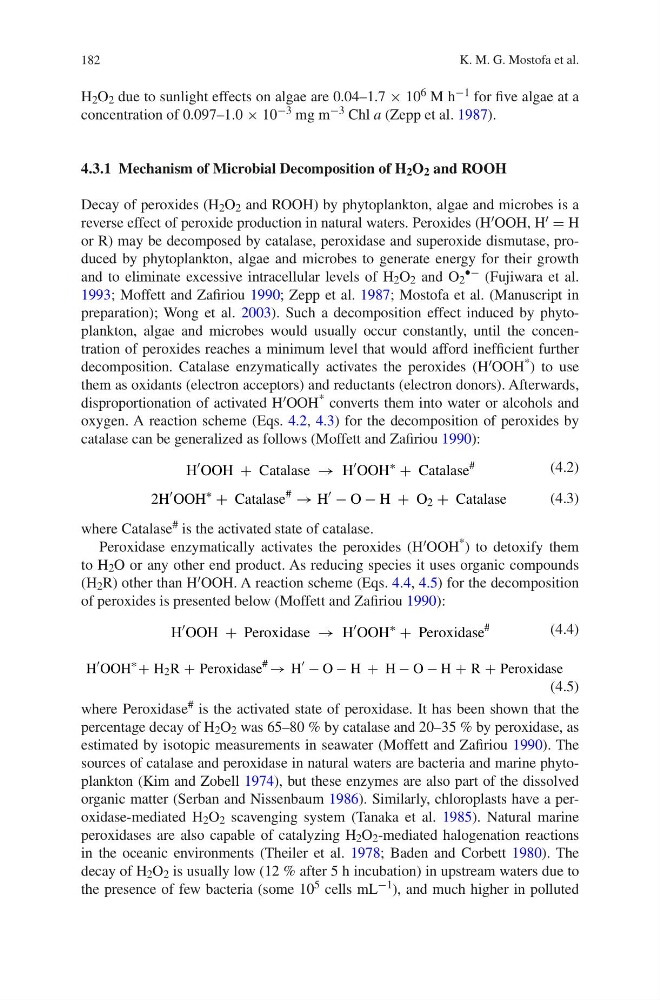
oxygen. A reaction scheme (Eqs. 4.2, 4.3) for the decomposition of peroxides by
catalase can be generalized as follows (Moffett and Zafiriou 1990):
where Catalase # is the activated state of catalase.
Peroxidase enzymatically activates the peroxides (H′OOH * ) to detoxify them
to H 2 O or any other end product. As reducing species it uses organic compounds
(H 2 R) other than H′OOH. A reaction scheme (Eqs. 4.4, 4.5) for the decomposition
of peroxides is presented below (Moffett and Zafiriou 1990):
where Peroxidase # is the activated state of peroxidase. It has been shown that the
percentage decay of H 2 O 2 was 65–80 % by catalase and 20–35 % by peroxidase, as
estimated by isotopic measurements in seawater (Moffett and Zafiriou 1990). The
sources of catalase and peroxidase in natural waters are bacteria and marine phytoplankton (Kim and Zobell 1974), but these enzymes are also part of the dissolved
organic matter (Serban and Nissenbaum 1986). Similarly, chloroplasts have a peroxidase-mediated H 2 O 2 scavenging system (Tanaka et al. 1985). Natural marine
peroxidases are also capable of catalyzing H 2 O 2 -mediated halogenation reactions
in the oceanic environments (Theiler et al. 1978; Baden and Corbett 1980). The
decay of H 2 O 2 is usually low (12 % after 5 h incubation) in upstream waters due to
the presence of few bacteria (some 10 5 cells mL −1 ), and much higher in polluted
(4.2)
H
′ OOH + Catalase → H
′ OOH
∗ + Catalase
#
(4.3)
2H
′ OOH
∗ + Catalase
# → H
′ − O − H + O 2 + Catalase
(4.4)
H
′ OOH + Peroxidase → H
′ OOH
∗ + Peroxidase
#
(4.5)
H
′ OOH
∗ + H 2 R + Peroxidase
# → H
′ − O − H + H − O − H + R + Peroxidase
K. M. G. Mostofa et al.
H 2 O 2 due to sunlight effects on algae are 0.04–1.7 × 10 6 M h −1 for five algae at a
concentration of 0.097–1.0 × 10 −3 mg m −3 Chl a (Zepp et al. 1987).
4.3.1 Mechanism of Microbial Decomposition of H 2 O 2 and ROOH
Decay of peroxides (H 2 O 2 and ROOH) by phytoplankton, algae and microbes is a
reverse effect of peroxide production in natural waters. Peroxides (H′OOH, H′ = H
or R) may be decomposed by catalase, peroxidase and superoxide dismutase, produced by phytoplankton, algae and microbes to generate energy for their growth
and to eliminate excessive intracellular levels of H 2 O 2 and O 2
•− (Fujiwara et al.
1993; Moffett and Zafiriou 1990; Zepp et al. 1987; Mostofa et al. (Manuscript in
preparation); Wong et al. 2003). Such a decomposition effect induced by phytoplankton, algae and microbes would usually occur constantly, until the concentration of peroxides reaches a minimum level that would afford inefficient further
decomposition. Catalase enzymatically activates the peroxides (H′OOH * ) to use
them as oxidants (electron acceptors) and reductants (electron donors). Afterwards,
disproportionation of activated H′OOH * converts them into water or alcohols and
oxygen. A reaction scheme (Eqs. 4.2, 4.3) for the decomposition of peroxides by
catalase can be generalized as follows (Moffett and Zafiriou 1990):
where Catalase # is the activated state of catalase.
Peroxidase enzymatically activates the peroxides (H′OOH * ) to detoxify them
to H 2 O or any other end product. As reducing species it uses organic compounds
(H 2 R) other than H′OOH. A reaction scheme (Eqs. 4.4, 4.5) for the decomposition
of peroxides is presented below (Moffett and Zafiriou 1990):
where Peroxidase # is the activated state of peroxidase. It has been shown that the
percentage decay of H 2 O 2 was 65–80 % by catalase and 20–35 % by peroxidase, as
estimated by isotopic measurements in seawater (Moffett and Zafiriou 1990). The
sources of catalase and peroxidase in natural waters are bacteria and marine phytoplankton (Kim and Zobell 1974), but these enzymes are also part of the dissolved
organic matter (Serban and Nissenbaum 1986). Similarly, chloroplasts have a peroxidase-mediated H 2 O 2 scavenging system (Tanaka et al. 1985). Natural marine
peroxidases are also capable of catalyzing H 2 O 2 -mediated halogenation reactions
in the oceanic environments (Theiler et al. 1978; Baden and Corbett 1980). The
decay of H 2 O 2 is usually low (12 % after 5 h incubation) in upstream waters due to
the presence of few bacteria (some 10 5 cells mL −1 ), and much higher in polluted
(4.2)
H
′ OOH + Catalase → H
′ OOH
∗ + Catalase
#
(4.3)
2H
′ OOH
∗ + Catalase
# → H
′ − O − H + O 2 + Catalase
(4.4)
H
′ OOH + Peroxidase → H
′ OOH
∗ + Peroxidase
#
(4.5)
H
′ OOH
∗ + H 2 R + Peroxidase
# → H
′ − O − H + H − O − H + R + Peroxidase