

171
Photoinduced and Microbial Generation of Hydrogen Peroxide
where F i(DOM) is the contribution percentage to the normalised net H 2 O 2
production rate in the water (%) by each identified fluorescent DOM component, r Fi(DOM) is the normalised H 2 O 2 production rate generated by each identified DOM component, and r net(DOM) is the whole, normalised net H 2 O 2 production
rate in the water samples. The percent contributions of unknown sources of H 2 O 2
in the water samples are estimated using a simple formula: F unknown = 100—
(F FA + F TRYP + F OTHERS ). In the formula, the sum of the normalized H 2 O 2 production rate of FA-like substances (F FA ), tryptophan-like substances (F TRYP ), and
other organic substances if any (F OTHERS ) is subtracted from the normalised, net
H 2 O 2 production rate that is assumed as 100 %.
2.3 Advanced Analytical Method for H 2 O 2 Determination
in Natural Waters
Theory: This method is based on the Fenton reaction, where H 2 O 2 reacts with
Fe 2+ in acidic solution to yield HO
• . The latter is scavenged by an aromatic compound (e.g. benzene) to produce the respective phenolic compound (e.g. phenol)
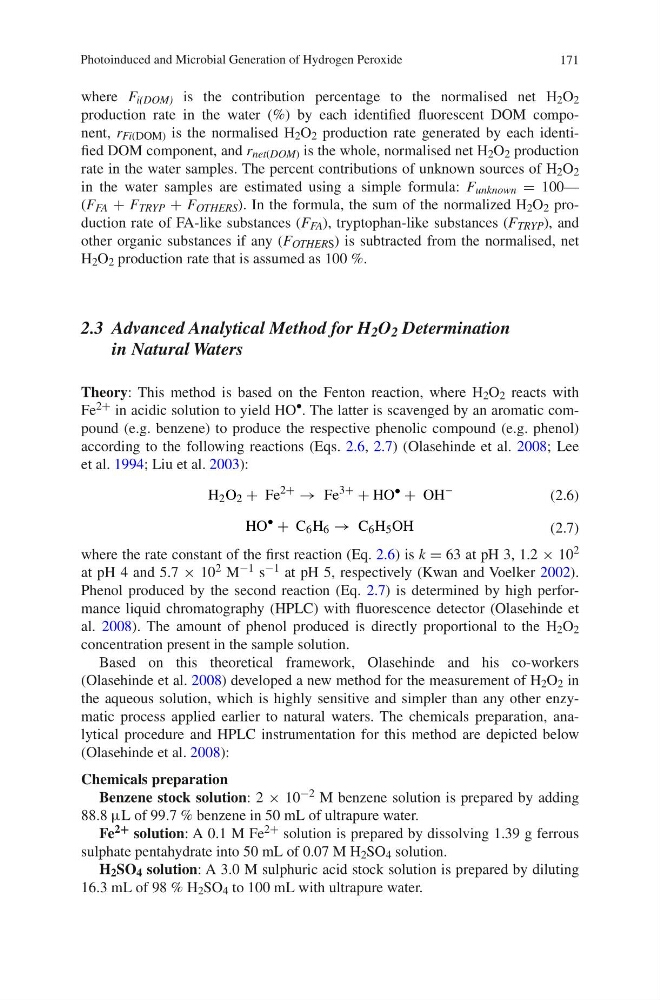
according to the following reactions (Eqs. 2.6, 2.7) (Olasehinde et al. 2008; Lee
et al. 1994; Liu et al. 2003):
where the rate constant of the first reaction (Eq. 2.6) is k = 63 at pH 3, 1.2 × 10 2
at pH 4 and 5.7 × 10 2 M −1 s −1 at pH 5, respectively (Kwan and Voelker 2002).
Phenol produced by the second reaction (Eq. 2.7) is determined by high performance liquid chromatography (HPLC) with fluorescence detector (Olasehinde et
al. 2008). The amount of phenol produced is directly proportional to the H 2 O 2
concentration present in the sample solution.
Based on this theoretical framework, Olasehinde and his co-workers
(Olasehinde et al. 2008) developed a new method for the measurement of H 2 O 2 in
the aqueous solution, which is highly sensitive and simpler than any other enzymatic process applied earlier to natural waters. The chemicals preparation, analytical procedure and HPLC instrumentation for this method are depicted below
(Olasehinde et al. 2008):
Chemicals preparation
Benzene stock solution: 2 × 10 −2 M benzene solution is prepared by adding
88.8 μL of 99.7 % benzene in 50 mL of ultrapure water.
Fe 2+ solution: A 0.1 M Fe 2+ solution is prepared by dissolving 1.39 g ferrous
sulphate pentahydrate into 50 mL of 0.07 M H 2 SO 4 solution.
H 2 SO 4 solution: A 3.0 M sulphuric acid stock solution is prepared by diluting
16.3 mL of 98 % H 2 SO 4 to 100 mL with ultrapure water.
(2.6)
H 2 O 2 + Fe
2+ → Fe
3+ + HO
• + OH
−
(2.7)
HO
• + C 6 H 6 → C 6 H 5 OH
Photoinduced and Microbial Generation of Hydrogen Peroxide
where F i(DOM) is the contribution percentage to the normalised net H 2 O 2
production rate in the water (%) by each identified fluorescent DOM component, r Fi(DOM) is the normalised H 2 O 2 production rate generated by each identified DOM component, and r net(DOM) is the whole, normalised net H 2 O 2 production
rate in the water samples. The percent contributions of unknown sources of H 2 O 2
in the water samples are estimated using a simple formula: F unknown = 100—
(F FA + F TRYP + F OTHERS ). In the formula, the sum of the normalized H 2 O 2 production rate of FA-like substances (F FA ), tryptophan-like substances (F TRYP ), and
other organic substances if any (F OTHERS ) is subtracted from the normalised, net
H 2 O 2 production rate that is assumed as 100 %.
2.3 Advanced Analytical Method for H 2 O 2 Determination
in Natural Waters
Theory: This method is based on the Fenton reaction, where H 2 O 2 reacts with
Fe 2+ in acidic solution to yield HO
• . The latter is scavenged by an aromatic compound (e.g. benzene) to produce the respective phenolic compound (e.g. phenol)
according to the following reactions (Eqs. 2.6, 2.7) (Olasehinde et al. 2008; Lee
et al. 1994; Liu et al. 2003):
where the rate constant of the first reaction (Eq. 2.6) is k = 63 at pH 3, 1.2 × 10 2
at pH 4 and 5.7 × 10 2 M −1 s −1 at pH 5, respectively (Kwan and Voelker 2002).
Phenol produced by the second reaction (Eq. 2.7) is determined by high performance liquid chromatography (HPLC) with fluorescence detector (Olasehinde et
al. 2008). The amount of phenol produced is directly proportional to the H 2 O 2
concentration present in the sample solution.
Based on this theoretical framework, Olasehinde and his co-workers
(Olasehinde et al. 2008) developed a new method for the measurement of H 2 O 2 in
the aqueous solution, which is highly sensitive and simpler than any other enzymatic process applied earlier to natural waters. The chemicals preparation, analytical procedure and HPLC instrumentation for this method are depicted below
(Olasehinde et al. 2008):
Chemicals preparation
Benzene stock solution: 2 × 10 −2 M benzene solution is prepared by adding
88.8 μL of 99.7 % benzene in 50 mL of ultrapure water.
Fe 2+ solution: A 0.1 M Fe 2+ solution is prepared by dissolving 1.39 g ferrous
sulphate pentahydrate into 50 mL of 0.07 M H 2 SO 4 solution.
H 2 SO 4 solution: A 3.0 M sulphuric acid stock solution is prepared by diluting
16.3 mL of 98 % H 2 SO 4 to 100 mL with ultrapure water.
(2.6)
H 2 O 2 + Fe
2+ → Fe
3+ + HO
• + OH
−
(2.7)
HO
• + C 6 H 6 → C 6 H 5 OH