

170
K. M. G. Mostofa et al.
(CH 3 OOOH) is reported in earlier studies (Fig. 8). For ROOH measurement,
50,000 units mL −1 catalase solution was used to decompose nearly all of the
ROOH in the samples during the same six minute reaction. In this way it is possible to provide only the signal of the background DOM or water fluorescence. The
fluorescence-developing reagent is peroxidase mixed with p-hydroxyphenylacetic
acid also in this case. The difference between the fluorescence measurements
using 500 and 50,000 units mL −1 of catalase (decomposition of H 2 O 2 alone and
of H 2 O 2 and ROOH, respectively) provides an estimate of the ROOH concentrations in the samples. Also in this case it is possible to use the external standards
for calibration (Fig. 8b).
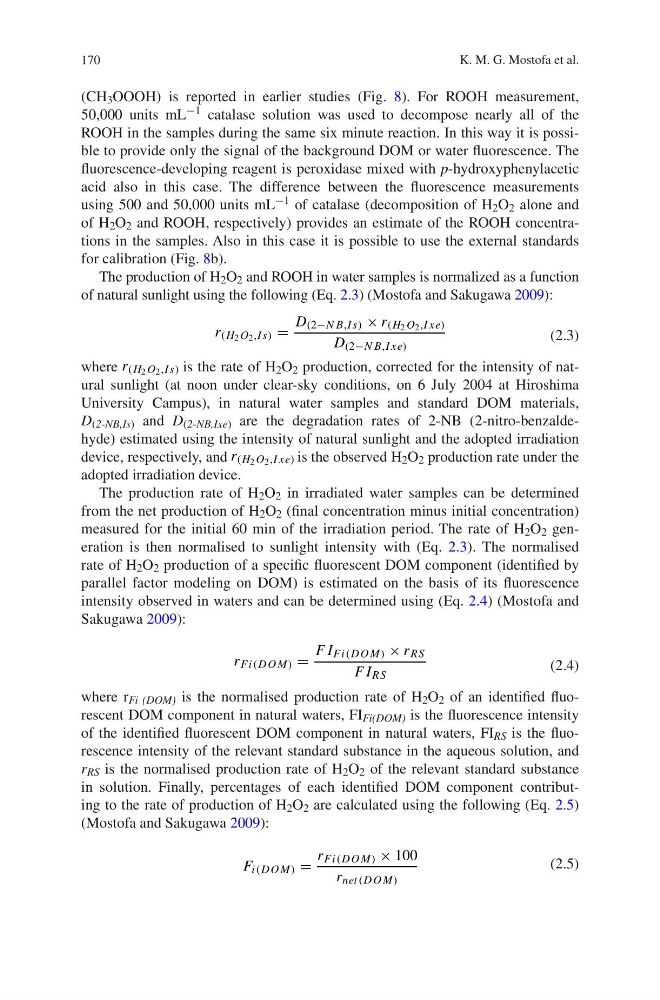
The production of H 2 O 2 and ROOH in water samples is normalized as a function
of natural sunlight using the following (Eq. 2.3) (Mostofa and Sakugawa 2009):
where r (H 2 O 2 ,I s) is the rate of H 2 O 2 production, corrected for the intensity of natural sunlight (at noon under clear-sky conditions, on 6 July 2004 at Hiroshima
University Campus), in natural water samples and standard DOM materials,
D (2-NB,Is) and D (2-NB,Ixe) are the degradation rates of 2-NB (2-nitro-benzaldehyde) estimated using the intensity of natural sunlight and the adopted irradiation
device, respectively, and r (H 2 O 2 ,I xe) is the observed H 2 O 2 production rate under the
adopted irradiation device.
The production rate of H 2 O 2 in irradiated water samples can be determined
from the net production of H 2 O 2 (final concentration minus initial concentration)
measured for the initial 60 min of the irradiation period. The rate of H 2 O 2 generation is then normalised to sunlight intensity with (Eq. 2.3). The normalised
rate of H 2 O 2 production of a specific fluorescent DOM component (identified by
parallel factor modeling on DOM) is estimated on the basis of its fluorescence
intensity observed in waters and can be determined using (Eq. 2.4) (Mostofa and
Sakugawa 2009):
where r Fi (DOM) is the normalised production rate of H 2 O 2 of an identified fluorescent DOM component in natural waters, FI Fi(DOM) is the fluorescence intensity
of the identified fluorescent DOM component in natural waters, FI RS is the fluorescence intensity of the relevant standard substance in the aqueous solution, and
r RS is the normalised production rate of H 2 O 2 of the relevant standard substance
in solution. Finally, percentages of each identified DOM component contributing to the rate of production of H 2 O 2 are calculated using the following (Eq. 2.5)
(Mostofa and Sakugawa 2009):
(2.3)
r (H 2 O 2 ,I s) =
D (2−N B,I s) × r (H 2 O 2 ,I xe)
D (2−N B,I xe)
(2.4)
r Fi(DO M) =
F I Fi(DO M) × r RS
F I RS
(2.5)
F i (DO M) =
r Fi(DO M) × 100
r net (DO M)
K. M. G. Mostofa et al.
(CH 3 OOOH) is reported in earlier studies (Fig. 8). For ROOH measurement,
50,000 units mL −1 catalase solution was used to decompose nearly all of the
ROOH in the samples during the same six minute reaction. In this way it is possible to provide only the signal of the background DOM or water fluorescence. The
fluorescence-developing reagent is peroxidase mixed with p-hydroxyphenylacetic
acid also in this case. The difference between the fluorescence measurements
using 500 and 50,000 units mL −1 of catalase (decomposition of H 2 O 2 alone and
of H 2 O 2 and ROOH, respectively) provides an estimate of the ROOH concentrations in the samples. Also in this case it is possible to use the external standards
for calibration (Fig. 8b).
The production of H 2 O 2 and ROOH in water samples is normalized as a function
of natural sunlight using the following (Eq. 2.3) (Mostofa and Sakugawa 2009):
where r (H 2 O 2 ,I s) is the rate of H 2 O 2 production, corrected for the intensity of natural sunlight (at noon under clear-sky conditions, on 6 July 2004 at Hiroshima
University Campus), in natural water samples and standard DOM materials,
D (2-NB,Is) and D (2-NB,Ixe) are the degradation rates of 2-NB (2-nitro-benzaldehyde) estimated using the intensity of natural sunlight and the adopted irradiation
device, respectively, and r (H 2 O 2 ,I xe) is the observed H 2 O 2 production rate under the
adopted irradiation device.
The production rate of H 2 O 2 in irradiated water samples can be determined
from the net production of H 2 O 2 (final concentration minus initial concentration)
measured for the initial 60 min of the irradiation period. The rate of H 2 O 2 generation is then normalised to sunlight intensity with (Eq. 2.3). The normalised
rate of H 2 O 2 production of a specific fluorescent DOM component (identified by
parallel factor modeling on DOM) is estimated on the basis of its fluorescence
intensity observed in waters and can be determined using (Eq. 2.4) (Mostofa and
Sakugawa 2009):
where r Fi (DOM) is the normalised production rate of H 2 O 2 of an identified fluorescent DOM component in natural waters, FI Fi(DOM) is the fluorescence intensity
of the identified fluorescent DOM component in natural waters, FI RS is the fluorescence intensity of the relevant standard substance in the aqueous solution, and
r RS is the normalised production rate of H 2 O 2 of the relevant standard substance
in solution. Finally, percentages of each identified DOM component contributing to the rate of production of H 2 O 2 are calculated using the following (Eq. 2.5)
(Mostofa and Sakugawa 2009):
(2.3)
r (H 2 O 2 ,I s) =
D (2−N B,I s) × r (H 2 O 2 ,I xe)
D (2−N B,I xe)
(2.4)
r Fi(DO M) =
F I Fi(DO M) × r RS
F I RS
(2.5)
F i (DO M) =
r Fi(DO M) × 100
r net (DO M)