

28
G.E. Napolitano
are dominated by 16:0, 18:0, and 18: I, and their concentrations decrease with
depth. This fatty acid profile coincides with that of Synechococcus lividus, a
cyanobacteria isolated from the hot spring, which is thought to play an important
role in the fonnation of the mat (Zeng et a!., 1992a).
Fatty acid composition can also describe the stratification and the seasonal
variations of different inputs of organic matter in lakes (Hama et a!., 1992). The
presence of large proportions of 22:60)3 in the seston of Lake Vetchen indicated
the dominance of dinoflagellates in the surface waters (Fredrickson et a!., 1986).
However, it was observed that the anoxic metalimnion of the lake supported a
dramatically different community that included cyanobacteria (Synechococcuslike) and bacteria. The presence of these procaryotes was confirmed by a fatty
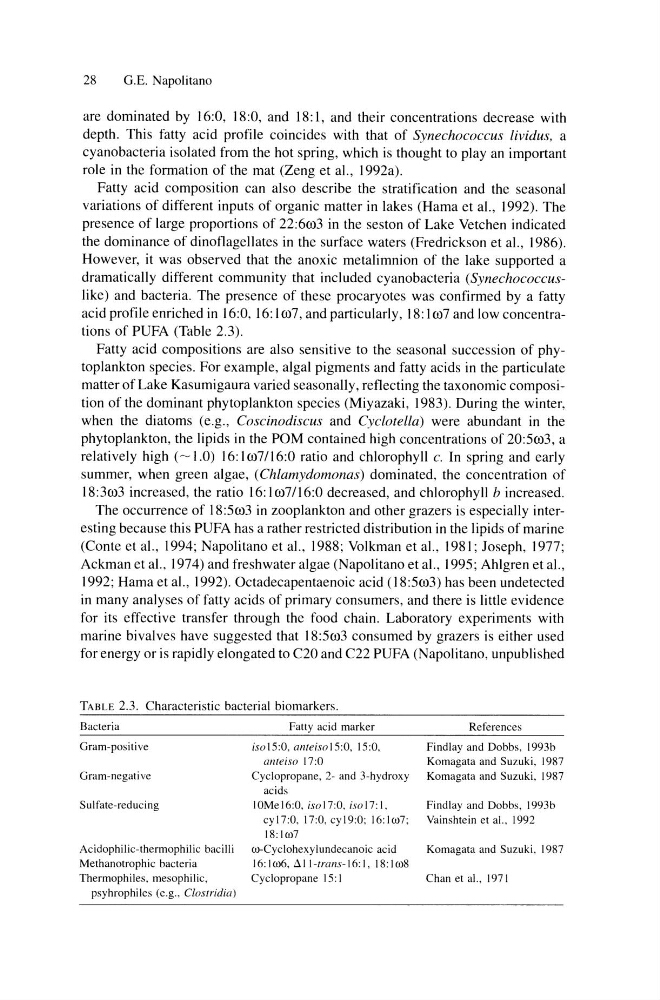
acid profile enriched in 16:0, 16: 10)7, and particularly, 18: 10)7 and low concentrations of PUFA (Table 2.3).
Fatty acid compositions are also sensitive to the seasonal succession of phytoplankton species. For example, algal pigments and fatty acids in the particulate
matter of Lake Kasumigaura varied seasonally, reflecting the taxonomic composition of the dominant phytoplankton species (Miyazaki, 1983). During the winter,
when the diatoms (e.g., Coscinodiscus and Cyclotella) were abundant in the
phytoplankton, the lipids in the POM contained high concentrations of 20:50)3, a
relatively high (~1.0) 16: I 0)7/16:0 ratio and chlorophyll c. In spring and early
summer, when green algae, (Chlamydomonas) dominated, the concentration of
18:30)3 increased, the ratio 16: 10)7/16:0 decreased, and chlorophyll b increased.
The occurrence of 18:50)3 in zooplankton and other grazers is especially interesting because this PUFA has a rather restricted distribution in the lipids of marine
(Conte et a!., 1994; Napolitano et aL 1988; Volkman et a!., 1981; Joseph, 1977;
Ackman et a!., 1974) and freshwater algae (Napolitano et a!., 1995; Ahlgren et a!.,
1992; Hama et a!., 1992). Octadecapentaenoic acid (18:50)3) has been undetected
in many analyses of fatty acids of primary consumers, and there is little evidence
for its effective transfer through the food chain. Laboratory experiments with
marine bivalves have suggested that 18:50)3 consumed by grazers is either used
for energy or is rapidly elongated to C20 and C22 PUFA (Napolitano, unpublished
TABLE 2.3. Characteristic bacterial biomarkers.
Bacteria
Gram-positive
Gram-negative
Sulfate-reducing
Acidophilic-thermophilic bacilli
Methanotrophic bacteria
Thermophiles, mesophilic,
psyhrophiles (e.g., Clostridia)
Fatty acid marker
isoI5:0. anteisoIS:O. 15:0.
anteiso 17:0
Cyclopropane. 2- and 3-hydroxy
acids
IOMeI6:0. isoI7:0, isoI7:1.
cy17:0. 17:0. cyI9:0: 16:1007;
18:1007
oo-Cyclohexylundecanoic acid
16:1006, ~11-tralls-16:1, 18:1008
Cyclopropane 15: I
References
Findlay and Dobbs, 1993b
Komagata and Suzuki. 1987
Komagata and Suzuki, 1987
Findlay and Dobbs. 1993b
Vainshtein et aI., 1992
Komagata and Suzuki, 1987
Chan et al.. 1971
G.E. Napolitano
are dominated by 16:0, 18:0, and 18: I, and their concentrations decrease with
depth. This fatty acid profile coincides with that of Synechococcus lividus, a
cyanobacteria isolated from the hot spring, which is thought to play an important
role in the fonnation of the mat (Zeng et a!., 1992a).
Fatty acid composition can also describe the stratification and the seasonal
variations of different inputs of organic matter in lakes (Hama et a!., 1992). The
presence of large proportions of 22:60)3 in the seston of Lake Vetchen indicated
the dominance of dinoflagellates in the surface waters (Fredrickson et a!., 1986).
However, it was observed that the anoxic metalimnion of the lake supported a
dramatically different community that included cyanobacteria (Synechococcuslike) and bacteria. The presence of these procaryotes was confirmed by a fatty
acid profile enriched in 16:0, 16: 10)7, and particularly, 18: 10)7 and low concentrations of PUFA (Table 2.3).
Fatty acid compositions are also sensitive to the seasonal succession of phytoplankton species. For example, algal pigments and fatty acids in the particulate
matter of Lake Kasumigaura varied seasonally, reflecting the taxonomic composition of the dominant phytoplankton species (Miyazaki, 1983). During the winter,
when the diatoms (e.g., Coscinodiscus and Cyclotella) were abundant in the
phytoplankton, the lipids in the POM contained high concentrations of 20:50)3, a
relatively high (~1.0) 16: I 0)7/16:0 ratio and chlorophyll c. In spring and early
summer, when green algae, (Chlamydomonas) dominated, the concentration of
18:30)3 increased, the ratio 16: 10)7/16:0 decreased, and chlorophyll b increased.
The occurrence of 18:50)3 in zooplankton and other grazers is especially interesting because this PUFA has a rather restricted distribution in the lipids of marine
(Conte et a!., 1994; Napolitano et aL 1988; Volkman et a!., 1981; Joseph, 1977;
Ackman et a!., 1974) and freshwater algae (Napolitano et a!., 1995; Ahlgren et a!.,
1992; Hama et a!., 1992). Octadecapentaenoic acid (18:50)3) has been undetected
in many analyses of fatty acids of primary consumers, and there is little evidence
for its effective transfer through the food chain. Laboratory experiments with
marine bivalves have suggested that 18:50)3 consumed by grazers is either used
for energy or is rapidly elongated to C20 and C22 PUFA (Napolitano, unpublished
TABLE 2.3. Characteristic bacterial biomarkers.
Bacteria
Gram-positive
Gram-negative
Sulfate-reducing
Acidophilic-thermophilic bacilli
Methanotrophic bacteria
Thermophiles, mesophilic,
psyhrophiles (e.g., Clostridia)
Fatty acid marker
isoI5:0. anteisoIS:O. 15:0.
anteiso 17:0
Cyclopropane. 2- and 3-hydroxy
acids
IOMeI6:0. isoI7:0, isoI7:1.
cy17:0. 17:0. cyI9:0: 16:1007;
18:1007
oo-Cyclohexylundecanoic acid
16:1006, ~11-tralls-16:1, 18:1008
Cyclopropane 15: I
References
Findlay and Dobbs, 1993b
Komagata and Suzuki. 1987
Komagata and Suzuki, 1987
Findlay and Dobbs. 1993b
Vainshtein et aI., 1992
Komagata and Suzuki, 1987
Chan et al.. 1971