

2. Fatty Acids as Trophic and Chemical Markers
27
2.4.2. Fatty Acids as Trophic Markers of Algae
and Cyanobacteria
Algae are the most important autochthonous source of dissolved and particulate
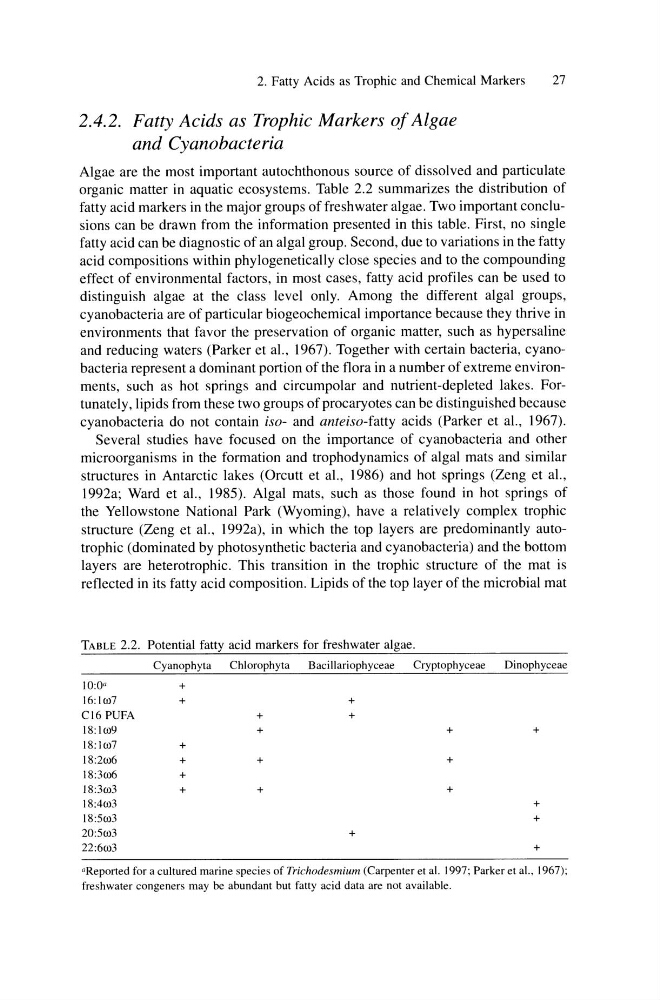
organic matter in aquatic ecosystems. Table 2.2 summarizes the distribution of
fatty acid markers in the major groups of freshwater algae. Two important conclusions can be drawn from the information presented in this table. First, no single
fatty acid can be diagnostic of an algal group. Second, due to variations in the fatty
acid compositions within phylogenetically close species and to the compounding
effect of environmental factors, in most cases, fatty acid profiles can be used to
distinguish algae at the class level only. Among the different algal groups,
cyanobacteria are of particular biogeochemical importance because they thrive in
environments that favor the preservation of organic matter, such as hypersaline
and reducing waters (Parker et aI., 1967). Together with certain bacteria, cyanobacteria represent a dominant portion of the flora in a number of extreme environments, such as hot springs and circumpolar and nutrient-depleted lakes. Fortunately, lipids from these two groups of procaryotes can be distinguished because
cyanobacteria do not contain iso- and anteiso-fatty acids (Parker et aI., 1967).
Several studies have focused on the importance of cyanobacteria and other
microorganisms in the formation and trophodynamics of algal mats and similar
structures in Antarctic lakes (Orcutt et aI., 1986) and hot springs (Zeng et aI.,
1992a; Ward et aI., 1985). Algal mats, such as those found in hot springs of
the Yellowstone National Park (Wyoming), have a relatively complex trophic
structure (Zeng et aI., 1992a), in which the top layers are predominantly autotrophic (dominated by photosynthetic bacteria and cyanobacteria) and the bottom
layers are heterotrophic. This transition in the trophic structure of the mat is
reflected in its fatty acid composition. Lipids of the top layer of the microbial mat
TABLE 2.2. Potential fatty acid markers for freshwater algae.
Cyanophyta
Chlorophyta
Bacillariophyceae
Cryptophyceae
Dinophyceae
10:Oa
+
16:1{J)7
+
+
CI6 PUFA
+
+
18:1{J)9
+
+
+
18:1{J)7
+
18:2{J)6
+
+
+
18:3{J)6
+
18:3{J)3
+
+
+
18:4{J)3
+
18:S{J)3
+
20:S{J)3
+
22:6{J)3
+
"Reported for a cultured marine species of Trichodesmium (Carpenter et a!. 1997; Parker et a!., 1967);
freshwater congeners may be abundant but fatty acid data are not available.
27
2.4.2. Fatty Acids as Trophic Markers of Algae
and Cyanobacteria
Algae are the most important autochthonous source of dissolved and particulate
organic matter in aquatic ecosystems. Table 2.2 summarizes the distribution of
fatty acid markers in the major groups of freshwater algae. Two important conclusions can be drawn from the information presented in this table. First, no single
fatty acid can be diagnostic of an algal group. Second, due to variations in the fatty
acid compositions within phylogenetically close species and to the compounding
effect of environmental factors, in most cases, fatty acid profiles can be used to
distinguish algae at the class level only. Among the different algal groups,
cyanobacteria are of particular biogeochemical importance because they thrive in
environments that favor the preservation of organic matter, such as hypersaline
and reducing waters (Parker et aI., 1967). Together with certain bacteria, cyanobacteria represent a dominant portion of the flora in a number of extreme environments, such as hot springs and circumpolar and nutrient-depleted lakes. Fortunately, lipids from these two groups of procaryotes can be distinguished because
cyanobacteria do not contain iso- and anteiso-fatty acids (Parker et aI., 1967).
Several studies have focused on the importance of cyanobacteria and other
microorganisms in the formation and trophodynamics of algal mats and similar
structures in Antarctic lakes (Orcutt et aI., 1986) and hot springs (Zeng et aI.,
1992a; Ward et aI., 1985). Algal mats, such as those found in hot springs of
the Yellowstone National Park (Wyoming), have a relatively complex trophic
structure (Zeng et aI., 1992a), in which the top layers are predominantly autotrophic (dominated by photosynthetic bacteria and cyanobacteria) and the bottom
layers are heterotrophic. This transition in the trophic structure of the mat is
reflected in its fatty acid composition. Lipids of the top layer of the microbial mat
TABLE 2.2. Potential fatty acid markers for freshwater algae.
Cyanophyta
Chlorophyta
Bacillariophyceae
Cryptophyceae
Dinophyceae
10:Oa
+
16:1{J)7
+
+
CI6 PUFA
+
+
18:1{J)9
+
+
+
18:1{J)7
+
18:2{J)6
+
+
+
18:3{J)6
+
18:3{J)3
+
+
+
18:4{J)3
+
18:S{J)3
+
20:S{J)3
+
22:6{J)3
+
"Reported for a cultured marine species of Trichodesmium (Carpenter et a!. 1997; Parker et a!., 1967);
freshwater congeners may be abundant but fatty acid data are not available.