

III
IV
286
R.G. Ackman
o
II
H-C-O-C -(CH2)14-CH3
I ~
H 2 -C -0- ~- O-C H 2 -C H2
0(_)
(+)N (C H3 )3
o
II
H-C-O- C -(C H2)14-CH3
I ~
H 2 -C -0- ~-O-C H 2 -C H2
0(_)
(+)N(C H3 )3
+
II
v
o
II
H-C-O-C -(CH2)14-CH3
I ~
H2-C - 0 - C -(C H 2 )14 -CH3
o
II
H-C -(CH2)14-CH3
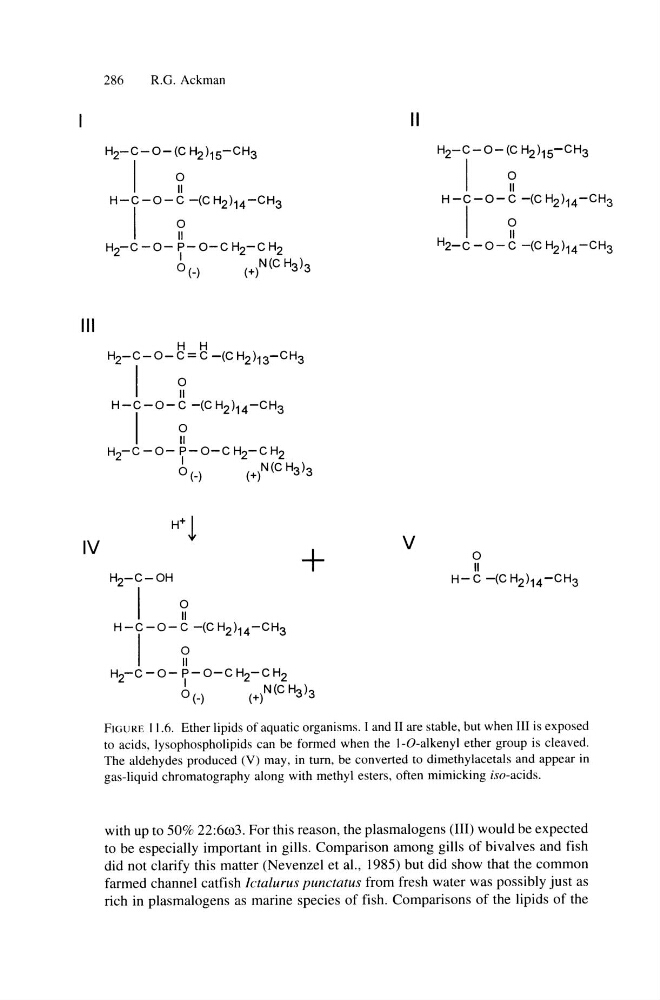
FIGURE 11.6. Ether lipids of aquatic organisms. I and II are stable, but when III is exposed
to acids, Iysophospholipids can be formed when the I-O-alkenyl ether group is cleaved.
The aldehydes produced (V) may, in tum, be converted to dimethylacetals and appear in
gas-liquid chromatography along with methyl esters, often mimicking iso-acids.
with up to 50% 22:6(03. For this reason, the plasmalogens (III) would be expected
to be especially important in gills. Comparison among gills of bivalves and fish
did not clarify this matter (Nevenzel et aI., 1985) but did show that the common
farmed channel catfish Ictalurus punctatus from fresh water was possibly just as
rich in plasmalogens as marine species of fish. Comparisons of the lipids of the
IV
286
R.G. Ackman
o
II
H-C-O-C -(CH2)14-CH3
I ~
H 2 -C -0- ~- O-C H 2 -C H2
0(_)
(+)N (C H3 )3
o
II
H-C-O- C -(C H2)14-CH3
I ~
H 2 -C -0- ~-O-C H 2 -C H2
0(_)
(+)N(C H3 )3
+
II
v
o
II
H-C-O-C -(CH2)14-CH3
I ~
H2-C - 0 - C -(C H 2 )14 -CH3
o
II
H-C -(CH2)14-CH3
FIGURE 11.6. Ether lipids of aquatic organisms. I and II are stable, but when III is exposed
to acids, Iysophospholipids can be formed when the I-O-alkenyl ether group is cleaved.
The aldehydes produced (V) may, in tum, be converted to dimethylacetals and appear in
gas-liquid chromatography along with methyl esters, often mimicking iso-acids.
with up to 50% 22:6(03. For this reason, the plasmalogens (III) would be expected
to be especially important in gills. Comparison among gills of bivalves and fish
did not clarify this matter (Nevenzel et aI., 1985) but did show that the common
farmed channel catfish Ictalurus punctatus from fresh water was possibly just as
rich in plasmalogens as marine species of fish. Comparisons of the lipids of the