

6
c.c. Parrish
20:5n-3
22:5n-3
22:6n-3
o
II
C"- OH
o
C"- OH
/OH
c
I I
o
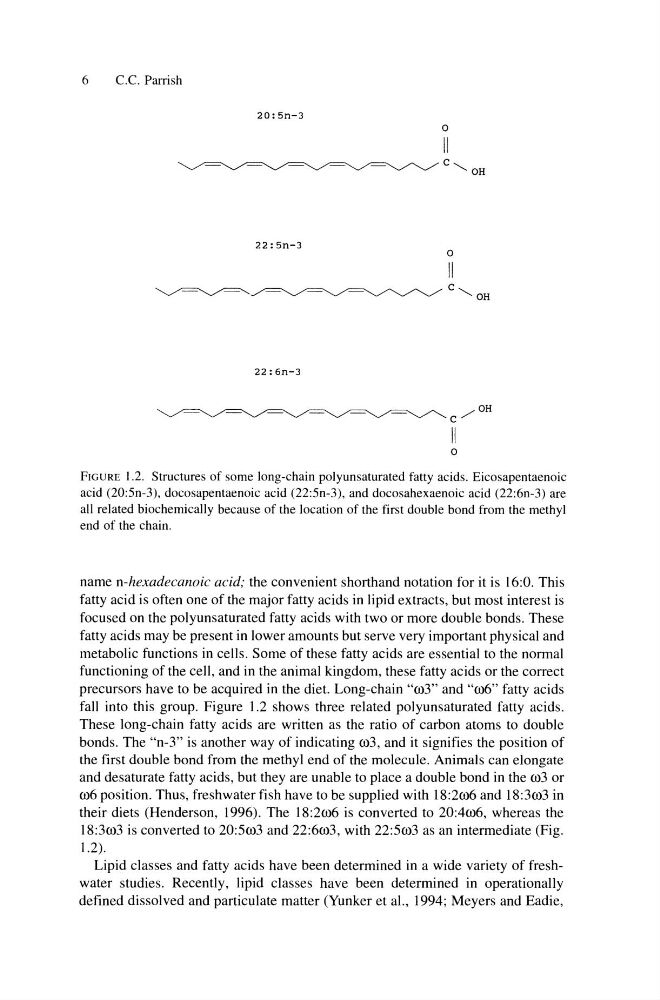
FIGURE 1.2. Structures of some long-chain polyunsaturated fatty acids. Eicosapentaenoic
acid (20:5n-3), docosapentaenoic acid (22:5n-3), and docosahexaenoic acid (22:6n-3) are
all related biochemically because of the location of the first double bond from the methyl
end of the chain.
name n-hexadecanoic acid; the convenient shorthand notation for it is 16:0. This
fatty acid is often one of the major fatty acids in lipid extracts, but most interest is
focused on the polyunsaturated fatty acids with two or more double bonds. These
fatty acids may be present in lower amounts but serve very important physical and
metabolic functions in cells. Some of these fatty acids are essential to the normal
functioning of the cell, and in the animal kingdom, these fatty acids or the correct
precursors have to be acquired in the diet. Long-chain "003" and "006" fatty acids
fall into this group. Figure 1.2 shows three related polyunsaturated fatty acids.
These long-chain fatty acids are written as the ratio of carbon atoms to double
bonds. The "n-3" is another way of indicating 003, and it signifies the position of
the first double bond from the methyl end of the molecule. Animals can elongate
and desaturate fatty acids, but they are unable to place a double bond in the 003 or
006 position. Thus, freshwater fish have to be supplied with 18:2006 and 18:3003 in
their diets (Henderson, 1996). The 18:2006 is converted to 20:4006, whereas the
18:3003 is converted to 20:5003 and 22:6003, with 22:5003 as an intermediate (Fig.
1.2).
Lipid classes and fatty acids have been determined in a wide variety of freshwater studies. Recently, lipid classes have been determined in operationally
defined dissolved and particulate matter (Yunker et ai., 1994; Meyers and Eadie,
c.c. Parrish
20:5n-3
22:5n-3
22:6n-3
o
II
C"- OH
o
C"- OH
/OH
c
I I
o
FIGURE 1.2. Structures of some long-chain polyunsaturated fatty acids. Eicosapentaenoic
acid (20:5n-3), docosapentaenoic acid (22:5n-3), and docosahexaenoic acid (22:6n-3) are
all related biochemically because of the location of the first double bond from the methyl
end of the chain.
name n-hexadecanoic acid; the convenient shorthand notation for it is 16:0. This
fatty acid is often one of the major fatty acids in lipid extracts, but most interest is
focused on the polyunsaturated fatty acids with two or more double bonds. These
fatty acids may be present in lower amounts but serve very important physical and
metabolic functions in cells. Some of these fatty acids are essential to the normal
functioning of the cell, and in the animal kingdom, these fatty acids or the correct
precursors have to be acquired in the diet. Long-chain "003" and "006" fatty acids
fall into this group. Figure 1.2 shows three related polyunsaturated fatty acids.
These long-chain fatty acids are written as the ratio of carbon atoms to double
bonds. The "n-3" is another way of indicating 003, and it signifies the position of
the first double bond from the methyl end of the molecule. Animals can elongate
and desaturate fatty acids, but they are unable to place a double bond in the 003 or
006 position. Thus, freshwater fish have to be supplied with 18:2006 and 18:3003 in
their diets (Henderson, 1996). The 18:2006 is converted to 20:4006, whereas the
18:3003 is converted to 20:5003 and 22:6003, with 22:5003 as an intermediate (Fig.
1.2).
Lipid classes and fatty acids have been determined in a wide variety of freshwater studies. Recently, lipid classes have been determined in operationally
defined dissolved and particulate matter (Yunker et ai., 1994; Meyers and Eadie,