

1. Lipid Determination in Aquatic Samples
5
o
TAG
II
o
HO
I I
H~
HO
HO 0
/
o
GL
HO~CH2 0
0-CH 2
0
HO
HO
I
\I
HC-O-C~
I
H2 C..........
A.
A.
A. A
A
A
A /
0 _ C/ V
V
V
V
V
V
v
\I
o
o
II
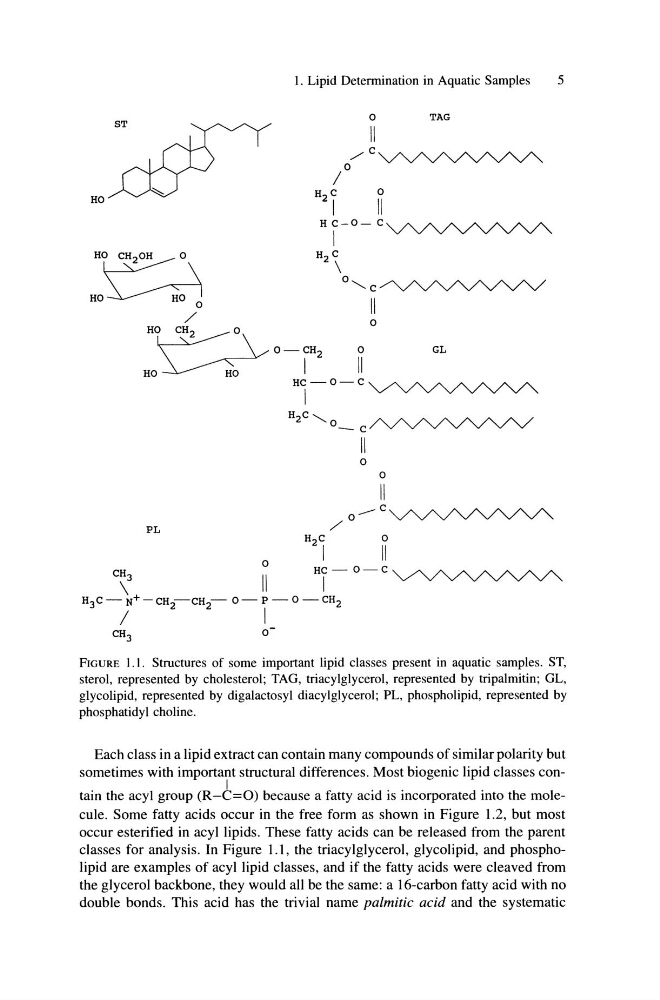
FIGURE 1.1. Structures of some important lipid classes present in aquatic samples. ST.
sterol. represented by cholesterol; TAG. triacylglycerol. represented by tripalmitin; GL.
glycolipid. represented by digalactosyl diacylglycerol; PL. phospholipid. represented by
phosphatidyl choline.
Each class in a lipid extract can contain many compounds of similar polarity but
sometimes with important structural differences. Most biogenic lipid classes conI
tain the acyl group (R-C=O) because a fatty acid is incorporated into the molecule. Some fatty acids occur in the free form as shown in Figure 1.2, but most
occur esterified in acyl lipids. These fatty acids can be released from the parent
classes for analysis. In Figure 1.1, the triacylglycerol, glycolipid, and phospholipid are examples of acyl lipid classes, and if the fatty acids were cleaved from
the glycerol backbone, they would all be the same: a 16-carbon fatty acid with no
double bonds. This acid has the trivial name palmitic acid and the systematic
5
o
TAG
II
o
HO
I I
H~
HO
HO 0
/
o
GL
HO~CH2 0
0-CH 2
0
HO
HO
I
\I
HC-O-C~
I
H2 C..........
A.
A.
A. A
A
A
A /
0 _ C/ V
V
V
V
V
V
v
\I
o
o
II
FIGURE 1.1. Structures of some important lipid classes present in aquatic samples. ST.
sterol. represented by cholesterol; TAG. triacylglycerol. represented by tripalmitin; GL.
glycolipid. represented by digalactosyl diacylglycerol; PL. phospholipid. represented by
phosphatidyl choline.
Each class in a lipid extract can contain many compounds of similar polarity but
sometimes with important structural differences. Most biogenic lipid classes conI
tain the acyl group (R-C=O) because a fatty acid is incorporated into the molecule. Some fatty acids occur in the free form as shown in Figure 1.2, but most
occur esterified in acyl lipids. These fatty acids can be released from the parent
classes for analysis. In Figure 1.1, the triacylglycerol, glycolipid, and phospholipid are examples of acyl lipid classes, and if the fatty acids were cleaved from
the glycerol backbone, they would all be the same: a 16-carbon fatty acid with no
double bonds. This acid has the trivial name palmitic acid and the systematic