

176
Y. Olsen
The mother deposits high amounts of EFA during egg formation, be it DHA for
marine fish larvae (Sargent et aI., 1993b) or other EFAs for other taxa. We may
anticipate that egg quality, fecundity, and the number of viable offspring are the
factors to be affected first by deficiency in EFA. The consequence for the premature organism will, in most cases, be ultimately fatal.
Poor outcomes can also be expected for EFA deficiency during the stages when
neural tissues, including eyes and brain, are developing. A brain-damaged, blind
fish cannot survive in nature or in culture, and the ultimate symptoms or effects of
deficiency will be reduced growth, enhanced mortality, and inadequate behavior
(Sargent et aI., 1993a). An early symptom of DHA deficiency known from many
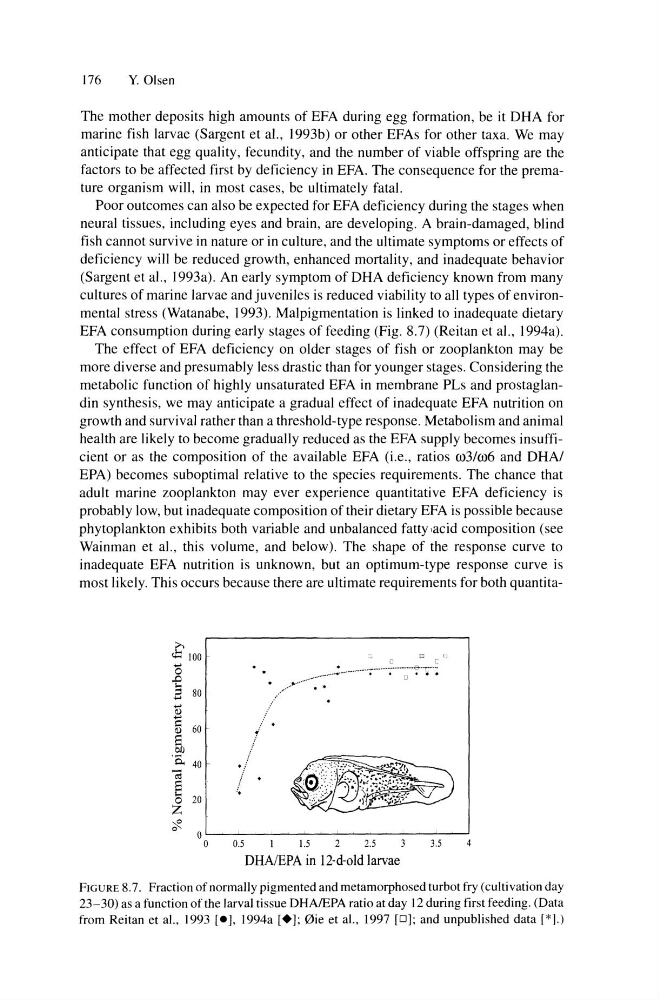
cultures of marine larvae and juveniles is reduced viability to all types of environmental stress (Watanabe, 1993). Malpigmentation is linked to inadequate dietary
EFA consumption during early stages of feeding (Fig. 8.7) (Reitan et aI., 1994a).
The effect of EFA deficiency on older stages of fish or zooplankton may be
more diverse and presumably less drastic than for younger stages. Considering the
metabolic function of highly unsaturated EFA in membrane PLs and prostaglandin synthesis, we may anticipate a gradual effect of inadequate EFA nutrition on
growth and survival rather than a threshold-type response. Metabolism and animal
health are likely to become gradually reduced as the EFA supply becomes insufficient or as the composition of the available EFA (i.e., ratios ro3/ro6 and DHN
EPA) becomes suboptimal relative to the species requirements. The chance that
adult marine zooplankton may ever experience quantitative EFA deficiency is
probably low, but inadequate composition of their dietary EFA is possible because
phytoplankton exhibits both variable and unbalanced fatty ,acid composition (see
Wainman et aI., this volume, and below). The shape of the response curve to
inadequate EFA nutrition is unknown, but an optimum-type response curve is
most likely. This occurs because there are ultimate requirements for both quantita£ 100
.....
0
~ 80
.....
..... Q)
:= 60
Q)
~
' s.. 40
ea
~
20
[]
o
c
~./""."",-"-:,:",-;"-"",-,-",;,--,,,:,,,--~-;'Y';
//
.,/
/
.j/
!
•
I.
~
0.5
1
1.5
2
2.5
3
3.5
4
DHAIEPA in l2-d-old larvae
FIGURE 8.7. Fraction of normally pigmented and metamorphosed turbot fry (cultivation day
23-30) as a function of the larval tissue DHAIEPA ratio at day 12 during first feeding. (Data
from Reitan et aI., 1993 [e], 1994a [+]; 0ie et aI., 1997 [D]; and unpublished data [*].)
Y. Olsen
The mother deposits high amounts of EFA during egg formation, be it DHA for
marine fish larvae (Sargent et aI., 1993b) or other EFAs for other taxa. We may
anticipate that egg quality, fecundity, and the number of viable offspring are the
factors to be affected first by deficiency in EFA. The consequence for the premature organism will, in most cases, be ultimately fatal.
Poor outcomes can also be expected for EFA deficiency during the stages when
neural tissues, including eyes and brain, are developing. A brain-damaged, blind
fish cannot survive in nature or in culture, and the ultimate symptoms or effects of
deficiency will be reduced growth, enhanced mortality, and inadequate behavior
(Sargent et aI., 1993a). An early symptom of DHA deficiency known from many
cultures of marine larvae and juveniles is reduced viability to all types of environmental stress (Watanabe, 1993). Malpigmentation is linked to inadequate dietary
EFA consumption during early stages of feeding (Fig. 8.7) (Reitan et aI., 1994a).
The effect of EFA deficiency on older stages of fish or zooplankton may be
more diverse and presumably less drastic than for younger stages. Considering the
metabolic function of highly unsaturated EFA in membrane PLs and prostaglandin synthesis, we may anticipate a gradual effect of inadequate EFA nutrition on
growth and survival rather than a threshold-type response. Metabolism and animal
health are likely to become gradually reduced as the EFA supply becomes insufficient or as the composition of the available EFA (i.e., ratios ro3/ro6 and DHN
EPA) becomes suboptimal relative to the species requirements. The chance that
adult marine zooplankton may ever experience quantitative EFA deficiency is
probably low, but inadequate composition of their dietary EFA is possible because
phytoplankton exhibits both variable and unbalanced fatty ,acid composition (see
Wainman et aI., this volume, and below). The shape of the response curve to
inadequate EFA nutrition is unknown, but an optimum-type response curve is
most likely. This occurs because there are ultimate requirements for both quantita£ 100
.....
0
~ 80
.....
..... Q)
:= 60
Q)
~
' s.. 40
ea
~
20
[]
o
c
~./""."",-"-:,:",-;"-"",-,-",;,--,,,:,,,--~-;'Y';
//
.,/
/
.j/
!
•
I.
~
0.5
1
1.5
2
2.5
3
3.5
4
DHAIEPA in l2-d-old larvae
FIGURE 8.7. Fraction of normally pigmented and metamorphosed turbot fry (cultivation day
23-30) as a function of the larval tissue DHAIEPA ratio at day 12 during first feeding. (Data
from Reitan et aI., 1993 [e], 1994a [+]; 0ie et aI., 1997 [D]; and unpublished data [*].)