

8. Lipids and Essential Fatty Acids in Aquatic Food Webs
175
30r-----------------------------------~
•
10L-~--------L---~--l-~---L--------~
60
62
64
66
68
70
Latitude (degrees)
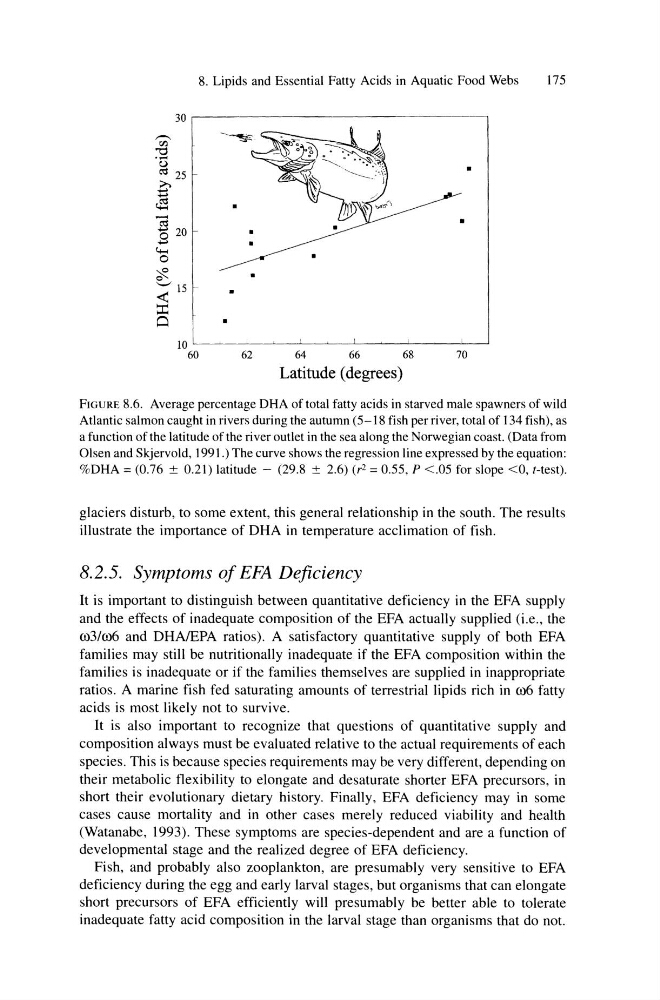
FIGURE 8.6. Average percentage DHA of total fatty acids in starved male spawners of wild
Atlantic salmon caught in rivers during the autumn (5-18 fish per river, total of 134 fish), as
a function of the latitude of the river outlet in the sea along the Norwegian coast. (Data from
Olsen and Skjervold, 1991.) The curve shows the regression line expressed by the equation:
%DHA = (0.76 ± 0.21) latitude - (29.8 ± 2.6) (r 2 = 0.55, P <.05 for slope <0, t-test).
glaciers disturb, to some extent, this general relationship in the south. The results
illustrate the importance of DHA in temperature acclimation of fish.
8.2.5. Symptoms of EFA Deficiency
It is important to distinguish between quantitative deficiency in the EFA supply
and the effects of inadequate composition of the EFA actually supplied (i.e., the
(03/(06 and DHAIEPA ratios). A satisfactory quantitative supply of both EFA
families may still be nutritionally inadequate if the EFA composition within the
families is inadequate or if the families themselves are supplied in inappropriate
ratios. A marine fish fed saturating amounts of terrestrial lipids rich in (06 fatty
acids is most likely not to survive.
It is also important to recognize that questions of quantitative supply and
composition always must be evaluated relative to the actual requirements of each
species. This is because species requirements may be very different, depending on
their metabolic flexibility to elongate and desaturate shorter EFA precursors, in
short their evolutionary dietary history. Finally, EFA deficiency may in some
cases cause mortality and in other cases merely reduced viability and health
(Watanabe, 1993). These symptoms are species-dependent and are a function of
developmental stage and the realized degree of EFA deficiency.
Fish, and probably also zooplankton, are presumably very sensitive to EFA
deficiency during the egg and early larval stages, but organisms that can elongate
short precursors of EFA efficiently will presumably be better able to tolerate
inadequate fatty acid composition in the larval stage than organisms that do not.
175
30r-----------------------------------~
•
10L-~--------L---~--l-~---L--------~
60
62
64
66
68
70
Latitude (degrees)
FIGURE 8.6. Average percentage DHA of total fatty acids in starved male spawners of wild
Atlantic salmon caught in rivers during the autumn (5-18 fish per river, total of 134 fish), as
a function of the latitude of the river outlet in the sea along the Norwegian coast. (Data from
Olsen and Skjervold, 1991.) The curve shows the regression line expressed by the equation:
%DHA = (0.76 ± 0.21) latitude - (29.8 ± 2.6) (r 2 = 0.55, P <.05 for slope <0, t-test).
glaciers disturb, to some extent, this general relationship in the south. The results
illustrate the importance of DHA in temperature acclimation of fish.
8.2.5. Symptoms of EFA Deficiency
It is important to distinguish between quantitative deficiency in the EFA supply
and the effects of inadequate composition of the EFA actually supplied (i.e., the
(03/(06 and DHAIEPA ratios). A satisfactory quantitative supply of both EFA
families may still be nutritionally inadequate if the EFA composition within the
families is inadequate or if the families themselves are supplied in inappropriate
ratios. A marine fish fed saturating amounts of terrestrial lipids rich in (06 fatty
acids is most likely not to survive.
It is also important to recognize that questions of quantitative supply and
composition always must be evaluated relative to the actual requirements of each
species. This is because species requirements may be very different, depending on
their metabolic flexibility to elongate and desaturate shorter EFA precursors, in
short their evolutionary dietary history. Finally, EFA deficiency may in some
cases cause mortality and in other cases merely reduced viability and health
(Watanabe, 1993). These symptoms are species-dependent and are a function of
developmental stage and the realized degree of EFA deficiency.
Fish, and probably also zooplankton, are presumably very sensitive to EFA
deficiency during the egg and early larval stages, but organisms that can elongate
short precursors of EFA efficiently will presumably be better able to tolerate
inadequate fatty acid composition in the larval stage than organisms that do not.