

6. Seasonal Dynamics of Lipids
125
6.4. Conclusions
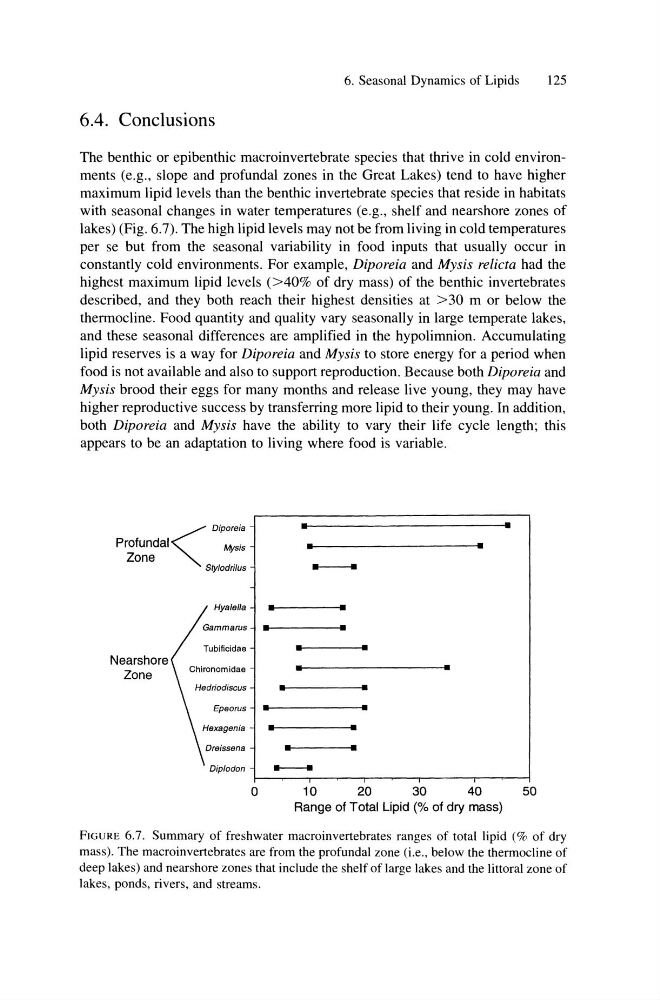
The benthic or epibenthic macroinvertebrate species that thrive in cold environments (e.g., slope and profundal zones in the Great Lakes) tend to have higher
maximum lipid levels than the benthic invertebrate species that reside in habitats
with seasonal changes in water temperatures (e.g., shelf and nearshore zones of
lakes) (Fig. 6.7). The high lipid levels may not be from living in cold temperatures
per se but from the seasonal variability in food inputs that usually occur in
constantly cold environments. For example, Diporeia and Mysis relicta had the
highest maximum lipid levels (>40% of dry mass) of the benthic invertebrates
described, and they both reach their highest densities at >30 m or below the
thermocline. Food quantity and quality vary seasonally in large temperate lakes,
and these seasonal differences are amplified in the hypolimnion. Accumulating
lipid reserves is a way for Diporeia and Mysis to store energy for a period when
food is not available and also to support reproduction. Because both Diporeia and
Mysis brood their eggs for many months and release live young, they may have
higher reproductive success by transferring more lipid to their young. In addition,
both Diporeia and Mysis have the ability to vary their life cycle length; this
appears to be an adaptation to living where food is variable.
<
Diporeia
Profundal
Mysls
Zone
Nearshore
Zone
Slylodrilus
0
•
•
•
•
•
•
•
•
•
•
•
•
•
•
•
•
•
•
•
•
--- 10 20 30 40 50
Range of Total Lipid (% of dry mass)
FIGURE 6.7. Summary of freshwater macroinvertebrates ranges of total lipid (% of dry
mass). The macroinvertebrates are from the profundal zone (i.e., below the thermocline of
deep lakes) and nearshore zones that include the shelf of large lakes and the littoral zone of
lakes, ponds, rivers, and streams.
125
6.4. Conclusions
The benthic or epibenthic macroinvertebrate species that thrive in cold environments (e.g., slope and profundal zones in the Great Lakes) tend to have higher
maximum lipid levels than the benthic invertebrate species that reside in habitats
with seasonal changes in water temperatures (e.g., shelf and nearshore zones of
lakes) (Fig. 6.7). The high lipid levels may not be from living in cold temperatures
per se but from the seasonal variability in food inputs that usually occur in
constantly cold environments. For example, Diporeia and Mysis relicta had the
highest maximum lipid levels (>40% of dry mass) of the benthic invertebrates
described, and they both reach their highest densities at >30 m or below the
thermocline. Food quantity and quality vary seasonally in large temperate lakes,
and these seasonal differences are amplified in the hypolimnion. Accumulating
lipid reserves is a way for Diporeia and Mysis to store energy for a period when
food is not available and also to support reproduction. Because both Diporeia and
Mysis brood their eggs for many months and release live young, they may have
higher reproductive success by transferring more lipid to their young. In addition,
both Diporeia and Mysis have the ability to vary their life cycle length; this
appears to be an adaptation to living where food is variable.
<
Diporeia
Profundal
Mysls
Zone
Nearshore
Zone
Slylodrilus
0
•
•
•
•
•
•
•
•
•
•
•
•
•
•
•
•
•
•
•
•
--- 10 20 30 40 50
Range of Total Lipid (% of dry mass)
FIGURE 6.7. Summary of freshwater macroinvertebrates ranges of total lipid (% of dry
mass). The macroinvertebrates are from the profundal zone (i.e., below the thermocline of
deep lakes) and nearshore zones that include the shelf of large lakes and the littoral zone of
lakes, ponds, rivers, and streams.