

112
J.E Cavaletto and W.S. Gardner
in spring blooms, thus allowing a greater proportion to settle to the bottom of the
lake and become available to the benthic community (Mazumder et aI., 1992;
10hannsson et aI., 1991). In Lake Michigan, hypolimnetic calanoid copepods are
dominant in the spring and readily feed on the diatom bloom (Vanderploeg et aI.,
1992).
Lipid levels in Diporeia are similar to lipid levels found in two species of
related amphipods from a Baltic archipelago. Monoporeia affinis had a maximum
lipid level in late summer of 27% of dry mass as compared with the less seasonally
variable lipid levels of PontoporeiaJemorata that were 20-23% of dry mass (Hill
et aI., 1992). Another study of Baltic Sea M. affinis revealed higher seasonal lipids
that had a maximum of 42% of dry mass (Lehtonen, 1996). The maximum lipid
level recorded for Diporeia from Lake Michigan was 46% of dry mass in 1984
(Gardner et aI., 1985a). However, annual variation occurs as demonstrated by a
decline in Diporeia maximum lipid levels to 31 % of dry mass in 1988 and 1989
(Fig. 6.1). Generally, Diporeia is an important pelagic benthic coupling link and
fish food source (McDonald et aI., 1990; Wells, 1980). Due to its high lipid
content, Diporeia contributed about 71% of the mean energy content of all
macroinvertebrates averaged over southern Lake Michigan as compared with
66% of the biomass (Gardner et aI., 1985a).
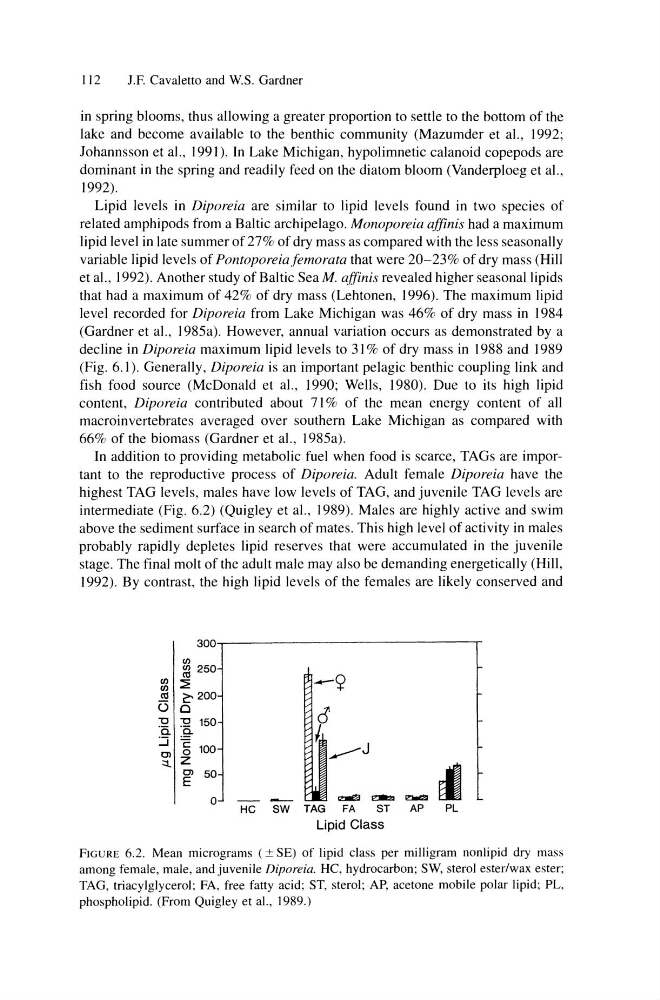
In addition to providing metabolic fuel when food is scarce, TAGs are important to the reproductive process of Diporeia. Adult female Diporeia have the
highest TAG levels, males have low levels of TAG, and juvenile TAG levels are
intermediate (Fig. 6.2) (Quigley et aI., 1989). Males are highly active and swim
above the sediment surface in search of mates. This high level of activity in males
probably rapidly depletes lipid reserves that were accumulated in the juvenile
stage. The final molt of the adult male may also be demanding energetically (Hill,
1992). By contrast, the high lipid levels of the females are likely conserved and
300
(/)
~ 250
-2
(/)
~
(/)
a:I ~200
(5 CI
0
"0 :2 150
'0. .9l
~
§ 100
.......-J
01
::I.. Z
~
Cl 50
E
0
I2IIGI eaa 1!:101121
He SW TAG FA ST AP PL
Lipid Class
FIGURE 6.2. Mean micrograms (± SE) of lipid class per milligram nonlipid dry mass
among female, male, and juvenile Diporeia. HC, hydrocarbon; SW, sterol ester/wax ester;
TAG, triacylglycerol; FA, free fatty acid; ST, sterol; AP, acetone mobile polar lipid; PL,
phospholipid. (From Quigley et aI., 1989.)
J.E Cavaletto and W.S. Gardner
in spring blooms, thus allowing a greater proportion to settle to the bottom of the
lake and become available to the benthic community (Mazumder et aI., 1992;
10hannsson et aI., 1991). In Lake Michigan, hypolimnetic calanoid copepods are
dominant in the spring and readily feed on the diatom bloom (Vanderploeg et aI.,
1992).
Lipid levels in Diporeia are similar to lipid levels found in two species of
related amphipods from a Baltic archipelago. Monoporeia affinis had a maximum
lipid level in late summer of 27% of dry mass as compared with the less seasonally
variable lipid levels of PontoporeiaJemorata that were 20-23% of dry mass (Hill
et aI., 1992). Another study of Baltic Sea M. affinis revealed higher seasonal lipids
that had a maximum of 42% of dry mass (Lehtonen, 1996). The maximum lipid
level recorded for Diporeia from Lake Michigan was 46% of dry mass in 1984
(Gardner et aI., 1985a). However, annual variation occurs as demonstrated by a
decline in Diporeia maximum lipid levels to 31 % of dry mass in 1988 and 1989
(Fig. 6.1). Generally, Diporeia is an important pelagic benthic coupling link and
fish food source (McDonald et aI., 1990; Wells, 1980). Due to its high lipid
content, Diporeia contributed about 71% of the mean energy content of all
macroinvertebrates averaged over southern Lake Michigan as compared with
66% of the biomass (Gardner et aI., 1985a).
In addition to providing metabolic fuel when food is scarce, TAGs are important to the reproductive process of Diporeia. Adult female Diporeia have the
highest TAG levels, males have low levels of TAG, and juvenile TAG levels are
intermediate (Fig. 6.2) (Quigley et aI., 1989). Males are highly active and swim
above the sediment surface in search of mates. This high level of activity in males
probably rapidly depletes lipid reserves that were accumulated in the juvenile
stage. The final molt of the adult male may also be demanding energetically (Hill,
1992). By contrast, the high lipid levels of the females are likely conserved and
300
(/)
~ 250
-2
(/)
~
(/)
a:I ~200
(5 CI
0
"0 :2 150
'0. .9l
~
§ 100
.......-J
01
::I.. Z
~
Cl 50
E
0
I2IIGI eaa 1!:101121
He SW TAG FA ST AP PL
Lipid Class
FIGURE 6.2. Mean micrograms (± SE) of lipid class per milligram nonlipid dry mass
among female, male, and juvenile Diporeia. HC, hydrocarbon; SW, sterol ester/wax ester;
TAG, triacylglycerol; FA, free fatty acid; ST, sterol; AP, acetone mobile polar lipid; PL,
phospholipid. (From Quigley et aI., 1989.)